Key takeaways
- Blade span versus room footprint: Rooms up to 150 square feet do well with 42 inches, standard bedrooms and living rooms land at 52 inches, and anything over 400 square feet or with vaulted ceilings benefits from 62 inches and up. Undersizing is the most common mistake and no motor can compensate for it.
- Mounting clearance: With ceilings under nine feet, a flush mount or low profile hugger keeps blades at a safe height without visually compressing the room. Taller ceilings need a downrod to bring blades into the 8 to 9 foot sweet spot where you actually feel the air.
- Airflow, not blade count: Look at CFM rather than assuming five blades beat three. Well-pitched three-blade designs frequently move more air with less drag, and DC motors deliver strong output at lower RPM, which is where the quiet comes from.
- Light or no light: If you already have layered lighting from sconces, pendants, or recessed cans, a fan without a light is the cleaner architectural choice. If the fan is your only ceiling source, prioritize dimmable output with selectable color temperature so it works morning and evening.
- Wet, damp, or dry rating: Covered patios and screened porches require a damp rating at minimum. Indoor-only fans installed outside will corrode, and blades not sealed against humidity warp and lose balance within a season.
What's inside
Ceiling fans have quietly become one of the hardest-working pieces in a well-considered room, and yet most shoppers still buy them the way they buy extension cords: fast, cheap, and without looking up. The result is a fixture that hums through movie night, wobbles at high speed, or drops a bulky motor housing into the middle of an otherwise clean ceiling plane. DC motor fans changed that equation. They pull roughly 60 to 70 percent less power than the old AC workhorses, run noticeably quieter, offer more speed steps, and reverse direction for winter circulation without a wall switch you have to reach for on a ladder.
This guide is written from a design-first perspective rather than a spec-sheet one. Below you’ll find the DC motor ceiling fans worth specifying in 2026, covering low-profile flush mounts for tight ceilings, oversized statement fans for open-plan great rooms, damp-rated options for covered porches, and mid-century pieces that read as lighting first and appliance second. Each pick is assessed on airflow, acoustic behavior, finish quality, and how gracefully it disappears into or elevates a room.
As an Amazon Associate we earn from qualifying purchases.


How to Choose a Dc Motor Ceiling Fan (2026)
- Blade span versus room footprint: Rooms up to 150 square feet do well with 42 inches, standard bedrooms and living rooms land at 52 inches, and anything over 400 square feet or with vaulted ceilings benefits from 62 inches and up. Undersizing is the most common mistake and no motor can compensate for it.
- Mounting clearance: With ceilings under nine feet, a flush mount or low profile hugger keeps blades at a safe height without visually compressing the room. Taller ceilings need a downrod to bring blades into the 8 to 9 foot sweet spot where you actually feel the air.
- Airflow, not blade count: Look at CFM rather than assuming five blades beat three. Well-pitched three-blade designs frequently move more air with less drag, and DC motors deliver strong output at lower RPM, which is where the quiet comes from.
- Light or no light: If you already have layered lighting from sconces, pendants, or recessed cans, a fan without a light is the cleaner architectural choice. If the fan is your only ceiling source, prioritize dimmable output with selectable color temperature so it works morning and evening.
- Wet, damp, or dry rating: Covered patios and screened porches require a damp rating at minimum. Indoor-only fans installed outside will corrode, and blades not sealed against humidity warp and lose balance within a season.
The Best Dc Motor Ceiling Fan (2026)s Reviewed
Sofucor 52 Inch Wood Ceiling Fan, No Light
This is the one I recommend most often for bedrooms with existing lamps or wall lighting, because the warm brown wood-look blades and slim flush-mount body read as millwork rather than hardware. Six speeds, a timer, and reversible operation give you real control, and the absence of a light fixture keeps the ceiling plane calm and uninterrupted.
Obabala 52 Inch Flush Mount Fan with App Control
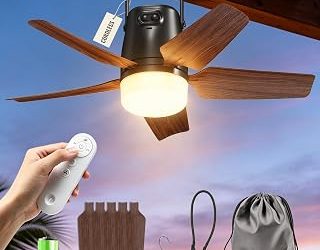
The five-blade black profile is genuinely low, which matters in rooms with 8-foot ceilings, and app control alongside the remote means you can schedule it rather than think about it. It handles garages, patios, and bedrooms equally well, and the silent operation at mid speeds is legitimately impressive.
Depuley 52-Inch Walnut Fandelier with Light
Three sculptural walnut blades and a dimmable central light make this the pick when the fan needs to carry the room’s design weight on its own. The fandelier styling suits covered patios and transitional interiors, and the DC motor keeps it whisper-quiet at the low speeds you’ll use most.
VEVOR 84 Inch Low Profile Fan with Light
At 84 inches, this is a serious airflow tool for great rooms, lofts, and open-plan spaces where smaller fans simply stir a pocket of air. The flush-mount body and matte black finish keep the scale from feeling heavy, and three-color-temperature dimming means it can serve as primary lighting.
ZMISHIBO 62″ Mid Century Fan, Black and Gold
The dual black-and-gold finish gives this fan a genuinely designed look, closer to a light fixture than an appliance, and the high-CFM motor backs up the styling with real performance. Damp rated and available with 3 CCT LED output, it works over a dining table or on a covered porch without compromise.
Frequently Asked Questions
Are DC motor ceiling fans actually quieter?
Yes, and the difference is audible. DC motors use permanent magnets and electronic commutation, so there’s no transformer hum and less mechanical vibration. Most of the noise people attribute to fans comes from air turbulence and loose mounting, not the motor itself, so proper installation matters just as much.
How much energy do they really save?
Expect roughly 60 to 70 percent lower consumption than a comparable AC fan at the same airflow. In practical terms, a DC fan running most of the day costs pennies, which is why running one alongside a higher thermostat setting is one of the cheapest comfort upgrades available.
Do I need a light in my ceiling fan?
Only if the fan is your sole ceiling source. Designers increasingly specify no-light fans in rooms with lamps, sconces, or recessed lighting because it produces a cleaner ceiling and better-quality light overall.
Can I install a flush mount fan on a sloped ceiling?
Usually not without an adapter. Flush mounts are engineered for flat ceilings; sloped installations typically require an angled mount kit and a downrod, so confirm the maximum slope tolerance before ordering.
Final Thoughts
For most rooms, the Sofucor 52-inch wood fan is the smartest default: quiet, low profile, and visually restrained enough to work in almost any interior. If you want the fan to do design work, the ZMISHIBO 62-inch mid-century model delivers strong airflow with a finish that holds its own over a dining table, and for large open-plan spaces the VEVOR 84-inch is the one that will actually move the volume of air you need.