Key takeaways
- Interior depth over drawer count: Ask for the internal measurement, not the case height. Anything at or above 5.5 inches handles folded sweaters and jeans comfortably; 7 inches and up starts swallowing bedding and bulk outerwear.
- Glide hardware and load rating: Deep drawers get heavy fast. Metal ball-bearing or roller glides rated for 30 to 50 pounds per drawer will keep sliding smoothly after a full season of use, where plastic or wood-on-wood runners tend to bind and sag.
- Width versus vertical stacking: A 63-inch nine-drawer layout gives you separation by category and doubles as a TV base. A five-drawer tall chest gives you the same volume in half the wall, better suited to smaller bedrooms and narrow hallways.
- Hardware style as the design lever: Handle-free push-to-open fronts read minimal and stay flush in tight walkways. Brass or matte black pulls add contrast and are easier to open with full hands. Both are legitimate; pick for the room, not the trend.
- Stability and finish practicality: Look for anti-tip hardware included in the box, a solid back panel rather than thin fiberboard, and a sealed laminate or veneer that wipes clean. Fluted and textured fronts look excellent but need occasional dusting along the grooves.
What's inside
Deep drawers are the quiet dividing line between a dresser that works and one that just occupies wall space. Most mass-market chests hover around four inches of interior depth, which is fine for socks and thin tees but hopeless for chunky knits, folded denim, bed linens, or the winter layers that need somewhere to live between October and April. Buyers usually discover this after assembly, when the drawer that looked generous in photos turns out to hold three sweaters and refuses to close.
This guide looks at dressers built specifically around drawer volume rather than drawer count. We cover the interior depth that actually matters, how glide hardware behaves under real weight, and which finishes hold up in bedrooms, hallways, and living rooms doing double duty as media consoles. Below are six current picks spanning 47 to 63 inches wide, in white, walnut, grey, and black, with notes on where each one earns its footprint.
As an Amazon Associate we earn from qualifying purchases.




How to Choose a Dresser With Deep Drawers (2026)
- Interior depth over drawer count: Ask for the internal measurement, not the case height. Anything at or above 5.5 inches handles folded sweaters and jeans comfortably; 7 inches and up starts swallowing bedding and bulk outerwear.
- Glide hardware and load rating: Deep drawers get heavy fast. Metal ball-bearing or roller glides rated for 30 to 50 pounds per drawer will keep sliding smoothly after a full season of use, where plastic or wood-on-wood runners tend to bind and sag.
- Width versus vertical stacking: A 63-inch nine-drawer layout gives you separation by category and doubles as a TV base. A five-drawer tall chest gives you the same volume in half the wall, better suited to smaller bedrooms and narrow hallways.
- Hardware style as the design lever: Handle-free push-to-open fronts read minimal and stay flush in tight walkways. Brass or matte black pulls add contrast and are easier to open with full hands. Both are legitimate; pick for the room, not the trend.
- Stability and finish practicality: Look for anti-tip hardware included in the box, a solid back panel rather than thin fiberboard, and a sealed laminate or veneer that wipes clean. Fluted and textured fronts look excellent but need occasional dusting along the grooves.
The Best Dressers With Deep Drawers (2026) Reviewed
63″ White 9-Drawer Dresser with Golden Handles
The most versatile piece here: a long, low profile that reads as a bedroom dresser, an entryway console, or a TV stand depending on where you put it, with brass-tone pulls that lift a plain white finish into something more considered. Nine drawers across three columns means you can dedicate whole banks to categories instead of layering everything into one deep pile.
Euro Slide Handle-Free 9-Drawer White Dresser
At 63 inches wide and only 15.7 inches deep, this is the pick for narrow rooms and hallway runs where protruding hardware becomes a hip hazard. The handle-free fronts keep the silhouette completely flat, which works especially well in closets and in bedrooms where the dresser sits opposite a bed with limited clearance.
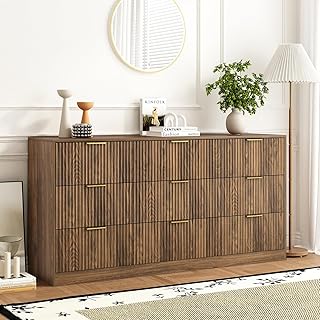
63″ Walnut Fluted 9-Drawer Dresser
The fluted walnut front is the most design-forward option in this group, adding vertical texture and warmth that laminate white cases can’t match. It performs well as a long media console in a living room, though the reeded detailing rewards owners who dust regularly.
GarveeHome 6-Drawer Grey Dresser
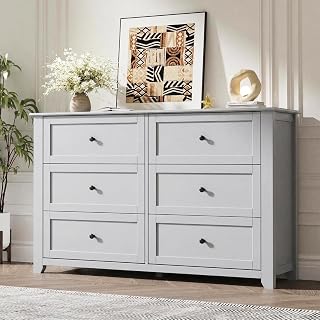
Six roomy drawers with metal knobs and a neutral grey finish that sits comfortably beside oak, walnut, or painted furniture without competing. A sensible middle-ground choice when you want real storage volume but don’t have wall space for a 63-inch run.
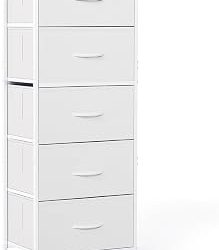
5-Drawer Tall White Farmhouse Dresser
The vertical answer to the same storage problem: five deep drawers stacked into a compact footprint, ideal for apartments, nurseries, and bedrooms where floor area is the constraint. Anchor it to the wall with the included anti-tip hardware, particularly if the top drawers carry the heaviest loads.
Frequently Asked Questions
How deep does a drawer need to be for folded sweaters?
Roughly six inches of interior depth holds three to four folded sweaters comfortably without compressing them. Below five inches you’ll be able to close the drawer, but clothes wrinkle and retrieval gets frustrating.
Can a 63-inch dresser really work as a TV stand?
Yes, and it’s one of the better uses of the format. Most of these cases sit around 30 to 31 inches tall, which puts a screen at comfortable seated eye level, and the top surface accommodates a 55 to 65-inch TV with room for a soundbar in front.
Are push-to-open drawers reliable long term?
Quality push latches hold up well, but they’re less forgiving under heavy loads than pull hardware. If you plan to fill drawers with denim and bedding, verify the stated per-drawer weight rating before committing to a handle-free design.
Do I need to secure the dresser to the wall?
Always, especially with taller five-drawer chests and in any home with children or pets. Anti-tip straps are inexpensive, usually included, and take five minutes to install.
Final Thoughts
For most bedrooms, the 63″ White 9-Drawer Dresser with Golden Handles offers the best balance of storage volume, layout flexibility, and finish quality, and it transitions easily into a living room console later. Choose the 63″ Walnut Fluted Dresser if you want the piece to carry the room’s design weight, or the 5-Drawer Tall White Farmhouse Dresser when floor space, not storage capacity, is the real constraint.