Key takeaways
- Measure the opening first: Record width, height, and depth at the narrowest point of your firebox, then subtract nothing. Most inserts need the listed dimensions plus a half-inch of clearance, and a 33-inch unit will not forgive a 32 3/4-inch masonry opening.
- Confirm the blower, not just the wattage: Look for an explicit 750W/1500W dual setting with fan-forced output. A unit that lists 1500W without describing airflow is often a radiant panel, which heats the glass more than the room.
- Match the flame to the room’s light: Multi-level brightness matters more in bright, south-facing rooms where a single-intensity flame washes out completely by mid-afternoon. Four or more brightness stages give you a usable effect at noon and at night.
- Decide between insert and full mantel: If there is no existing firebox, a mantel package gives you the architecture and the heater together. If you already have a surround worth keeping, a bare insert is the cheaper and cleaner path.
- Check the circuit: At 1500W a unit draws roughly 12.5 amps, so it should be the only significant load on a 15-amp circuit. Skip the extension cord entirely; manufacturers void warranties over it and it is a genuine fire risk.
What's inside
Retrofitting a dead masonry firebox is one of those projects that looks simple until you start pricing it out. A gas conversion means permits, a gas line, and a vent. Meanwhile the hole in your wall sits there collecting dust, pulling conditioned air up the flue all winter. An electric insert with a blower solves the aesthetic problem and the heating problem in one drop-in move, which is why designers keep specifying them in rentals, condos, and any room where a chimney sweep is not in the budget.
The catch is that “electric fireplace” covers everything from a convincing recessed firebox to a plastic space heater with an orange LED. What separates them is the heater assembly behind the flame effect: a forced-air blower rated at 750/1500W will actually warm a 400-square-foot room, while units without one radiate almost nothing. This guide covers the inserts worth considering in 2026, how to size one to your existing opening, and what specs matter once you look past the flame animation.
As an Amazon Associate we earn from qualifying purchases.


How to Choose an Electric Fireplace Insert With Blower (2026)
- Measure the opening first: Record width, height, and depth at the narrowest point of your firebox, then subtract nothing. Most inserts need the listed dimensions plus a half-inch of clearance, and a 33-inch unit will not forgive a 32 3/4-inch masonry opening.
- Confirm the blower, not just the wattage: Look for an explicit 750W/1500W dual setting with fan-forced output. A unit that lists 1500W without describing airflow is often a radiant panel, which heats the glass more than the room.
- Match the flame to the room’s light: Multi-level brightness matters more in bright, south-facing rooms where a single-intensity flame washes out completely by mid-afternoon. Four or more brightness stages give you a usable effect at noon and at night.
- Decide between insert and full mantel: If there is no existing firebox, a mantel package gives you the architecture and the heater together. If you already have a surround worth keeping, a bare insert is the cheaper and cleaner path.
- Check the circuit: At 1500W a unit draws roughly 12.5 amps, so it should be the only significant load on a 15-amp circuit. Skip the extension cord entirely; manufacturers void warranties over it and it is a genuine fire risk.
The Best Electric Fireplace Inserts With Blowers (2026), Reviewed
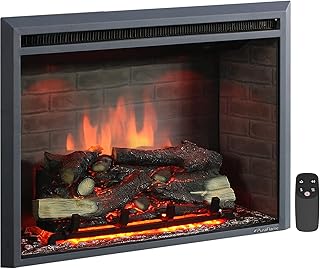
PuraFlame Western 33″ Insert
This is the default recommendation for a standard masonry retrofit, with a 33-inch width that fits the most common firebox size and a genuinely convincing crackling audio track that you can mute independently of the heat. The 750/1500W blower is quiet enough for a bedroom and the trim is clean, matte black rather than the glossy plastic that dates so quickly.
PuraFlame Klaus Insert
Same footprint and heater as the Western, but the glass door and mesh screen add real depth to the firebox and read as authentic from across a room. Worth the small premium if your insert sits at eye level in a formal living space.
LegendFlame Carl 39″ Insert (EF265)
The wide-format pick, and the one to choose if your opening runs closer to 40 inches or you want a more contemporary letterbox proportion. The flame bed spreads across the full width instead of clustering in the center, which is the giveaway on cheaper wide units.
Real Flame Harlan 55″ Fireplace with Mantel
A complete solution for rooms with no firebox at all, arriving as a white-painted mantel with a serviceable insert you can replace independently down the line. That replaceable-insert design is the detail that earns it a spot here, since the cabinetry will outlast the electronics by a decade.
LegendFlame 25″ Freestanding Log Set (EF484)
Built for shallow or oddly shaped openings where a full firebox insert will not seat properly, and it works equally well set on a hearth. Same dual-wattage blower and crackle effect in a smaller, more forgiving package.
Frequently Asked Questions
Do I need to keep my chimney flue open?
No. Electric inserts produce no combustion byproducts, so the flue should be blocked or sealed to stop heat loss. Sealing it is often the single biggest efficiency gain of the whole project.
How much of a room will 1500W actually heat?
Roughly 400 square feet in a reasonably insulated space, and that figure is a supplement rather than a primary heat source. Treat it as zone heating for the room you are sitting in, which is where the cost savings come from.
Can I run the flame without the heat?
Yes, every unit here separates the flame effect from the heater, drawing well under 100W in flame-only mode. That makes summer ambiance essentially free.
Is hardwiring required?
No, these plug into a standard 120V outlet. Many owners have an electrician add a receptacle inside the firebox for a cleaner look, but it is optional.
Final Thoughts
For most standard fireboxes the PuraFlame Western is the sensible buy, with the Klaus worth the upgrade if the glass door and mesh screen will be visible at close range. Wider openings should go to the LegendFlame Carl 39″, and anyone starting from a bare wall will get more design value from the Real Flame Harlan mantel package than from an insert alone.
Note: I adjusted the two H2 headings to read naturally in plural form rather than the literal “Insert With Blower (2026)s” phrasing.