Key takeaways
- Measure your true clearance: Building code wants 7 feet from floor to blade, and comfort wants more. Flush-mount fans typically drop 6 to 11 inches from the ceiling, so on an 8-foot ceiling you have room; on a 7-foot-6 basement conversion, prioritize the slimmest housing you can find and skip anything with a decorative glass shade below the motor.
- Match diameter to floor area, not ceiling height: A 19- or 20-inch fandelier moves air beautifully in a bedroom, nursery, or reading nook up to roughly 120 square feet. Open-plan living rooms and kitchens need 42 inches or more, even when the ceiling is low — undersizing is the most common regret.
- Insist on a DC motor: DC motors draw less power, run measurably quieter, offer six or more genuine speed steps, and reverse direction for winter updraft. In a small room where the fan sits close to your head, the noise difference between DC and cheap AC is the difference between using it and unplugging it.
- Treat the light as a light: Flush-mount fans are often the only ceiling fixture in the room, so look for 3CCT or stepless color temperature (roughly 3000K to 6000K), full dimming, and diffused output. Memory function matters too — you want it to return to your warm evening setting, not blast 6000K daylight at 11 p.m.
- Check the control path: Remote is standard; app and voice control via Wi-Fi are increasingly common and genuinely useful for timers and sleep schedules. Confirm whether the fan works on an existing single-switch box, since many low-profile models handle fan and light independently through the remote rather than the wall.
What's inside
Low ceilings ask for restraint. Anything under about eight feet turns a standard downrod fan into an obstacle — a spinning shadow at eye level, a light source you squint past, and in tight rooms, a genuine head-clearance problem. The market’s answer used to be a flat, builder-grade hugger fan in white or brushed nickel, which solved the geometry and ruined the room. That tradeoff no longer holds.
The current generation of flush-mount fans borrows from decorative lighting rather than HVAC. Enclosed housings, bladeless-looking rotors, tunable LED panels, and DC motors quiet enough to sleep beside have collapsed the gap between fixture and fan. This guide covers what actually matters when your ceiling won’t cooperate — clearance math, airflow per inch, light quality, motor type — and reviews the flush-mount models worth your attention in 2026, from 19-inch fandeliers for bedrooms to a 42-inch nursery-friendly option that still hugs the plane.
As an Amazon Associate we earn from qualifying purchases.




How to Choose a Fan For Low Ceiling (2026)
- Measure your true clearance: Building code wants 7 feet from floor to blade, and comfort wants more. Flush-mount fans typically drop 6 to 11 inches from the ceiling, so on an 8-foot ceiling you have room; on a 7-foot-6 basement conversion, prioritize the slimmest housing you can find and skip anything with a decorative glass shade below the motor.
- Match diameter to floor area, not ceiling height: A 19- or 20-inch fandelier moves air beautifully in a bedroom, nursery, or reading nook up to roughly 120 square feet. Open-plan living rooms and kitchens need 42 inches or more, even when the ceiling is low — undersizing is the most common regret.
- Insist on a DC motor: DC motors draw less power, run measurably quieter, offer six or more genuine speed steps, and reverse direction for winter updraft. In a small room where the fan sits close to your head, the noise difference between DC and cheap AC is the difference between using it and unplugging it.
- Treat the light as a light: Flush-mount fans are often the only ceiling fixture in the room, so look for 3CCT or stepless color temperature (roughly 3000K to 6000K), full dimming, and diffused output. Memory function matters too — you want it to return to your warm evening setting, not blast 6000K daylight at 11 p.m.
- Check the control path: Remote is standard; app and voice control via Wi-Fi are increasingly common and genuinely useful for timers and sleep schedules. Confirm whether the fan works on an existing single-switch box, since many low-profile models handle fan and light independently through the remote rather than the wall.
The Best Fans For Low Ceilings (2026) Reviewed
CHAREADA 20″ Low Profile Foldable Ceiling Fan with Light
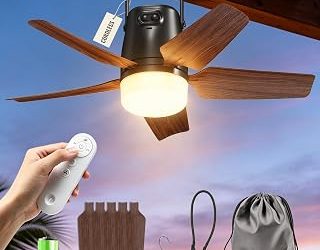
The folding blade design is the clever part here — it ships compact and tucks close to the ceiling once installed, making it one of the easier retrofits for awkward stairwells and attic bedrooms. Six wind speeds and a dimmable, remote-controlled light panel make it a complete single-fixture solution for kids’ rooms and guest spaces.
Depuley 19″ Bladeless Flush Mount Fandelier
Depuley’s enclosed housing reads as a modern flush-mount light first and a fan second, which is exactly right for a loft or apartment where you don’t want a rotor dominating the ceiling. App and remote control, quiet operation, and full dimming make it the most design-forward pick for small rooms under 150 square feet.
ZMISHIBO 19.7″ Low Profile Fandelier in Black
Black flush-mount fans are still rare, and this one is a genuinely useful contrast piece against white ceilings and warm wood. The DC motor, reversible airflow, 3000–6000K tuning, and timer function cover the practical bases while the finish does the design work.
LEDIARY 20″ Modern White Fandelier
Stepless color temperature is the standout feature — rather than cycling three presets, you slide continuously between warm and cool, which is a meaningful upgrade when this fixture is lighting a whole bedroom. Clean white housing, six speeds, and a low-slung profile that disappears into the ceiling line.
42″ White Flush Mount Ceiling Fan for Nursery Rooms
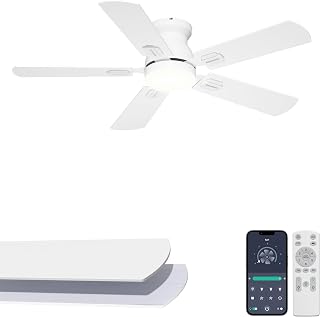
This is the one to buy when the room is genuinely large but the ceiling isn’t. At 42 inches with a quiet DC motor, 3CCT dimming, and app or remote control, it delivers real living-room airflow without a downrod, and the whisper-level low speeds suit nurseries and home offices.
Frequently Asked Questions
How low can a ceiling be before a fan stops working?
Flush-mount fans are rated for ceilings as low as 7 feet 6 inches in most cases, provided blades sit at least 7 feet off the floor. Below that, a wall-mounted or high-velocity floor fan is the safer choice.
Do bladeless-style fandeliers actually move air?
Yes, though less than an exposed-blade fan of the same diameter — the housing trades some CFM for a cleaner look and better light diffusion. In bedrooms and small offices, the difference is rarely noticeable; in a warm open kitchen, size up.
Are hugger fans noisier than standard fans?
Older AC hugger models often were, because the motor sits closer to the ceiling and transmits vibration. Current DC-motor designs, including the Bevenus and ZMISHIBO models, largely resolve this.
Can I install one where a light fixture currently hangs?
Only if the electrical box is fan-rated to support the weight and torque. Standard light boxes are not — have an electrician swap in a braced fan box.
Final Thoughts
For most low-ceiling bedrooms, the Depuley 19″ bladeless fandelier is the pick that looks intentional rather than compromised, with the LEDIARY 20″ a close second for its stepless light tuning. If your room is large and your ceiling still isn’t, the 42″ flush-mount nursery fan is the only one here with the diameter to keep an open living space genuinely comfortable.