Key takeaways
- Blade span versus room volume: A vaulted room needs more sweep than its square footage suggests. Rooms over 400 square feet with a pitched ceiling generally want 72 inches or more; 52-inch models suit smaller vaults, bedrooms, and secondary spaces where the peak is under ten feet.
- Downrod length: Aim to land the blades eight to nine feet above the floor. That often means a 12- to 24-inch rod on a moderate slope and 36 inches or longer on a dramatic cathedral pitch. Fans that ship with multiple downrods save you a second order.
- Slope rating on the canopy: Check the maximum degree the mount supports. Many fans cap out around 15 degrees, which covers common pitches but not steep A-frames. Confirm the number before you commit.
- DC motor for quiet low-speed running: DC motors draw roughly 60 to 70 percent less power than AC equivalents and hold a steady, near-silent low speed. That matters more when the fan is far overhead and you’ll leave it running for hours.
- Light placement and control: Fixtures mounted high wash a room differently. Dimmable 3CCT LEDs let you dial warmth and intensity to suit the ceiling height, and remote or app control means you’re not wiring a new switch loop.
What's inside
Vaulted ceilings do something wonderful for a room’s proportions and something unfortunate to its comfort. All that volume overhead means warm air stacks up eight, ten, even fourteen feet above where anyone is actually sitting, while the living space below stays stubbornly still. Standard flush-mount fans, sized and hung for eight-foot ceilings, spin politely into the void and move almost nothing at floor level. The fix isn’t more speed. It’s the right combination of blade span, downrod length, and a mount that can handle the slope of your pitch without binding or wobbling.
This guide focuses on fans built specifically for that job: wide-sweep designs with high airflow ratings, DC motors that stay quiet at low speed, and hardware rated for sloped installation. We looked at how each model handles downrod options, whether the canopy accommodates steeper pitches, and how the light output performs when it’s mounted well above eye level. Below you’ll find our current picks, followed by a buyer’s framework and answers to the questions that come up most often.
As an Amazon Associate we earn from qualifying purchases.



How to Choose a Fan For Vaulted Ceiling (2026)
- Blade span versus room volume: A vaulted room needs more sweep than its square footage suggests. Rooms over 400 square feet with a pitched ceiling generally want 72 inches or more; 52-inch models suit smaller vaults, bedrooms, and secondary spaces where the peak is under ten feet.
- Downrod length: Aim to land the blades eight to nine feet above the floor. That often means a 12- to 24-inch rod on a moderate slope and 36 inches or longer on a dramatic cathedral pitch. Fans that ship with multiple downrods save you a second order.
- Slope rating on the canopy: Check the maximum degree the mount supports. Many fans cap out around 15 degrees, which covers common pitches but not steep A-frames. Confirm the number before you commit.
- DC motor for quiet low-speed running: DC motors draw roughly 60 to 70 percent less power than AC equivalents and hold a steady, near-silent low speed. That matters more when the fan is far overhead and you’ll leave it running for hours.
- Light placement and control: Fixtures mounted high wash a room differently. Dimmable 3CCT LEDs let you dial warmth and intensity to suit the ceiling height, and remote or app control means you’re not wiring a new switch loop.
The Best Fan For Vaulted Ceiling (2026)s Reviewed
ZMISHIBO 72″ Ceiling Fan with Lights
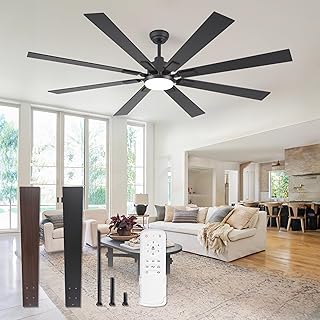
This is the most complete package here for a large vaulted living room or covered patio, pairing a genuinely high-CFM sweep with a quiet DC motor and a damp rating that holds up under a porch roof. The dual-finish blades give you two looks from one purchase, which is a smart hedge if your palette is still evolving.
Fanbulous 72 Inch Ceiling Fan with DC Motor
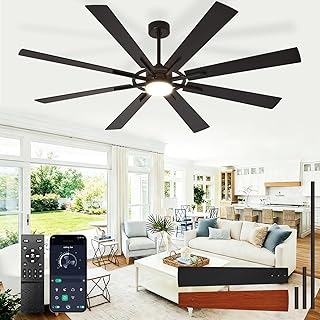
Fanbulous leans into control: remote plus app, dimmable 3CCT lighting, and a memory function that restores your last setting instead of defaulting to full blast. The reversible blades and explicit flat-or-sloped compatibility make it an easy specification for open-plan great rooms.
ZMISHIBO 96 Inch Industrial Ceiling Fan
At eight feet across with no light kit, this is the choice for cathedral-height volume where air movement is the only priority: converted barns, tall garages, and double-height entryways. Three included downrods cover most drop distances out of the box, and the aluminum blades keep the rotating mass manageable.
52 Inch Ceiling Fan with Sloped Ceiling Mount
A clean, restrained white fan for bedrooms and smaller vaults, rated for slopes up to 15 degrees on the included downrod. The reversible DC motor and dimmable 3CCT LED make it quiet enough for a room you sleep in, which is where many oversized fans fall short.
Modern 72 Inch 8 Blade Outdoor Ceiling Fan
Eight blades and six speeds give this one a smoother, more even air pattern than four- or five-blade fans at the same span, and the matte black finish reads as intentional against exposed beams. App control and full dimming round out a fan that works indoors or under cover.
Frequently Asked Questions
Do I need a special mount for a vaulted ceiling?
You need a canopy rated for your pitch. Most fans include a ball-and-socket downrod mount that handles moderate slopes, but steep pitches may require a dedicated sloped-ceiling adapter sold separately. Measure your angle first.
How long should the downrod be?
Position the blades roughly eight to nine feet off the floor. Subtract that from your ceiling height at the mounting point, then subtract the fan body height to find your rod length. When in doubt, size up rather than down.
Will one large fan outperform two smaller ones?
In a single open volume, usually yes: a wider sweep moves more air at a lower speed, which means less noise. Two fans make more sense when a vaulted space is divided into distinct zones, such as a kitchen and seating area under one roofline.
Should the fan reverse direction in winter?
Yes, and vaulted rooms benefit more than most. Running clockwise at low speed pulls the warm air trapped near the peak back down along the walls without creating a draft, which can noticeably reduce heating demand.
Final Thoughts
For most vaulted living rooms, the ZMISHIBO 72″ with its high-CFM motor and dual-finish blades is the balanced pick, while the Fanbulous 72 Inch earns its place if app control and memory settings matter to how you actually live in the space. When the ceiling climbs past twelve feet and lighting is handled elsewhere, the ZMISHIBO 96 Inch is the one that will genuinely move the air.