Key takeaways
- Fuel format: Propane throws more heat and needs no outlet, but requires tank storage and clearance overhead. Electric infrared warms objects and people directly, works under roofs and pergolas, and costs less per hour — choose it if your space is covered or your seating is fixed.
- BTU against real coverage: A 46,000–50,000 BTU tower realistically warms a 9- to 12-foot circle, not an entire yard. Match the number to your seating cluster; two well-placed mid-size units beat one oversized heater stranded in a corner.
- Footprint and sightlines: Full-height towers run 85–92 inches and read as vertical architecture, so treat them as furniture. On tight balconies, a tabletop model preserves the floor plan and keeps views open.
- Weather rating and safety hardware: Look for an IPX-rated enclosure on electric units, and tip-over shutoff, anti-tilt switches, and overheat protection across the board. A ballast-friendly water-fillable base is the quiet feature that keeps a tall unit upright in gusts.
- Mobility and storage: Wheels matter more than spec sheets suggest — you’ll reposition seasonally and roll units under cover. A fitted cover, or a wall-mount option for electric models, decides how the heater survives its off-months.
What's inside
Every year the same thing happens: the patio gets designed, styled, and photographed in July, then quietly abandoned by mid-October. The furniture stays, the string lights stay, but the people go inside. Outdoor heat is the piece most people leave out of the plan, and then try to solve in a panic when the temperature drops. The result is usually a rushed purchase that either underperforms, looks wrong next to everything else, or turns out to be unusable on the covered porch it was bought for.
This guide approaches patio heat the way we’d approach any other furnishing decision: proportion, material, placement, and performance, in that order. Below are the models worth considering in 2026 across the three formats that actually matter — freestanding propane towers for open decks and dining zones, tabletop units for small balconies and intimate seating, and electric infrared for covered spaces where a flame simply isn’t an option. We’ve noted where each one earns its footprint and where it doesn’t.
As an Amazon Associate we earn from qualifying purchases.


How to Choose a Heater For Outside Patio (2026)
- Fuel format: Propane throws more heat and needs no outlet, but requires tank storage and clearance overhead. Electric infrared warms objects and people directly, works under roofs and pergolas, and costs less per hour — choose it if your space is covered or your seating is fixed.
- BTU against real coverage: A 46,000–50,000 BTU tower realistically warms a 9- to 12-foot circle, not an entire yard. Match the number to your seating cluster; two well-placed mid-size units beat one oversized heater stranded in a corner.
- Footprint and sightlines: Full-height towers run 85–92 inches and read as vertical architecture, so treat them as furniture. On tight balconies, a tabletop model preserves the floor plan and keeps views open.
- Weather rating and safety hardware: Look for an IPX-rated enclosure on electric units, and tip-over shutoff, anti-tilt switches, and overheat protection across the board. A ballast-friendly water-fillable base is the quiet feature that keeps a tall unit upright in gusts.
- Mobility and storage: Wheels matter more than spec sheets suggest — you’ll reposition seasonally and roll units under cover. A fitted cover, or a wall-mount option for electric models, decides how the heater survives its off-months.
The Best Heaters For Outside Patio (2026), Reviewed
Amazon Basics 46,000 BTU Propane Patio Heater
The most sensible entry point into freestanding heat: 46,000 BTU, a nine-foot radius, wheels, and a water-fillable base that adds stability without permanent weight. The slate gray finish is deliberately neutral, which makes it the easiest tower to slot into an existing scheme without redesigning around it.
EAST OAK 50,000 BTU Patio Heater with Table
The integrated round tabletop is the smart move here — it converts the heater’s dead zone into usable surface for drinks and glassware, which is exactly what a standing gathering needs. The double-layer stainless burner runs steadier in breeze than single-wall designs, and the triple protection system covers tilt, flameout, and gas shutoff.
Pamapic 48,000 BTU Pyramid Flame Heater
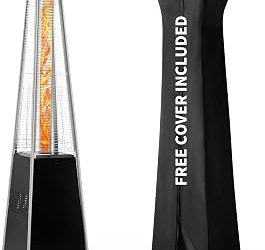
This is the design-forward choice: a 48,000 BTU pyramid with a quartz glass tube that puts a visible column of flame at the center of the seating area, doing the work of both heater and fire feature. The hammered bronze finish leans warm and tactile, and the included cover is genuinely necessary given the glass.
Cuisinart 11,000 BTU Tabletop Patio Heater
For balconies, bistro tables, and two-chair corners, an 11,000 BTU tabletop covering roughly 30 square feet is the correct scale — a full tower in that space is both wasteful and visually overwhelming. The anti-tilt switch and burner screen guard make it the more relaxed option when the table is crowded.
Paraheeter 1500W Outdoor Electric Infrared Heater
The most flexible unit on this list: 1500W of waterproof, CSA-certified infrared that mounts to a wall for a permanent, floor-free install or rides a tripod when you want it portable. Remote control and instant-on heat make it the right answer for covered patios, pergolas, and garages where propane doesn’t belong.
Frequently Asked Questions
How many BTUs do I need for my patio?
Estimate roughly 3,000–5,000 BTU per person in open air, or plan by zone: one 45,000–50,000 BTU tower per seating cluster, one tabletop per small table. Wind, humidity, and open sides all reduce effective output, so err upward outdoors and downward under a roof.
Can I use a propane patio heater under a covered porch?
Only with substantial vertical clearance and open sides for ventilation — most manufacturers specify several feet above the reflector. For enclosed or low-ceilinged covered spaces, electric infrared is the appropriate choice; a wall-mounted or tower unit like the 42-inch 1500W infrared model with IPX5 protection is built for exactly that condition.
How long does one propane tank last?
A standard 20 lb tank runs about eight to ten hours at full output on a 45,000–50,000 BTU heater, and considerably longer on lower settings. Keeping a second tank on hand is standard practice for anyone entertaining regularly.
Is electric or propane cheaper to run?
Electric infrared costs less per hour in most regions and wastes less energy heating air that drifts away. Propane wins on raw output and freedom from cords, which is why open decks tend toward propane and covered patios toward electric.
Final Thoughts
For most open patios, the EAST OAK 50,000 BTU tower is the best-balanced buy — strong output, a genuinely useful integrated table, and thorough safety hardware. Choose the Pamapic pyramid if you want the heat source to double as the focal point of the space, and the Paraheeter 1500W infrared if your patio is covered, your layout is fixed, or you’d rather the heater disappear onto a wall than occupy the floor.