Key takeaways
- Temperature range and steps: Look for presets that map to real use. Green tea wants 175°F, pour-over sits near 200°F, and instant noodles need a true boil. Units offering five to eight settings across roughly 105°F to 212°F cover a household without guesswork.
- Tank size versus footprint: A 3L reservoir handles a family morning without refills, while 20L and 30L boilers are built for continuous service. Measure your under-cabinet clearance before committing, since most home units need vertical room to lift the tank out.
- Dispense volume control: Preset pour amounts are the underrated feature here. Being able to send exactly one cup to a mug, or a larger measure to a French press, means less overflow and less reheating.
- Materials and serviceability: BPA-free tanks and 304 stainless interiors resist scale and off-flavors. Removable reservoirs matter more than spec sheets suggest, because a tank you can carry to the sink is a tank you will actually descale.
- Safety and finish: Child lock is essential in a home with kids, and standby shutoff protects against dry heating. Aesthetically, decide early whether you want the appliance to disappear into a white or matte scheme or read as a deliberate object on the shelf.
What's inside
The electric kettle earned its place on the counter, but it has never quite kept pace with how we actually live. You boil a full liter for one cup of oolong, wait, then wait again when someone wants pour-over at 205°F and a bottle of formula at body temperature ten minutes later. In a kitchen where counter space is the most contested real estate in the house, a machine that only does one thing at one temperature is a hard sell.
Countertop hot water dispensers solve that in a footprint roughly the size of a canister. Fill the reservoir once, choose a temperature, choose a volume, and hot water arrives in seconds instead of minutes. This guide covers what separates a genuinely useful dispenser from a bulky novelty, then walks through five models worth considering in 2026, spanning slim home units with touchscreens to stainless commercial boilers built for a boba counter or a busy office pantry.
As an Amazon Associate we earn from qualifying purchases.



How to Choose a Hot Water Dispenser Countertop (2026)
- Temperature range and steps: Look for presets that map to real use. Green tea wants 175°F, pour-over sits near 200°F, and instant noodles need a true boil. Units offering five to eight settings across roughly 105°F to 212°F cover a household without guesswork.
- Tank size versus footprint: A 3L reservoir handles a family morning without refills, while 20L and 30L boilers are built for continuous service. Measure your under-cabinet clearance before committing, since most home units need vertical room to lift the tank out.
- Dispense volume control: Preset pour amounts are the underrated feature here. Being able to send exactly one cup to a mug, or a larger measure to a French press, means less overflow and less reheating.
- Materials and serviceability: BPA-free tanks and 304 stainless interiors resist scale and off-flavors. Removable reservoirs matter more than spec sheets suggest, because a tank you can carry to the sink is a tank you will actually descale.
- Safety and finish: Child lock is essential in a home with kids, and standby shutoff protects against dry heating. Aesthetically, decide early whether you want the appliance to disappear into a white or matte scheme or read as a deliberate object on the shelf.
The Best Hot Water Dispenser Countertop (2026)s Reviewed
AIRHOP 3L Instant Hot Water Dispenser
Three-second heating and five temperature settings make this the most natural kettle replacement of the group, and the slim profile tucks into a coffee corner or a home office without dominating it. The child lock and removable 100oz BPA-free tank cover the two things that usually go wrong with compact dispensers: safety and cleaning access.
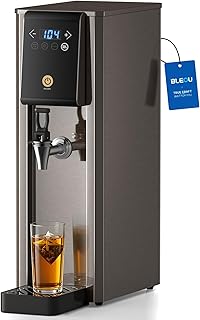
Bleou 1800W Commercial Hot Water Dispenser
Rated at roughly 20 liters per hour with a 304 stainless build, this is the pick when demand is constant rather than occasional. The 104°F to 212°F adjustable range covers boba prep, tea service, and coffee bar work, and the industrial finish looks intentional in a light commercial or open-plan setting.
BUYDEEM S9013 Instant Hot Water Dispenser
Eight temperatures and five output volumes give this the most precise control here, which matters if you brew delicate teas or mix baby formula where a few degrees are not negotiable. The green colorway is also the most design-forward option on the list, reading more like small-batch ceramics than an appliance.
NutriChef 5.2 Qt Hot Water Dispenser
The largest home-scale tank in this roundup, paired with a stainless interior and a clear digital panel that keeps the interface legible. Five temperatures, three dispense volumes, and a safety lock make it a sensible choice for larger households or shared kitchens where refill frequency is the real complaint.
VEVOR Instant Hot Water Dispenser
Six temperatures and seven volume presets deliver the most granular pouring options at a home scale, controlled through a touchscreen that wipes clean in one pass. The 101oz removable tank and child lock round out a well-specified unit for families who want flexibility without a commercial footprint.
Frequently Asked Questions
Do these replace an electric kettle entirely?
For most households, yes. You gain temperature precision and per-cup volume control, and you lose the stovetop-style silhouette some people prefer on display. The main tradeoff is that dispensers require a reservoir refill rather than filling under the tap.
How often should I descale?
Every one to three months depending on water hardness, or sooner if heating slows or you see white residue. Filtered water meaningfully extends the interval and keeps flavors clean.
Is a commercial unit overkill for a home?
Usually. A 20L or 30L boiler makes sense for offices, cafes, and tea shops, but the size and heat output are hard to justify in a residential kitchen unless you entertain constantly.
Are they energy efficient?
Heating on demand is typically more efficient than keeping a thermal pot hot all day, since you only heat the volume you dispense. Look for standby shutoff if the unit offers a keep-warm mode.
Final Thoughts
For most kitchens, the AIRHOP 3L is the easy recommendation: fast, compact, and safe enough for a family counter. Step up to the BUYDEEM S9013 if temperature precision and a considered look matter to you, or the Bleou 1800W if you are serving a room rather than a household.