Key takeaways
- Runtime that clears a full night: Tear film thins most during sleep, so look for 24 hours or more of continuous output. A unit that quits at 3 a.m. leaves you with exactly the dry air you were trying to fix.
- Sub-30dB operation: Anything above roughly 30 decibels registers as a presence in a quiet bedroom. The 23–28dB range reads as background hush, which matters because broken sleep worsens dry eye on its own.
- Cool mist over warm: Cool mist adds moisture without raising room temperature, and it sidesteps the burn risk of a heating element — the safer default in nurseries and anywhere the unit sits near a bed.
- Top-fill design and a wide tank opening: Biofilm in a neglected tank aerosolizes into the air you’re breathing near your eyes. If you can pour water in without flipping the unit and reach every interior surface with a cloth, you’ll clean it weekly instead of monthly.
- Humidity control, not just fan speeds: A built-in hygrometer with a target setting holds the room near 45% and stops there. Guessing with low-medium-high tends to overshoot into damp-window territory or undershoot entirely.
What's inside
Dry eyes rarely announce themselves. They show up as a gritty blink at 4 p.m., a burning sensation while you scroll in bed, contact lenses that stop cooperating by dinner. And more often than not, the culprit isn’t your screen at all — it’s the air. Forced-air heating and always-on cooling strip indoor humidity down to desert numbers, sometimes below 25%, and your tear film evaporates faster than your eyes can replace it. Ophthalmologists point to the same target again and again: keep relative humidity somewhere between 40% and 60%, and a surprising amount of that afternoon irritation simply stops happening.
The trouble is that most humidifiers are designed for stuffy noses, not sensitive eyes — which means loud fans, awkward top-heavy tanks, and mist output you can’t dial in. This guide takes a curator’s view instead: units that hold a steady humidity level overnight without waking you, that live comfortably on a nightstand or a low console without looking like medical equipment, and that you’ll actually rinse out on schedule. Below are the models worth your counter space in 2026, plus the specifications that genuinely matter when your eyes are the reason you’re shopping.
As an Amazon Associate we earn from qualifying purchases.



How to Choose a Humidifier For Dry Eyes (2026)
- Runtime that clears a full night: Tear film thins most during sleep, so look for 24 hours or more of continuous output. A unit that quits at 3 a.m. leaves you with exactly the dry air you were trying to fix.
- Sub-30dB operation: Anything above roughly 30 decibels registers as a presence in a quiet bedroom. The 23–28dB range reads as background hush, which matters because broken sleep worsens dry eye on its own.
- Cool mist over warm: Cool mist adds moisture without raising room temperature, and it sidesteps the burn risk of a heating element — the safer default in nurseries and anywhere the unit sits near a bed.
- Top-fill design and a wide tank opening: Biofilm in a neglected tank aerosolizes into the air you’re breathing near your eyes. If you can pour water in without flipping the unit and reach every interior surface with a cloth, you’ll clean it weekly instead of monthly.
- Humidity control, not just fan speeds: A built-in hygrometer with a target setting holds the room near 45% and stops there. Guessing with low-medium-high tends to overshoot into damp-window territory or undershoot entirely.
The Best Humidifier For Dry Eyes (2026)s Reviewed
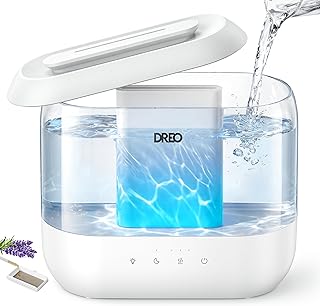
DREO 4L Humidifier (HM311)
The 36-hour runtime is the headline here, and it’s the right one — this is the unit for anyone who resents refilling appliances, since a single 4L tank comfortably covers a weekend of overnight use in a large bedroom. At 28dB with a dimmable nightlight and a genuinely wide fill opening, it manages to be the practical choice without looking like a compromise.
DREO 3L Humidifier
Same engineering lineage in a slimmer black body, and it adds precise humidity control — you set a target percentage and the unit modulates to hold it, which is the single most useful feature on this list for dry eye. The 360° nozzle lets you steer mist away from a headboard or artwork, a small detail that saves finishes over a long winter.
Homvana 3.6L Top-Fill Humidifier
At 23dB this is the quietest unit here, and the muted grey shell is one of the few humidifier designs that doesn’t fight a considered bedroom. It doubles as an oil diffuser, though for dry eyes I’d run it plain — the two-in-one function is a nice option to have, not a nightly habit.
Levoit 2.5L Top Fill Humidifier
Levoit’s strength is unglamorous reliability: 25 hours of run time, 28dB, auto shut-off when the tank empties, and an interior you can actually wipe clean in under a minute. A smart pick for a smaller bedroom or a home office desk where a 4L footprint would dominate.
Clarston 2L Cool Mist Humidifier
The most compact option that still delivers a 25-hour night, with 24dB output and a 360° nozzle that punches above the tank size for room coverage. BPA-free construction and a soft nightlight make it an easy nursery or guest-room addition at the entry end of the range.
Frequently Asked Questions
Will a humidifier actually relieve dry eyes?
It addresses one specific cause: low ambient humidity accelerating tear evaporation. If your symptoms worsen in heated or air-conditioned rooms and ease outdoors, raising humidity to 40–60% often helps noticeably within a few nights. It won’t resolve dry eye caused by meibomian gland dysfunction, medication, or autoimmune conditions, so persistent symptoms deserve an optometrist’s assessment.
Where should I place the unit?
Three to six feet from the bed, elevated on a nightstand or low shelf, with the nozzle aimed toward open space rather than directly at your face or a wall. Mist pointed at bedding or plaster creates damp spots; mist dispersed into the room raises humidity evenly.
Do I need distilled water?
In hard-water areas, yes — mineral content in tap water becomes fine white dust that settles on surfaces and can irritate eyes and airways. Distilled or filtered water eliminates the problem and extends the life of the unit.
How often does it need cleaning?
Empty and dry the tank daily, and do a proper wipe-down with white vinegar or a mild descaler weekly. This isn’t optional maintenance for dry eye sufferers — a contaminated tank sends bacteria and mold spores straight into the air around your eyes.
Final Thoughts
For most bedrooms, the DREO 4L HM311 is the one to buy — 36 hours between refills means it stays running, and running consistently is what actually moves the needle on dry eye. If you want tighter control over the number on the hygrometer, step to the DREO 3L for its precise humidity targeting, and if a near-silent unit that suits a carefully styled room is the priority, the 23dB Homvana 3.6L is the most design-literate option on the list.