Key takeaways
- One-way vs. two-way control: Standard sponge and gel humidifiers only add moisture, so you have to judge when to stop. Two-way systems absorb excess humidity as well, holding a set range without input — the better choice if you travel between climates or forget to check.
- Built-in hygrometer: A humidifier without a gauge is a guess. Combination units give you a reading at the soundhole, which matters far more than the number on a wall thermometer across the room.
- Case vs. open storage: Soundhole humidifiers are designed for a closed case, where the sealed volume does the work. A guitar displayed on a stand or wall mount needs room-level humidity management instead, or a case for the dry season.
- Drip risk and construction: Look for a sealed inner membrane or non-drip housing. Water contacting bare wood inside the body causes staining and swelling, the exact problem you were trying to avoid.
- Refill rhythm: Sponge units want attention every one to two weeks in winter; sachet-based systems run four to eight weeks per set. Choose the maintenance interval you will realistically keep.
What's inside
An acoustic guitar is one of the few objects in a home that responds to the room around it. Spruce and rosewood keep breathing long after they leave the workshop, expanding through humid summers and shrinking through the dry months when forced-air heat runs from dusk to morning. The damage rarely announces itself. A top goes slightly concave, the action drops until strings buzz on the frets, and a hairline seam opens along the lower bout — the kind of failure that costs more to repair than a decade of preventive care. If your instrument lives on a wall hook in the living room or leans in a corner of the study, it is subject to the same dry indoor air that cracks leather bindings and splits butcher block.
The fix is small and unglamorous: a device that holds water and releases it slowly into the guitar’s immediate airspace, ideally paired with a gauge so you are working from data rather than guesswork. This guide covers the humidifiers that working players and luthiers actually trust, how the main designs differ, and which one suits the way your instrument is stored.
As an Amazon Associate we earn from qualifying purchases.




How to Choose a/an Humidifier For Guitars (2026)
- One-way vs. two-way control: Standard sponge and gel humidifiers only add moisture, so you have to judge when to stop. Two-way systems absorb excess humidity as well, holding a set range without input — the better choice if you travel between climates or forget to check.
- Built-in hygrometer: A humidifier without a gauge is a guess. Combination units give you a reading at the soundhole, which matters far more than the number on a wall thermometer across the room.
- Case vs. open storage: Soundhole humidifiers are designed for a closed case, where the sealed volume does the work. A guitar displayed on a stand or wall mount needs room-level humidity management instead, or a case for the dry season.
- Drip risk and construction: Look for a sealed inner membrane or non-drip housing. Water contacting bare wood inside the body causes staining and swelling, the exact problem you were trying to avoid.
- Refill rhythm: Sponge units want attention every one to two weeks in winter; sachet-based systems run four to eight weeks per set. Choose the maintenance interval you will realistically keep.
The Best Humidifier For Guitars (2026)s Reviewed
D’Addario Humidipak Maintain Kit
The most hands-off option available: three sachets sit in the case and hold a steady 45 to 50 percent relative humidity, releasing or absorbing moisture as conditions shift. No water to add and no over-humidification, which makes it the default recommendation for valuable instruments and anyone who tours.
Oasis OH-1 Soundhole Humidifier
A slim fabric tube filled with water-absorbing crystals that visibly shrinks as it empties, so you can read its status at a glance. The design has been a luthier favorite for years because the outer membrane releases vapor without ever letting liquid reach the wood.
MusicNomad Humitar ONE (MN311)
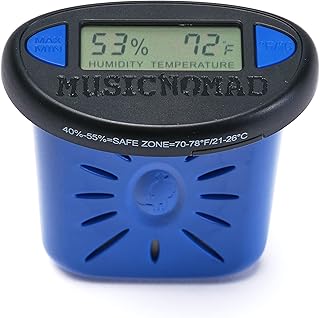
Pairs the Humitar’s non-drip sponge housing with an accurate digital hygrometer in a single soundhole clip, giving you moisture and measurement in one part. The best value if you want real readings without buying two separate accessories.
Oasis OH-5 Humidifier
Essentially the OH-1 concept adapted for players who prefer a case-mounted or clip position rather than a hanging soundhole tube. Same slow, even output and same reliable seal, with a form factor that suits shallower cases and smaller-bodied guitars.
GUITTO GHD-01 2-in-1
A clip-on soundhole unit with a refillable sponge and an analog gauge that needs no battery, which means nothing to replace mid-winter. Straightforward and inexpensive, and the mechanical dial is easier to read in a dim case than small digital displays.
Frequently Asked Questions
What humidity level should I aim for?
Between 45 and 55 percent relative humidity. Below 40 percent, wood begins losing moisture quickly; above 60 percent, tops swell and glue joints soften.
Do solid-body electric guitars need this?
Far less. Solid bodies tolerate dry air well, though extreme conditions can still affect fretboards and neck relief. Acoustics and hollow-bodies are the priority.
How often do I refill a sponge humidifier?
Roughly every one to two weeks during heating season, less in mild months. A hygrometer tells you precisely; the reading matters more than the calendar.
Can I skip a case and humidify the room?
Yes, and it is ideal for displayed instruments. A room humidifier plus a monitor works well, but it uses considerably more water than a case system.
Final Thoughts
For a cherished instrument that deserves protection you never have to think about, the D’Addario Humidipak Maintain Kit is the clear pick. If you want visibility into what is actually happening inside the case, the MusicNomad Humitar ONE combines both functions cleanly, while the Oasis OH-1 remains the quiet, dependable standard for anyone who prefers a proven soundhole design.