Key takeaways
- Match the fixture to your pitch: Most sloped-rated downlights handle roughly a 0–35 degree incline, or about 2:12 to 8:12 in roofing terms. Gimbal styles that rotate and tilt give you the widest tolerance; check the stated degree range against your ceiling before ordering in bulk.
- Prioritize glare control: On a slope, the light source sits closer to your sightline than it would overhead. Look for deep-regressed lenses, baffled interiors, and a CRI of 90 or better so skin tones and wood finishes read accurately rather than washed out.
- Get selectable color temperature: A 5-CCT switch lets you dial 2700K for a cozy loft bedroom or 4000K over a kitchen island without reordering. Commit to one temperature per zone, though; mixed Kelvin across a single vaulted plane looks like a mistake.
- Confirm IC rating and airtight construction: Vaulted ceilings usually mean insulation directly against the housing. IC-rated, airtight canless units can contact insulation safely and stop conditioned air from escaping into the roof cavity, which matters for both code compliance and energy bills.
- Plan spacing and dimming together: Space downlights at roughly half the ceiling height and verify your dimmer appears on the manufacturer’s compatibility list. Incompatible drivers are the number one cause of flicker and audible buzz in retrofit installs.
What's inside
A sloped ceiling does beautiful things for a room’s proportions and terrible things for its lighting plan. Standard recessed housings sit perpendicular to the surface they’re mounted in, so on a pitched plane they aim light down the slope instead of into the room. The result is that familiar scalloped wash on the drywall, hot glare in your eyeline when you’re seated, and dim pools exactly where you actually need brightness. Vaulted great rooms, finished attics, A-frame cabins, and dormer bedrooms all share the same problem, and it isn’t solved by simply adding more fixtures.
The fix is hardware built for pitch: sloped-ceiling trims with an angled inner reflector, gimbal or eyeball downlights that swivel to correct the aim, or semi-flush fixtures on a canopy that tolerates an incline. This guide covers the options worth your money in 2026, from single-fixture upgrades to multi-pack retrofits for a whole vaulted ceiling, plus the specs that determine whether the finished room looks intentional or improvised.
As an Amazon Associate we earn from qualifying purchases.


How to Choose a Light For Sloped Ceiling (2026)
- Match the fixture to your pitch: Most sloped-rated downlights handle roughly a 0–35 degree incline, or about 2:12 to 8:12 in roofing terms. Gimbal styles that rotate and tilt give you the widest tolerance; check the stated degree range against your ceiling before ordering in bulk.
- Prioritize glare control: On a slope, the light source sits closer to your sightline than it would overhead. Look for deep-regressed lenses, baffled interiors, and a CRI of 90 or better so skin tones and wood finishes read accurately rather than washed out.
- Get selectable color temperature: A 5-CCT switch lets you dial 2700K for a cozy loft bedroom or 4000K over a kitchen island without reordering. Commit to one temperature per zone, though; mixed Kelvin across a single vaulted plane looks like a mistake.
- Confirm IC rating and airtight construction: Vaulted ceilings usually mean insulation directly against the housing. IC-rated, airtight canless units can contact insulation safely and stop conditioned air from escaping into the roof cavity, which matters for both code compliance and energy bills.
- Plan spacing and dimming together: Space downlights at roughly half the ceiling height and verify your dimmer appears on the manufacturer’s compatibility list. Incompatible drivers are the number one cause of flicker and audible buzz in retrofit installs.
The Best Light For Sloped Ceiling (2026)s Reviewed
Maxxima 4″ Canless Sloped Anti-Glare LED Downlight
Purpose-built for pitch rather than merely tolerant of it, this 4-inch canless unit combines a deeply recessed anti-glare optic with 1000 lumens and 90 CRI, so it stays comfortable to sit beneath in a vaulted living room. The five selectable color temperatures and IC rating make it the most complete small-aperture pick here.
HALO RLS 6″ Adjustable Canless Recessed Light
HALO’s RLS series brings commercial-grade engineering to a residential retrofit, with a fully adjustable aperture that corrects aim on a slope and 1600 lumens for higher vaulted ceilings where light has further to travel. The 2700K–5000K selector and reliable dimming performance make it the safe specification when you want zero callbacks.
WAC Lighting Lotos 4″ Adjustable Recessed Light
This is the designer’s choice: a crisp, minimal 4-inch trim with adjustable aiming, airtight IC-rated construction, universal 120V–277V input, and 2-hour fire rating. Sold as a 24-pack, it’s aimed at whole-home or great-room projects where visual consistency across every ceiling plane matters more than per-fixture cost.
6″ Black Gimbal Canless Wafer Lights, 6-Pack
Black gimbal trims read as deliberate architectural detail against white drywall or stained tongue-and-groove, and the swiveling head lets you square the beam to the floor on any moderate pitch. At 1050 lumens and 12W with 5-CCT selection, this six-pack covers a single room or a dormer hallway neatly.
6″ Black Gimbal Wafer Lights, 12-Pack
The same directional gimbal design in a twelve-pack, which is the right quantity for a full vaulted great room or a finished attic level. ETL listing, five color temperatures, and dimmable drivers deliver strong value per fixture without giving up the aiming flexibility a slope demands.
Frequently Asked Questions
Can I use standard recessed lights on a sloped ceiling?
Not well. A standard housing aims the beam perpendicular to the ceiling, which on a pitch throws light at the wall and puts the bright source directly in your line of sight. Use a sloped-specific trim or an adjustable gimbal instead.
How far apart should downlights be on a vaulted ceiling?
Start with spacing equal to about half the ceiling height at the fixture, then tighten slightly toward the low end of the slope where the ceiling is closer to the floor. Measure along the sloped surface, not the floor plan.
Are gimbal lights better than fixed sloped trims?
Gimbals offer more flexibility and let you accent artwork or a fireplace wall. Dedicated sloped trims typically control glare better because the angled reflector is engineered as a single optical unit. Choose gimbals for aimable accent light, sloped trims for even ambient coverage.
What about a flush mount on a slope?
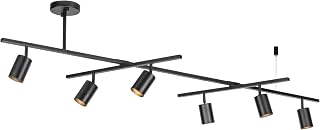
A semi-flush fixture such as the Industrial Black 2-Light Semi Flush Mount works when the canopy is rated for an incline, and it’s a good option for entryways, hallways, or dining nooks where you want visible character rather than hidden light.
Final Thoughts
For most vaulted rooms, the Maxxima 4″ sloped anti-glare downlight delivers the cleanest ceiling and the most comfortable light for the money, while the HALO RLS 6″ is the one to specify when you need higher output and dependable dimming. If you’re lighting an entire great room and want a single cohesive look, the WAC Lotos 4″ multi-pack is worth the upgrade.