Key takeaways
- Wall clearance: Standard recliners want 12 to 18 inches behind them. Wall-hugger designs like the Ashley Frohn drop that to roughly three inches, which is the difference between a sofa that works in an apartment and one that floats awkwardly in the middle of the floor.
- Upholstery honesty: Genuine leather softens and develops character; faux and bonded leather stay uniform but can peel at stress points within a few years. Chenille and polyester breathe better in warm climates and hide fewer sins than you’d think. Match the material to your household, not the showroom photo.
- Mechanism type: Pull-tab levers are simpler and less likely to fail than side handles, and multi-position stops let you land somewhere between upright and fully reclined. Test the resistance if you can, a mechanism that requires real force is a mechanism you’ll stop using.
- Frame and weight rating: Kiln-dried hardwood or reinforced steel beats particleboard every time. Look for stated per-seat capacity above 250 pounds, and treat heavier shipping weight as a rough proxy for build density rather than a drawback.
- Assembly reality: Most three-seat recliners arrive in two or three boxes with snap-on backs. That’s genuinely manageable solo, but measure your doorways and stairwell first. Sectional-style recliner sets give you more routing options through tight entries.
What's inside
Recliners have shaken off their bad reputation, but shopping for one still feels like a gamble. Manual models in particular get lumped together in listings that recycle the same three photos and say almost nothing about seat depth, frame construction, or how much wall clearance you actually need. Meanwhile the real failure points, sagging foam by month eight, a pull-tab that fights you, upholstery that cracks along the seams, only surface after delivery. Most buyers end up choosing on price and hoping.
This guide takes the opposite approach. We looked at manual reclining sofas through the lens of how they behave in a real room: whether the reclined footprint works in a 12-foot living space, how bonded and faux leathers age against genuine hide, and which mechanisms feel smooth after a few hundred cycles. Below are the six models worth your attention in 2026, followed by a short buying framework and answers to the questions that come up most often.
As an Amazon Associate we earn from qualifying purchases.


How to Choose a Manual Reclining Sofa (2026)
- Wall clearance: Standard recliners want 12 to 18 inches behind them. Wall-hugger designs like the Ashley Frohn drop that to roughly three inches, which is the difference between a sofa that works in an apartment and one that floats awkwardly in the middle of the floor.
- Upholstery honesty: Genuine leather softens and develops character; faux and bonded leather stay uniform but can peel at stress points within a few years. Chenille and polyester breathe better in warm climates and hide fewer sins than you’d think. Match the material to your household, not the showroom photo.
- Mechanism type: Pull-tab levers are simpler and less likely to fail than side handles, and multi-position stops let you land somewhere between upright and fully reclined. Test the resistance if you can, a mechanism that requires real force is a mechanism you’ll stop using.
- Frame and weight rating: Kiln-dried hardwood or reinforced steel beats particleboard every time. Look for stated per-seat capacity above 250 pounds, and treat heavier shipping weight as a rough proxy for build density rather than a drawback.
- Assembly reality: Most three-seat recliners arrive in two or three boxes with snap-on backs. That’s genuinely manageable solo, but measure your doorways and stairwell first. Sectional-style recliner sets give you more routing options through tight entries.
The Best Manual Reclining Sofa (2026)s Reviewed
ANJ Premium Genuine Leather Manual Reclining Sofa, Blue
This is the one that reads as intentional design rather than a compromise, real leather in a saturated blue that anchors a room instead of disappearing into it. The overstuffed padded backrest and oversized proportions make it a genuine lounging piece, though the heavy-duty build means you’ll want help positioning it.
Genuine Leather Manual Reclining Sofa, Dark Brown
A quieter take on the same premise: full-grain feel, overstuffed armrests, and a dark brown finish that suits offices and studies as readily as living rooms. It’s the safest long-term buy here because leather this substantial improves with use rather than degrading.
Signature Design by Ashley Frohn Reclining Sofa, Gray Chenille
The three-inch wall-hugger profile is the headline, and it solves a problem no leather model on this list addresses. Chenille over polyester keeps it soft in summer, the three-position pull-tab is refreshingly low-drama, and snap-on back assembly means you’re seated in under thirty minutes.
Faux Leather Mid-Century Manual Reclining Sofa, Brown
Mid-century tapering and overstuffed arms are an odd pairing on paper, but it works here, giving you recliner comfort without the bulky silhouette. Best suited to lower-traffic rooms where the faux leather won’t see daily abrasion.
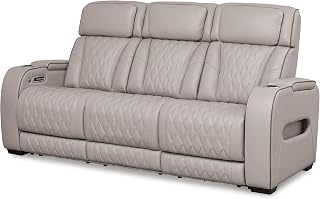
Manual Reclining Sofa Set, Light Brown
The lightest colorway of the group, and the one that keeps a small room feeling open rather than closed in. Sold as a set with overstuffed arms and a straightforward mechanism, it’s a sensible pick for a first apartment or a secondary den.
Frequently Asked Questions
Is manual better than power reclining?
Manual has fewer failure modes, no cords, no motor, no transformer, and typically costs less for comparable materials. Power wins on ease if mobility is a concern; otherwise manual is the more durable choice.
How much space do I need behind the sofa?
Budget 15 inches for a conventional recliner and about three for a wall-hugger. Always measure to the fully extended position, not the resting one.
Does faux leather actually last?
Three to five years in regular use is realistic before seam wear appears. It’s a reasonable trade for the price, but genuine leather is the better value across a decade.
Can one person assemble these?
Usually yes. Snap-on backs and pre-attached mechanisms mean most of the work is lifting, not building. A second person makes it faster and safer.
Final Thoughts
If you want a sofa that ages well and reads as a design decision, the ANJ genuine leather model in blue is the standout, with the dark brown genuine leather option as the more understated alternative. For small rooms and tight layouts, the Ashley Frohn’s wall-hugger profile makes it the practical winner regardless of budget.