Key takeaways
- Damp vs. wet rating: Damp-rated fans belong under a solid roof with no direct spray, which covers most porches, lanais, and garages. If rain reaches the ceiling, or you’re in coastal air, hold out for a wet-rated housing with sealed hardware and ABS or aluminum blades.
- Blade span matched to the bay: Measure the shortest wall of the space. Up to 10 feet, a 44 to 52-inch fan is right; 12 to 18 feet of covered depth justifies 60 to 72 inches. Oversizing a small porch creates noise and turbulence, not comfort.
- CFM over speed count: Airflow is the number that determines whether you feel cooler. Look for 5,000 CFM minimum on a mid-size patio and 8,000-plus for a large or breezeless one. Six speeds mean little if the top speed barely stirs the air.
- DC or BLDC motor: Brushless DC motors draw a fraction of the power of legacy AC units, run noticeably quieter, and offer reverse for winter circulation. They’re now standard on anything worth installing over a dining table.
- Light quality and control: Prioritize dimmable LEDs with selectable color temperature and memory recall so the fixture returns to your setting after a power blip. Decide upfront whether you want a remote only, a hardwired wall control, or app and voice integration.
What's inside
Covered porches and pergolas ask more of a ceiling fan than any room inside the house. Humidity swells wood blades, salt air pits cheap hardware, and a light kit that looked crisp in the showroom turns into a yellow glare bomb once the sun drops. Add the fact that most patios sit under a low soffit or an open rafter bay, and the shopping problem gets specific fast: you need real moisture resistance, enough airflow to move sticky air across an open space, and lighting that reads as ambient rather than institutional.
This guide narrows the field to six fans that actually earn a spot on an exterior ceiling in 2026, spanning a 72-inch aluminum workhorse for deep porches, warm solid-wood profiles that flatter timber and stucco, a plug-in caged option for renters, and a big-box classic that keeps showing up in well-built outdoor rooms. Below, you’ll find the shortlist, then a buying framework and short reviews of the top performers.
As an Amazon Associate we earn from qualifying purchases.



How to Choose a/an Outdoor Ceiling Fan With Lights (2026)
- Damp vs. wet rating: Damp-rated fans belong under a solid roof with no direct spray, which covers most porches, lanais, and garages. If rain reaches the ceiling, or you’re in coastal air, hold out for a wet-rated housing with sealed hardware and ABS or aluminum blades.
- Blade span matched to the bay: Measure the shortest wall of the space. Up to 10 feet, a 44 to 52-inch fan is right; 12 to 18 feet of covered depth justifies 60 to 72 inches. Oversizing a small porch creates noise and turbulence, not comfort.
- CFM over speed count: Airflow is the number that determines whether you feel cooler. Look for 5,000 CFM minimum on a mid-size patio and 8,000-plus for a large or breezeless one. Six speeds mean little if the top speed barely stirs the air.
- DC or BLDC motor: Brushless DC motors draw a fraction of the power of legacy AC units, run noticeably quieter, and offer reverse for winter circulation. They’re now standard on anything worth installing over a dining table.
- Light quality and control: Prioritize dimmable LEDs with selectable color temperature and memory recall so the fixture returns to your setting after a power blip. Decide upfront whether you want a remote only, a hardwired wall control, or app and voice integration.
The Best Outdoor Ceiling Fans With Lights (2026), Reviewed
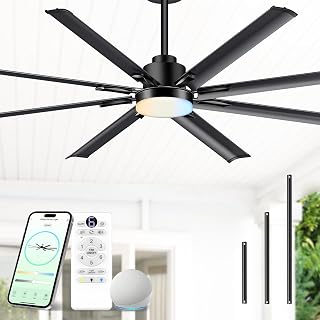
72″ Aluminum Outdoor Ceiling Fan, 8 Metal Blades
At 9,744 CFM from a quiet BLDC motor, this is the fan for deep porches, breezeways, and garages where a 52-inch unit simply can’t reach the perimeter. The eight-blade aluminum assembly and damp rating handle real weather, and Alexa control plus dimmable LED with memory make it surprisingly livable for something this industrial.
52″ Solid Wood Walnut Fan with Wall Control
Three sculpted walnut blades give this one a furniture-grade presence that suits timber-frame porches and farmhouse exteriors far better than painted metal. The DC motor is genuinely quiet across all six speeds, and the included wall control is a meaningful upgrade if you dislike hunting for a remote.
52″ Dark Walnut Propeller Ceiling Fan
A high-CFM propeller profile in a darker walnut finish, this fan reads well on covered decks with black window frames or bronze hardware. It moves more air than its slim silhouette suggests, making it a strong indoor-outdoor pick for open-plan spaces that flow onto a patio.
addlon 20″ IP65 Plug-In Caged Fan
The renter’s answer and the pergola solution: IP65 waterproofing, a hanging hook, and a standard plug mean no electrician and no junction box. The reversible DC motor, timer, and remote punch well above the 20-inch footprint for gazebos, balconies, and screened porches.
Harbor Breeze Merrimack II 52-in Matte Bronze
Five blades, a matte bronze finish, and a wet-rated build have kept this model in rotation for years, and the value still holds. It’s the safe specification when you need two or three matching fans across a long porch without a designer budget.
Frequently Asked Questions
Can I install an indoor ceiling fan on my porch?
No. Indoor fans use untreated motor housings and pressed-wood blades that corrode and warp in humidity, and the installation violates most electrical codes. Damp or wet rating is not a marketing tier, it’s a construction difference.
What’s the difference between damp-rated and wet-rated?
Damp-rated fans tolerate humidity and condensation but not direct water contact. Wet-rated fans are sealed for rain and spray, which is what you need on open pergolas, uncovered decks, and exposed coastal ceilings.
How low can the fan hang?
Keep blades at least seven feet above the finished floor and 18 inches from any wall or column. On a low soffit, a flush or hugger mount is the answer; on a vaulted rafter bay, add a downrod to bring blades into the eight to nine-foot sweet spot where airflow is felt.
Will a ceiling fan keep mosquitoes off the patio?
Partly. Moving air at higher speeds disrupts their flight and disperses the carbon dioxide they track, so a strong fan noticeably reduces landings without chemicals. It’s a helpful layer, not a replacement for screens.
Final Thoughts
For large covered spaces, the 72-inch aluminum fan is the clear performance choice and the only one here that fully conquers a deep porch. If the ceiling is part of the design story, the 52-inch solid wood walnut model with wall control delivers warmth and near-silent operation, while the matte black and gold 52-inch fan brings a sharper, more contemporary edge. Renters and pergola owners should go straight to the addlon 20-inch caged fan and skip the wiring entirely.