Key takeaways
- Damp vs. wet rating: Damp-rated fans need full overhead cover and protection from blowing rain. Wet-rated and IP65 models tolerate direct moisture, which is what you want on an open pergola, a screened porch with weather-exposed corners, or anywhere near a pool.
- Mounting reality: No ceiling junction box means a plug-in fan with a hanging hook is your path forward, and it installs in minutes with zero electrician. Hardwired downrod fans deliver better air movement and cleaner sightlines, but only where wiring already exists.
- Blade span to square footage: Roughly 20 inches suits a gazebo table or seating nook, 42 inches handles a small patio, and 48 to 52 inches covers a standard deep porch. Undersizing is the most common regret.
- DC motor and speed range: Reversible DC motors draw less power, run noticeably quieter, and usually offer six speeds instead of three. That low first speed matters for evening dining when you want air without a wind tunnel.
- Light quality and control: Look for selectable color temperature in the 3000K to 6000K range so the fixture can shift from warm entertaining light to task-bright. Remotes with timers are standard now and worth insisting on.
What's inside
Covered porches and pergolas sit in an odd design gap. They read as rooms, they get furnished like rooms, and then the air just sits there. Most buyers reach for the same fan they’d hang in a bedroom, discover the fine print about damp versus wet ratings, and end up with a fixture that rusts by the second summer or, worse, a downrod mount where no junction box exists. Outdoor spaces also rarely have hardwired ceiling wiring, which rules out half the catalog before styling even enters the conversation.
This guide sorts the current crop of outdoor ceiling fans with integrated light by how they actually install and where they belong. Plug-in caged models for gazebos and rentals, mid-size options for compact patios, and full 48 to 52 inch wet-rated fans for deep covered porches. Ratings, motor type, blade span, and finish durability are all weighed, so you can match the fixture to the structure instead of hoping for the best.
As an Amazon Associate we earn from qualifying purchases.


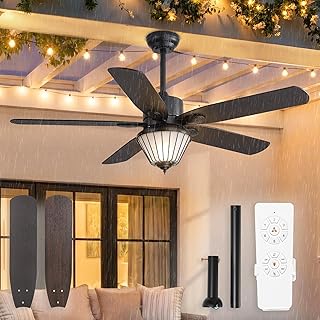
How to Choose an Outdoor Ceiling Fan With Light (2026)
- Damp vs. wet rating: Damp-rated fans need full overhead cover and protection from blowing rain. Wet-rated and IP65 models tolerate direct moisture, which is what you want on an open pergola, a screened porch with weather-exposed corners, or anywhere near a pool.
- Mounting reality: No ceiling junction box means a plug-in fan with a hanging hook is your path forward, and it installs in minutes with zero electrician. Hardwired downrod fans deliver better air movement and cleaner sightlines, but only where wiring already exists.
- Blade span to square footage: Roughly 20 inches suits a gazebo table or seating nook, 42 inches handles a small patio, and 48 to 52 inches covers a standard deep porch. Undersizing is the most common regret.
- DC motor and speed range: Reversible DC motors draw less power, run noticeably quieter, and usually offer six speeds instead of three. That low first speed matters for evening dining when you want air without a wind tunnel.
- Light quality and control: Look for selectable color temperature in the 3000K to 6000K range so the fixture can shift from warm entertaining light to task-bright. Remotes with timers are standard now and worth insisting on.
The Best Outdoor Ceiling Fans With Light (2026), Reviewed
addlon 20″ IP65 Caged Plug-In Fan
The most flexible entry here, with a hanging hook, plug-in cord, and IP65 sealing that lets it live on a gazebo frame or pergola beam without electrical work. Six speeds off a reversible DC motor plus a timer make it genuinely quiet at low settings, and the caged silhouette suits industrial and modern-rustic schemes equally.
LEDIARY 20″ IP65 Gazebo Fan
A close sibling to the addlon with the same install-anywhere logic, and a good pick if you want a slightly softer profile over an outdoor dining table. Best treated as a spot-cooling fixture for a defined zone rather than a whole-patio solution.
Harbor Breeze Merrimack II 52″ Matte Bronze
Five blades, a 52 inch span, and a matte bronze finish that reads warmer than black on cedar and stained wood ceilings. This is the traditional hardwired choice for a deep covered porch, and the included light kit keeps the ceiling plane uncluttered.
Westinghouse Oasis 48″ Bronze
Weather-resistant construction and restrained contemporary lines make the Oasis the most architecturally quiet option in this group. At 48 inches it fits porches where a 52 inch fan would crowd the perimeter, and Westinghouse’s finish durability is a known quantity.
Amico 42″ IP65 Waterproof Fan
The middle-ground pick, with a 42 inch span, six speeds, and 3000K to 6000K tunable light on a hook-and-plug install. Ideal for a pergola or garage bay that needs real air movement but has no ceiling box.
Frequently Asked Questions
Can I use an indoor ceiling fan outside if it’s fully covered?
No. Indoor fans use untreated metals and non-sealed electrical components that corrode in humid air, and doing so typically voids both the warranty and any insurance claim tied to the fixture.
What’s the difference between IP65 and wet-rated?
IP65 is an ingress protection standard covering dust and low-pressure water jets. Wet-rated is a UL listing for North American installation. Both signal direct-moisture tolerance, and many outdoor fans carry one or the other.
Do plug-in fans move enough air?
Within a defined zone, yes. A 20 inch caged fan cools a seating group or table effectively, but it will not condition an entire large patio the way a 52 inch fan does.
Should the fan run reverse in winter?
On an enclosed or heated porch, yes, since reverse mode pushes warm air down. On an open patio it makes little difference.
Final Thoughts
For hardwired covered porches, the Harbor Breeze Merrimack II and the Westinghouse Oasis are the two most livable choices, differing mostly in span and styling temperature. If your space has no ceiling wiring, the addlon 20 inch caged fan is the cleanest solution, with the Amico 42 inch stepping up when you need broader coverage.