Key takeaways
- Footprint before capacity: A 9-foot stand needs roughly 10 to 11 feet of clear length plus swing clearance at each end. Measure your patio’s usable span first, then shop — a space-saving frame that actually fits will get used far more than a larger one wedged into a corner.
- Read the load rating honestly: Treat listed capacity as a static maximum, not a target. For two adults who intend to move around, aim for 450 to 500 lbs so you are operating well under the ceiling. Also look at frame construction: powder-coated heavy-gauge steel with wide-set feet resists flex better than thin tubing with a high number printed on the box.
- Weave and bed material: Cotton rope breathes beautifully and drapes to the body, but it needs a pad or quilted layer to stop the diamond-pattern imprint. Solid polyester or quilted beds dry faster and resist mildew, making them the better choice in humid climates or anywhere the hammock stays out overnight.
- Stability hardware: The features that separate a relaxing hammock from a nervous one are unglamorous — anti-tip spreader bars, balance straps or ropes, and adjustable hang height. Balance ropes in particular reduce the side-to-side roll that makes two-person lounging feel precarious.
- Assembly and storage: Tool-free frames that lock together in ten to fifteen minutes are now standard, and a carrying bag matters more than it sounds. If you plan to move the hammock between deck, lawn, and garage, prioritize portability over maximum heft.
What's inside
Almost every hammock fantasy begins with two perfectly spaced trees, and almost every real backyard fails to provide them. Deck boards, patio pavers, balconies, gravel side yards, and rental courtyards all have the same problem: nothing to tie to. A hammock with its own stand removes that dependency entirely, but it introduces new ones — a steel frame that has to hold two adults without flexing, a footprint that has to coexist with your furniture, and a fabric bed that has to survive real sun and real weather rather than a product photo.
This guide focuses on freestanding double hammocks worth putting in a finished outdoor room. We look at load ratings and how they translate to actual two-person use, frame stability features like anti-tip spreader bars and balance straps, weave and pad quality, and how quickly each setup collapses into a bag when the season turns. Below are our current picks, followed by the criteria we used and short reviews of the standouts.
As an Amazon Associate we earn from qualifying purchases.



How to Choose an Outdoor Hammock With Stand (2026)
- Footprint before capacity: A 9-foot stand needs roughly 10 to 11 feet of clear length plus swing clearance at each end. Measure your patio’s usable span first, then shop — a space-saving frame that actually fits will get used far more than a larger one wedged into a corner.
- Read the load rating honestly: Treat listed capacity as a static maximum, not a target. For two adults who intend to move around, aim for 450 to 500 lbs so you are operating well under the ceiling. Also look at frame construction: powder-coated heavy-gauge steel with wide-set feet resists flex better than thin tubing with a high number printed on the box.
- Weave and bed material: Cotton rope breathes beautifully and drapes to the body, but it needs a pad or quilted layer to stop the diamond-pattern imprint. Solid polyester or quilted beds dry faster and resist mildew, making them the better choice in humid climates or anywhere the hammock stays out overnight.
- Stability hardware: The features that separate a relaxing hammock from a nervous one are unglamorous — anti-tip spreader bars, balance straps or ropes, and adjustable hang height. Balance ropes in particular reduce the side-to-side roll that makes two-person lounging feel precarious.
- Assembly and storage: Tool-free frames that lock together in ten to fifteen minutes are now standard, and a carrying bag matters more than it sounds. If you plan to move the hammock between deck, lawn, and garage, prioritize portability over maximum heft.
The Best Outdoor Hammocks With Stands (2026), Reviewed
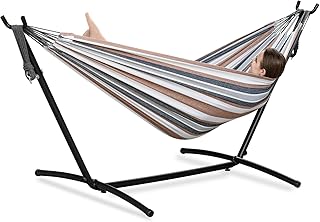
Double Cotton Rope Hammock with Stand and Carrying Bag (Dark Gray)
This is the classic look done properly: hand-woven cotton rope in a muted dark gray that reads as considered rather than kitschy, paired with a polyester pad that solves the rope-imprint problem most cotton hammocks ignore. The included carrying bag makes it a genuine three-season piece you can pack away rather than a fixture you have to design around.
Heavy-Duty Portable Double Hammock with Stand (Coffee)
A 450-lb rating on a 9-foot space-saving steel frame makes this the most apartment-friendly two-person option here — the compact footprint fits balconies and narrow patios where full-size stands simply will not go. Assembly is straightforward, and the coffee finish disappears against wood decking and warm-toned pavers.
ANAGOO Double Hammock with Stand, 500 lbs (White)
The 500-lb capacity and wide, stable steel base give this one the most reassuring feel underweight, and the included balance strap noticeably calms the roll when two people climb in at once. The white colorway is the sharpest architectural choice in this group, though it will ask more of you in terms of cleaning.
Portable Hammock with Stand and Sun-Protective Canopy (Beige)
The patent-pending canopy is the reason to choose this one: it turns an open patio into usable midday shade without committing to an umbrella or pergola. The beige palette keeps the whole assembly visually quiet, which matters when a canopy adds this much vertical mass to a small space.
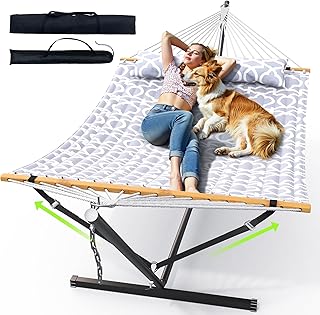
Portable Heavy-Duty Hammock with Balance Ropes (Dark Blue)
Balance ropes plus a soft pillow make this the most comfort-focused pick for solo afternoons and the steadiest for reading rather than napping. The dark blue holds its color well in direct sun, and the carrying bag means it stores flat through winter.
Frequently Asked Questions
Do hammock stands work on grass and uneven ground?
Yes, provided the ground is reasonably level. On soft turf, wide steel feet can sink slightly under load — laying pavers or thin boards under each foot keeps the frame from settling unevenly.
Can I leave a hammock with a stand outside year-round?
The powder-coated frames tolerate weather, but the fabric bed is the weak point. Cotton rope should come indoors after use or during long wet stretches; polyester and quilted beds handle exposure better. Either way, storing the hammock through winter meaningfully extends its life.
How much weight capacity do two people actually need?
Look for 450 lbs at minimum for regular two-person use, and 500 lbs if either occupant is larger or you expect kids to pile on. Staying comfortably below the rated maximum reduces frame flex and fabric stretch over time.
How long does assembly take, and do I need tools?
Most current stands are tool-free and take ten to fifteen minutes, largely spent aligning the main tubes. Having a second person on hand makes the final connection noticeably easier.
Final Thoughts
For most patios, the ANAGOO 500-lb Double Hammock is the safest all-around choice — the highest capacity here, a genuinely stable base, and a balance strap that earns its place. If square footage is tight, the Heavy-Duty Portable Double in coffee delivers real two-person comfort in a space-saving 9-foot frame, and if you are fighting afternoon sun, the beige canopy model solves shade and seating in a single purchase.