Key takeaways
- Stand or no stand: If you don’t have two solid trees 10 to 15 feet apart, buy the stand version. Retrofitting a stand later usually means discovering your hammock’s hardware doesn’t match the frame’s hook spacing, and you end up buying twice.
- Real weight capacity, not headline capacity: Ratings between 450 and 500 pounds are static numbers. Getting in and out creates dynamic load, so treat the rating as a ceiling with margin rather than a target. Two adults plus movement is where cheap welds show up.
- Spreader bar versus gathered end: Spreader bars give you a flat, sofa-like bed that’s easy to sit on and easier to tip. Gathered-end designs cocoon you, feel more stable, and are less photogenic. Pick the geometry that matches how you actually lie down.
- Fabric behavior in your climate: Cotton rope breathes beautifully and stains, sags, and mildews if it lives outside year-round. Polyester and quilted synthetics hold color and shed water. Nylon parachute fabric dries fastest and offers the least insulation.
- Footprint and portability: A 9-foot stand needs closer to 10 feet of clear ground. If you plan to move it between deck and lawn or store it in winter, prioritize tool-free assembly and a carrying bag you’ll genuinely use.
What's inside
Hammocks are one of the few pieces of outdoor furniture people buy on feeling and regret on logistics. The shopping experience rewards color swatches and lifestyle photos, then leaves out the parts that actually determine whether the thing gets used: whether you have two trees the right distance apart, whether the stand will sink into soft lawn, whether the spreader bar makes it tip when you sit down sideways, whether 450 pounds of stated capacity means one adult and a dog or two adults and a book. The result is a lot of hammocks folded in garages.
This guide sorts the current field by use case rather than by looks. We cover freestanding steel-frame models for patios and decks with no anchor points, quilted double beds for people who want the hammock to read as furniture, and packable nylon options for trips where weight matters more than plushness. For each pick, we note the honest tradeoff, because every hammock design gives something up.
As an Amazon Associate we earn from qualifying purchases.




How to Choose a/an Outdoor Hammock (2026)
- Stand or no stand: If you don’t have two solid trees 10 to 15 feet apart, buy the stand version. Retrofitting a stand later usually means discovering your hammock’s hardware doesn’t match the frame’s hook spacing, and you end up buying twice.
- Real weight capacity, not headline capacity: Ratings between 450 and 500 pounds are static numbers. Getting in and out creates dynamic load, so treat the rating as a ceiling with margin rather than a target. Two adults plus movement is where cheap welds show up.
- Spreader bar versus gathered end: Spreader bars give you a flat, sofa-like bed that’s easy to sit on and easier to tip. Gathered-end designs cocoon you, feel more stable, and are less photogenic. Pick the geometry that matches how you actually lie down.
- Fabric behavior in your climate: Cotton rope breathes beautifully and stains, sags, and mildews if it lives outside year-round. Polyester and quilted synthetics hold color and shed water. Nylon parachute fabric dries fastest and offers the least insulation.
- Footprint and portability: A 9-foot stand needs closer to 10 feet of clear ground. If you plan to move it between deck and lawn or store it in winter, prioritize tool-free assembly and a carrying bag you’ll genuinely use.
The Best Outdoor Hammocks of 2026, Reviewed
Portable Outdoor Hammock with Stand, Balance Ropes
The balance ropes are the detail worth paying for here: they meaningfully reduce the sideways lurch that makes spreader-bar hammocks feel precarious, which makes this a sound pick for anyone nervous about getting in and out. The dark blue fabric and included pillow read casual rather than designed, so it suits a working backyard more than a curated terrace.
Two Person Cotton Rope Hammock with Stand
Cotton rope with a polyester pad is the classic combination for a reason. Airflow through the weave keeps it cool in humid heat while the pad softens the rope grid, and the dark gray finish ages more gracefully than white. Plan on bringing it in during long wet stretches to protect the cotton.
Double Hammock with Stand for Outside, Coffee
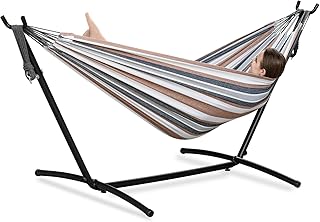
A 450-pound rating on a 9-foot space-saving steel frame makes this the most sensible choice for small patios where the stand has to disappear visually. Assembly is genuinely quick, and the coffee colorway is one of the few neutrals that doesn’t fight with wood decking or brick.
ANAGOO Double Hammock with Stand, White
At 500 pounds this has the highest capacity in the group, and the balance strap plus tool-free assembly make it the easiest two-person option to trust on day one. White is the design-forward call and the maintenance-heavy one, so choose it only if the hammock will be stored or covered rather than left under trees.
Sunnydaze Quilted Double Hammock, Mountainside
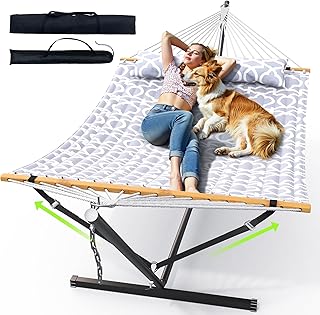
The quilted 74-by-55-inch bed is the most comfortable surface here and the closest thing to an outdoor daybed, with a matching pillow that stays put. No stand is included, so budget for one or confirm your anchor points before ordering.
Frequently Asked Questions
How far apart should my trees be?
Roughly 10 to 15 feet for most gathered-end hammocks, with the straps mounted about 5 to 6 feet up. Aim for a sag that forms a shallow curve rather than a taut line; taut hammocks squeeze your shoulders.
Can I leave a hammock outside all season?
Synthetic and quilted polyester models tolerate it best, though UV exposure still fades fabric over a few summers. Cotton rope should come in when rain is forecast for days. Steel stands last longer with a cover at the joints, where powder coating chips first.
Is a double hammock actually comfortable for two people?
For lounging, yes, especially spreader-bar designs with a wide bed. For sleeping, most couples find one person ends up rolling toward the center. If two-person sleeping is the goal, look at bed width first and capacity second.
Do I need a hammock stand if I’m camping?
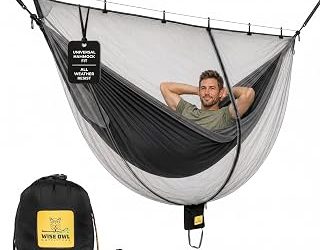
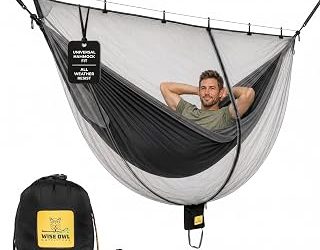
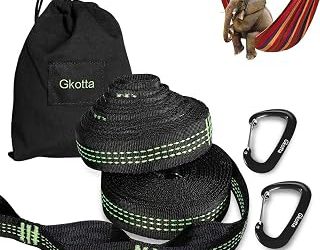
No, and it defeats the purpose. A lightweight parachute hammock with tree straps packs down small and sets up in minutes, which is exactly what the Camping Hammock Lightweight with Two Tree Straps is built for. Add an underquilt or pad for cool nights, since nylon offers no insulation.
Final Thoughts
For most buyers with a patio and no trees, the ANAGOO Double Hammock with Stand is the safest all-round choice thanks to its 500-pound rating and tool-free setup. If comfort is the deciding factor and you already have anchor points or a stand, the Sunnydaze Quilted Double is the nicest place to spend an afternoon, while the Camping Hammock Lightweight remains the obvious pick for travel and trailheads.