Key takeaways
- Roof type: Adjustable louvers give you sun, shade, and full rain cover from one structure. Hardtops are the simplest all-weather option. Slatted wood trellises filter light beautifully but will not keep a table dry.
- Post thickness and frame: Post dimension tells you more than material alone. Look for aluminum uprights in the 3.5″–4″ range, reinforced steel roof members, and cedar posts sized for permanent installation rather than seasonal setup.
- Footprint versus furniture: Measure your seating group, then add three feet of circulation on every side. A 10′ x 13′ shelters a dining set for six; sectionals and outdoor kitchens want 12′ x 16′ or larger.
- Water management: Integrated gutters and in-post downspouts route runoff away from your deck instead of onto it. This single feature separates structures you use in shoulder season from ones you abandon.
- Anchoring and assembly: Confirm the hardware suits your surface — concrete, wood deck, or pavers — and read the assembly claims honestly. Wood pavilions above 16 feet generally warrant professional installation.
What's inside
A pergola is one of the few backyard purchases that changes how you use the space rather than just how it looks. The problem is that the category has quietly split into three very different products that all share the same name: fixed-slat wood structures that filter light, hardtop gazebos that behave like a small roof, and motorized louvered systems that let you dial the sky open or closed. Shoppers comparing a cedar trellis against an aluminum louvered frame are not comparing competitors — they are comparing two separate answers to the question of what shade should do.
This guide sorts the 2026 field by that logic. Each pick below is evaluated on roof behavior, post and frame substance, drainage, realistic assembly effort, and how the footprint maps onto actual furniture layouts. Sizes span a compact 10′ x 12′ deck cover through a 20′ x 20′ pavilion, with both powder-coated aluminum and rot-resistant cedar represented so the recommendation matches the architecture it sits beside.
As an Amazon Associate we earn from qualifying purchases.


How to Choose a Outdoor Pergola (2026)
- Roof type: Adjustable louvers give you sun, shade, and full rain cover from one structure. Hardtops are the simplest all-weather option. Slatted wood trellises filter light beautifully but will not keep a table dry.
- Post thickness and frame: Post dimension tells you more than material alone. Look for aluminum uprights in the 3.5″–4″ range, reinforced steel roof members, and cedar posts sized for permanent installation rather than seasonal setup.
- Footprint versus furniture: Measure your seating group, then add three feet of circulation on every side. A 10′ x 13′ shelters a dining set for six; sectionals and outdoor kitchens want 12′ x 16′ or larger.
- Water management: Integrated gutters and in-post downspouts route runoff away from your deck instead of onto it. This single feature separates structures you use in shoulder season from ones you abandon.
- Anchoring and assembly: Confirm the hardware suits your surface — concrete, wood deck, or pavers — and read the assembly claims honestly. Wood pavilions above 16 feet generally warrant professional installation.
The Best Outdoor Pergolas (2026) Reviewed
Louvered Pergola 10′ x 13′ Aluminum with Reinforced Steel Roof
The most sensible entry point into louvered shade: the steel-reinforced roof holds its geometry under snow load, and the 10′ x 13′ footprint sits comfortably over a six-seat dining setup without swallowing a mid-sized patio. Gray powder coat reads as neutral against brick, siding, and composite decking alike.
Jocisland 20′ x 20′ Cedar Wood Gazebo
This is a pavilion, not a patio accessory — 400 square feet under a sloped galvanized steel roof, framed in rot-resistant cedar that weathers into a genuinely architectural presence. Budget for a proper foundation and installation help, and it functions as a permanent outdoor room.
Aoxun Louvered Pergola 10′ x 16′
The 3.8″ thickened posts and built-in drainage put this in a heavier structural class than its price suggests, and the patented assembly system meaningfully reduces the two-weekend build most louvered kits demand. The narrow-and-long proportion works well along a house wall or beside a pool.
12′ x 16′ Louvered Pergola with Curtains and Netting
The most complete package here: adjustable louvers, an integrated gutter system, and both privacy curtains and insect netting included rather than sold as add-ons. At 192 square feet it holds a sectional plus a dining table, and the dark gray frame flatters contemporary exteriors.
10′ x 12′ Hardtop Gazebo, Brown
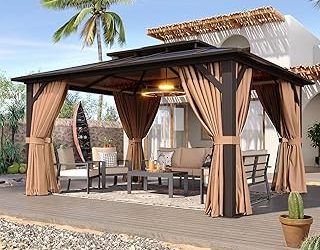
A double galvanized steel roof delivers real weather protection and better heat performance than single-layer hardtops, and the compact footprint suits smaller yards and townhome decks. Curtains and netting make it usable through mosquito season.
Frequently Asked Questions
Do louvered pergolas actually keep rain out?
Yes, when closed. Quality systems seal along the louver edges and channel water into perimeter gutters and hollow posts. Look explicitly for a drainage system in the specifications — louvers alone will drip.
Aluminum or cedar?
Aluminum wins on maintenance, span, and adjustable roof options. Cedar wins on warmth and how it ages, and suits traditional or garden-forward properties. Cedar needs sealing every few years; aluminum needs washing.
Can these be installed on a wood deck?
Most can, provided the deck framing can carry the load and you anchor into joists or blocking rather than decking boards alone. Larger pavilions typically require footings.
How much assembly help do I need?
Plan on two people and a full day for a 10′ x 13′ aluminum pergola. Larger louvered models and any cedar pavilion over 16 feet realistically need three people or a contractor.
Final Thoughts
For most homeowners, the 12′ x 16′ louvered pergola with curtains and netting is the strongest all-round choice — it covers the full range of shade, rain, and bug conditions in one structure. The Aoxun 10′ x 16′ is the value pick thanks to its thickened posts and manageable build, while the Jocisland 20′ x 20′ cedar gazebo is the one to specify when you want permanent architecture rather than patio furniture.