Key takeaways
- Measure your awning shade, not your rig: The rug should stop roughly where the awning’s shadow does. A 9×12 suits most travel trailers and Class C awnings; 9×18 is for long fifth-wheel setups or a rug-plus-seating zone. Compact vans, teardrops and balcony landings do better with a 5×8 or 4×6.
- Insist on breathable, reversible weave: Woven polypropylene straw lets air and water pass through, so the grass underneath survives and the underside dries fast. Reversible patterns also double your look and let you flip away a stain until laundry day.
- Check UV treatment before color: Untreated plastic chalks and goes brittle after one desert summer. UV-stabilized fibers hold saturation far longer, which matters most with deep greys, browns and blues.
- Plan for wind and storage: Look for corner grommets or reinforced edges you can stake, plus an included carry bag. A rug that folds cleanly into its own tote gets used; one that doesn’t ends up crumpled in the bed of the truck.
- Match the pattern to your palette: Wave and boho geometrics in grey read modern and hide dirt well. Warm leaf and brown motifs sit better against wood decks and canvas awnings. Choose the one you’d tolerate looking at for a hundred nights.
What's inside
The patch of ground outside a camper door is the hardest-working square footage in any campsite. It collects pine needles, wet sand, spilled coffee and dog paws, then bakes in the afternoon sun until whatever you’ve laid down there starts to warp, fade or smell like a wet tent. Most people solve it twice: once with a cheap mat that shreds by the second season, and again with something they actually researched.
This guide is the second purchase. I’ve focused on reversible plastic straw and polypropylene weaves, the format that has quietly become the standard for awning space because it sheds water instead of holding it, hoses clean in about ninety seconds, and folds into a bag small enough to live in an exterior compartment. Below you’ll find sizes from a tidy 4×6 to a full 9×18 patio footprint, with notes on where each one earns its keep.
As an Amazon Associate we earn from qualifying purchases.



How to Choose a Outdoor Rug For Camper (2026)
- Measure your awning shade, not your rig: The rug should stop roughly where the awning’s shadow does. A 9×12 suits most travel trailers and Class C awnings; 9×18 is for long fifth-wheel setups or a rug-plus-seating zone. Compact vans, teardrops and balcony landings do better with a 5×8 or 4×6.
- Insist on breathable, reversible weave: Woven polypropylene straw lets air and water pass through, so the grass underneath survives and the underside dries fast. Reversible patterns also double your look and let you flip away a stain until laundry day.
- Check UV treatment before color: Untreated plastic chalks and goes brittle after one desert summer. UV-stabilized fibers hold saturation far longer, which matters most with deep greys, browns and blues.
- Plan for wind and storage: Look for corner grommets or reinforced edges you can stake, plus an included carry bag. A rug that folds cleanly into its own tote gets used; one that doesn’t ends up crumpled in the bed of the truck.
- Match the pattern to your palette: Wave and boho geometrics in grey read modern and hide dirt well. Warm leaf and brown motifs sit better against wood decks and canvas awnings. Choose the one you’d tolerate looking at for a hundred nights.
The Best Outdoor Rug For Camper (2026)s Reviewed
fifame 9×18 Outdoor Woven Patio Mat
At 9×18 this is less a rug than an outdoor room: enough coverage for a full awning run plus chairs, a grill mat zone and a dog bed without crowding. It’s the pick for long-stay campers and snowbirds who essentially build a patio, though it’s genuinely large, so confirm your site pad can take it.
Kohree Wave 9×12 Outdoor Rug
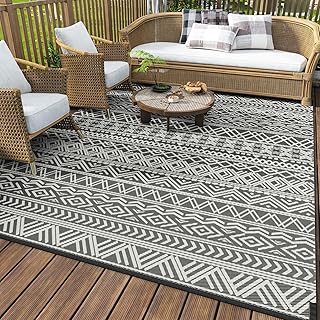
The grey and white wave pattern is the most design-forward option here, closer to a coastal indoor flatweave than typical campground plastic, and the non-slip weave stays put on decking. If you want your setup to photograph well and still hose off, this is the one.
FACOYANS 9×12 “Home Is Where We Park It” Camper Mat
Same generous 9×12 footprint with a bit of personality, and it ships with a carry bag that actually fits the rug back inside after a season of use. The UV-resistant straw weave held color well through repeated sun exposure, making it a solid all-round travel trailer choice.
Pauwer 5×8 Waterproof Patio Rug, Leaf Brown
The warm brown leaf motif is a natural fit for wood decks, campfire circles and anyone tired of grey. At 5×8 it’s ideal as a doorway landing pad or for van and teardrop setups where space is measured in inches.
MontVoo 5×8 Reversible Boho Grey Rug
A compact, quietly stylish option with a boho geometric on one face and a cleaner reverse side, so it transitions easily from campsite to balcony to beach day. Lightweight enough to shake out one-handed, which you’ll appreciate more than you expect.
Frequently Asked Questions
Will an outdoor camper rug kill the grass underneath?
Woven straw mats are breathable, so short stays are fine. Many campgrounds require this style specifically. For stays beyond a week, lift and shift the rug every few days.
How do I clean it?
Shake it out, then hose it down and scrub stubborn spots with mild soap and a soft brush. Hang or drape it to dry fully before folding, since trapped moisture is what causes odor.
Is 4×6 ever big enough?
Yes. A 4×6 waterproof patio rug works well as a boot-and-step landing zone for small campers, balconies and porch decks where a full patio mat would overwhelm the space.
How do I keep it from blowing away?
Stake the corners with rug pegs and weight the edges with chair legs or a storage bin. Roll it up on windy nights rather than trusting stakes alone.
Final Thoughts
For most travel trailers, the Kohree Wave 9×12 hits the sweet spot of size, grip and genuinely good looks, while the FACOYANS 9×12 is the value-minded alternative with a carry bag that holds up. If your site is long and you’re staying a while, size up to the fifame 9×18 and treat it like the patio it is.