Key takeaways
- Toilet clearance: Measure from the floor to the highest point of your tank, then add a few inches of breathing room for lifting the lid. Most units land between 33″ and 34″ of clearance, and an adjustable crossbar buys you flexibility if your toilet sits taller than average.
- Interior width and depth: Check that the opening clears your tank and any side-mounted flush handle. Depth matters just as much in a narrow room, since anything past 9″ starts crowding the walkway between the toilet and the door.
- Anti-tip hardware: These cabinets are tall, shallow, and light, which is exactly the profile that tips forward when a drawer is pulled or a child grabs a shelf. Every pick here ships with a wall bracket, and it should go in the wall on day one.
- Open versus closed storage: Doors hide the unglamorous inventory, but open shelving keeps towels ventilated and daily items reachable. A mix of both is the practical sweet spot for shared bathrooms.
- Material and finish: Look for FSC-certified MDF with a sealed laminate or painted finish rather than raw particleboard, and wipe down splashes rather than letting them sit. Solid wood and oak veneer read warmer, though they ask for a little more care near a shower.
What's inside
The space above a toilet is the most consistently wasted real estate in a home. It sits at eye level in a room people visit a dozen times a day, and in most bathrooms it holds nothing but a stretch of paint and maybe a lonely air freshener. Meanwhile the vanity is overflowing, backup toilet paper lives in a shopping bag on the floor, and the tank lid has become a shelf for whatever did not fit anywhere else. It is a storage problem disguised as a decorating problem.
An over-the-toilet cabinet fixes both at once, but the category has gotten crowded and the specs that actually matter are easy to miss. This guide breaks down the measurements to check before you order, the difference between closed and open storage in a humid room, and why anti-tip hardware is non-negotiable. Then we walk through the standouts for 2026, from clean beadboard shapes to the arched silhouettes currently defining the look of a well-considered small bath.
As an Amazon Associate we earn from qualifying purchases.


How to Choose an Over The Toilet Storage Cabinet (2026)
- Toilet clearance: Measure from the floor to the highest point of your tank, then add a few inches of breathing room for lifting the lid. Most units land between 33″ and 34″ of clearance, and an adjustable crossbar buys you flexibility if your toilet sits taller than average.
- Interior width and depth: Check that the opening clears your tank and any side-mounted flush handle. Depth matters just as much in a narrow room, since anything past 9″ starts crowding the walkway between the toilet and the door.
- Anti-tip hardware: These cabinets are tall, shallow, and light, which is exactly the profile that tips forward when a drawer is pulled or a child grabs a shelf. Every pick here ships with a wall bracket, and it should go in the wall on day one.
- Open versus closed storage: Doors hide the unglamorous inventory, but open shelving keeps towels ventilated and daily items reachable. A mix of both is the practical sweet spot for shared bathrooms.
- Material and finish: Look for FSC-certified MDF with a sealed laminate or painted finish rather than raw particleboard, and wipe down splashes rather than letting them sit. Solid wood and oak veneer read warmer, though they ask for a little more care near a shower.
The Best Over The Toilet Storage Cabinets (2026), Reviewed
Spirich Over The Toilet Storage Cabinet with Doors
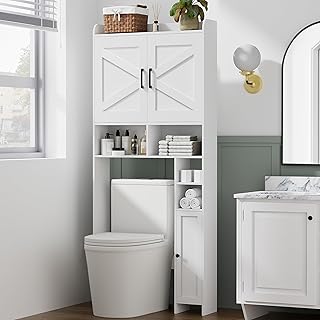
The beadboard doors give this one a quiet architectural quality that flatters both cottage and transitional bathrooms, and the 33.3″ clearance plus adjustable crossbar means it fits over most standard tanks without modification. It remains the most reliable all-rounder in the category: closed storage below, open display above, and hardware that inspires confidence.
UTEX Over The Toilet Storage Cabinet
UTEX splits the difference between hidden and open storage more evenly than most, with adjustable shelves behind the doors and a generous 34″ of clearance for taller toilets. The flat white front is deliberately anonymous, which is a virtue if you want the cabinet to disappear into the wall rather than announce itself.
Spurgehom Arch Over Toilet Storage Cabinet
The arched profile is the single most effective way to make a functional bathroom cabinet look intentional, and Spurgehom executes the curve cleanly in a warm wood tone. Best suited to bathrooms where the cabinet is a visible focal point rather than a utility piece tucked behind a door.
Extra Tall Over The Toilet Cabinet with 4 Open Shelves and 2 Barn Doors
This is the volume champion: four open shelves stacked above a barn-door cabinet, engineered for people who need genuine capacity rather than a decorative accent. The extra height pays off in rooms with tall ceilings, and it earns its keep in a laundry area just as easily as a bathroom.
IFGET Arched Cabinet with Acrylic Doors
Fluted acrylic doors over natural oak is the most current-looking combination on this list, diffusing what is behind the glass so contents read as texture instead of clutter. It is a smaller-scale piece, so treat it as a design gesture with useful storage attached rather than a bulk solution.
Frequently Asked Questions
Do I really need to anchor it to the wall?
Yes. Tall, shallow furniture tips forward under very little provocation, and the included anti-tip bracket takes about five minutes to install. If you are renting, a small anchor hole is far easier to patch than a tipped cabinet is to explain.
How do I know it will clear my toilet?
Measure floor-to-tank-top and the widest point of your tank, including the flush handle, before ordering. Compare those numbers against the listed clearance, and favor models with an adjustable crossbar if your measurements are close to the limit.
Will bathroom humidity ruin the finish?
Sealed MDF and laminate handle everyday steam well provided you run an exhaust fan and wipe standing water off horizontal surfaces. Unsealed edges and raw wood are where moisture damage typically starts, so avoid installing directly adjacent to a shower spray zone.
How difficult is assembly?
Expect 45 to 90 minutes with a screwdriver, and plan to assemble the unit outside the bathroom before walking it into place. A second set of hands helps considerably when squaring the frame and hanging doors.
Final Thoughts
For most bathrooms, the Spirich cabinet is the safest pick, balancing generous closed storage, forgiving clearance, and a finish that suits nearly any palette. Choose the IFGET arched cabinet if the room deserves a piece with real design presence, and go with the extra-tall barn-door unit when sheer capacity is the point. The Homhedy barn-door cabinet is worth a look too if a farmhouse read and an integrated paper holder line up with your space.