Key takeaways
- Measure the swing, not just the slab: Map your usable area after accounting for door clearance, grill space, and a walking path. Rockers and gliders need six to eight inches of rear travel, so subtract that from any wall-adjacent placement before you order.
- Match the frame to your climate: Powder-coated steel handles wind well and resists tipping, while PE rattan over an aluminum or steel core stays lighter and shrugs off humidity. In coastal or high-salt environments, look for coated hardware and check whether replacement feet are available.
- Decide whether you want motion: Rocking frames add genuine comfort on a porch or balcony but consume more depth and cannot be pushed flush against a railing. Static chairs tuck tighter and stack more reliably if storage is a concern.
- Prioritize a table that earns its footprint: A tempered glass or slatted top around 15 to 20 inches wide holds two drinks and a plate without blocking your path. Folding tables are worth the small stability trade-off if you host or need the space cleared seasonally.
- Read the fabric, not the color: Textilene and other open-weave slings dry fast and skip cushion storage entirely. Olefin or polyester cushions are more comfortable but need a dry spot between rains, so plan for a bin or hook nearby.
What's inside
Small outdoor spaces punish guesswork. A balcony that measures five by eight feet, a townhouse patio hemmed in by a fence, a landing barely wide enough for a door swing — these are the spaces most furniture is not designed for. Walk through any outdoor showroom and you will find deep-seated sectionals and eight-person dining tables scaled for a suburban deck, then a thin afterthought of “apartment-friendly” pieces that either feel like folding cafeteria chairs or swallow the entire floor once assembled. The result is a familiar frustration: buyers order something that looked compact in a listing photo, then discover the sliding door no longer opens.
This guide takes the opposite approach and starts from the constraint. Every set below is a three-piece configuration — two chairs and a table — chosen because that layout gives you real seating for two without the circulation problems a larger group brings. We looked at frame construction, actual seat dimensions rather than shipping-box measurements, how each set handles rain and sun, and whether it can be moved, stacked, or folded when you need the floor back. What follows are the picks worth your money in 2026, plus the specifications that matter before you commit.
As an Amazon Associate we earn from qualifying purchases.



How to Choose a Patio Furniture For Small Spaces (2026)
- Measure the swing, not just the slab: Map your usable area after accounting for door clearance, grill space, and a walking path. Rockers and gliders need six to eight inches of rear travel, so subtract that from any wall-adjacent placement before you order.
- Match the frame to your climate: Powder-coated steel handles wind well and resists tipping, while PE rattan over an aluminum or steel core stays lighter and shrugs off humidity. In coastal or high-salt environments, look for coated hardware and check whether replacement feet are available.
- Decide whether you want motion: Rocking frames add genuine comfort on a porch or balcony but consume more depth and cannot be pushed flush against a railing. Static chairs tuck tighter and stack more reliably if storage is a concern.
- Prioritize a table that earns its footprint: A tempered glass or slatted top around 15 to 20 inches wide holds two drinks and a plate without blocking your path. Folding tables are worth the small stability trade-off if you host or need the space cleared seasonally.
- Read the fabric, not the color: Textilene and other open-weave slings dry fast and skip cushion storage entirely. Olefin or polyester cushions are more comfortable but need a dry spot between rains, so plan for a bin or hook nearby.
The Best Patio Furniture For Small Spaces Reviewed
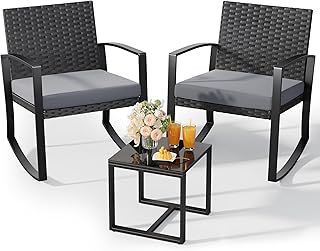
Qsun 3-Piece Rocking Bistro Set
The rattan weave and generous grey cushions give this set a living-room softness that most balcony furniture never reaches, and the rocking frames are smooth rather than springy. Reserve it for spaces with at least eight inches of clearance behind each chair, and give yourself a plan for stashing the cushions during long rain stretches.
Shintenchi 3-Piece Textilene Rocking Set
Textilene sling seating is the low-maintenance answer here: it drains immediately after a storm, stays cooler in direct sun, and eliminates cushion storage altogether. The black frame reads sharp against brick or pale siding, making this the practical choice for a front porch that gets weather without much cover.
Grand Patio 3-Piece Folding Bistro Set
This is the pick for spaces that need to change function — the steel table and chairs fold flat and lean against a wall in seconds, freeing a small balcony for anything else. Expect a firmer, more European café sit than the cushioned sets, which is exactly the trade for that recoverable floor space.
Murago 3-Piece Wicker Bistro Set
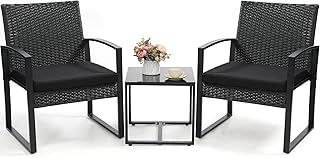
An all-black frame and cushion combination gives this conversation set a quietly architectural look that flatters modern exteriors and hides the dust that pale wicker shows within a week. The compact coffee table sits low enough to keep sightlines open, which makes the whole arrangement feel larger than its footprint.
Devoko 3-Piece Wicker Conversation Set
The brown PE rattan brings warmth that grey and black sets cannot, and the pieces are light enough for one person to rearrange or bring inside before a storm. It is a strong value choice for a covered balcony or shaded yard corner where UV exposure stays moderate.
Frequently Asked Questions
How much space does a three-piece bistro set actually need?
Plan on roughly five by five feet for a static set and closer to five by seven for rockers, including rear travel and a path to walk through. If your balcony is under 30 square feet, prioritize folding pieces or a single chair with a side table instead.
Can I leave these sets outside all year?
The frames handle year-round exposure far better than the textiles. Cushions should come inside or under a cover during extended wet weather and winter, while textilene sling seats and steel or PE rattan frames tolerate the seasons with occasional cleaning.
Do rocking chairs work on a balcony?
They do, provided the deck surface is level and you have clearance behind each chair. On uneven pavers or tile, a static frame will feel more stable and quieter for neighbors below.
How do I keep lightweight furniture from blowing over?
Position chairs so the railing or wall breaks prevailing wind, and store cushions when you are away since they act like sails. Adhesive furniture pads or a weighted planter placed against the table base add stability without permanent installation.
Final Thoughts
For most small patios, the Qsun rocking bistro set delivers the best balance of comfort and compact geometry, with cushions plush enough to make an eight-foot balcony feel like a room. If your space sees real weather and you would rather not manage cushions, the Shintenchi textilene set is the low-effort pick, and the Grand Patio folding set remains unmatched when the floor needs to do double duty.