Key takeaways
- Material and gauge: Steel is the only material worth buying now. It carries 40 to 100+ lbs per panel, won’t bow in humidity, and keeps crisp edges. Hardboard chips at the hole and telegraphs every heavy tool.
- Hole size: Confirm 1/8″ versus 1/4″ before you buy a single hook. Quarter-inch grids dominate metal systems and accept the widest range of third-party accessories; eighth-inch is largely a legacy hardboard spec.
- Panel format: Multi-panel packs (four to six tiles) let you wrap corners, skip studs, and expand later. Single large boards look cleaner but demand a wide uninterrupted wall and a second pair of hands.
- Mounting depth: Hooks need clearance behind the board. Look for integrated standoffs or included spacers — and check that drywall anchors ship in the box, since most failures trace back to substituted hardware.
- Finish and visual weight: Matte black recedes against dark paint and reads as intentional; it also hides scuffs. In lighter rooms, treat the board as a graphic element and leave breathing room rather than filling every hole.
What's inside
Wall space is the last honest storage frontier in a home. Closets fill, drawers jam, and bins stack into towers nobody wants to dismantle — meanwhile the vertical plane above a workbench, desk, or counter sits empty. Pegboard solves this, but the category has quietly split in two: flimsy hardboard sheets that sag under a cordless drill, and powder-coated steel panels that behave like real architecture. Buyers keep getting burned by the first kind, then assume pegboard itself is the problem.
This guide looks at the panels worth mounting in 2026, judged the way a designer would judge them: gauge and rigidity, how the mounting hardware reads on a finished wall, whether the hook system is standardized or proprietary, and how the grid looks when it’s only half-loaded. Below you’ll find modular steel kits for garages, refined systems for studios and offices, and one accessory haul that rescues a board you already own.
As an Amazon Associate we earn from qualifying purchases.


How to Choose a Pegboard (2026)
- Material and gauge: Steel is the only material worth buying now. It carries 40 to 100+ lbs per panel, won’t bow in humidity, and keeps crisp edges. Hardboard chips at the hole and telegraphs every heavy tool.
- Hole size: Confirm 1/8″ versus 1/4″ before you buy a single hook. Quarter-inch grids dominate metal systems and accept the widest range of third-party accessories; eighth-inch is largely a legacy hardboard spec.
- Panel format: Multi-panel packs (four to six tiles) let you wrap corners, skip studs, and expand later. Single large boards look cleaner but demand a wide uninterrupted wall and a second pair of hands.
- Mounting depth: Hooks need clearance behind the board. Look for integrated standoffs or included spacers — and check that drywall anchors ship in the box, since most failures trace back to substituted hardware.
- Finish and visual weight: Matte black recedes against dark paint and reads as intentional; it also hides scuffs. In lighter rooms, treat the board as a graphic element and leave breathing room rather than filling every hole.
The Best Pegboards (2026) Reviewed
Spampur 4-Pack Metal Pegboard with 50 Hooks
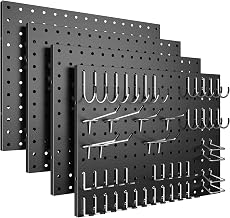
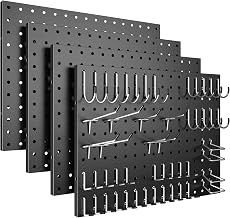
The most complete entry point in the category: four steel tiles plus a fifty-piece hook assortment, so the wall is functional the afternoon it goes up. Tiles butt together cleanly for a continuous grid, and Spampur also sells a bare-panel version of the same four-pack if you’ve already got hooks and would rather not pay twice.
Wall Control 4 ft. Metal Pegboard Tool Storage Kit
This is the reference standard, and the price reflects real engineering — formed steel with rolled edges, a slot-and-hole hybrid grid, and accessories that lock rather than rattle loose when you pull a wrench. If the wall is visible from a living space or you’re building something you won’t touch again for a decade, buy this one.
PBHEPJ 6 Pcs Metal Pegboard Panels
Six heavy-duty panels with anchors and screws included, which makes it the value pick for covering a large garage or utility wall in one pass. Hooks are sold separately, so budget for those — but the extra coverage per dollar is hard to beat.
INCLY 48×36 Inch Metal Pegboard Kit
A genuine turnkey system: six panels forming a 48×36 field, paired with 234 hooks, bins, and holders on a 1/4″ grid. It’s the closest thing here to a designed wall rather than an assembled one, and it suits a workbench zone where everything should have a dedicated home.
INCLY 278PCS Pegboard Accessories Kit
Not a board — a rescue kit. If your existing pegboard is underused because you only own a dozen mismatched hooks, this 278-piece assortment of hooks and bins fits both 1/8″ and 1/4″ grids and transforms capacity overnight.
Frequently Asked Questions
How much weight can a metal pegboard hold?
Quality steel panels typically handle 40 to 100 lbs each, but the anchors are the real limit. Hit studs where you can, and use the supplied toggle or expansion anchors everywhere else.
Can I install pegboard on drywall without studs?
Yes, with proper drywall anchors — most kits include them. Spread the load across at least four fixing points per panel and keep the heaviest items low and near a fastener.
Will hooks from one brand fit another brand’s board?
Usually, if the hole size and spacing match. Wall Control’s hybrid slot system is the notable exception and works best with its own accessories.
Does pegboard belong anywhere besides a garage?
Absolutely. Matte black grids look sharp in craft rooms, home offices, pantries, and entryways — the trick is restraint. Load it to about two-thirds and it reads as design, not storage.
Final Thoughts
For a finished, long-term wall, the Wall Control 4 ft. kit remains the benchmark and is worth its premium. If you want maximum function on day one, the INCLY 48×36 kit delivers a complete system in a single box, while the Spampur 4-pack with 50 hooks is the smartest low-risk way to find out how much wall storage you actually need.