Key takeaways
- Footprint before style: Measure the furniture you plan to put under it, then add three feet of clearance on every side. A 10×12 comfortably holds a six-seat dining set; anything smaller starts to feel like a carport. Chalk the outline on the ground and live with it for a day.
- Complete kit vs. bracket kit: Full kits arrive pre-cut, pre-drilled, and pre-stained, which removes almost all guesswork. Bracket kits cost a fraction of the price but require you to source, cut, and finish your own 4×4 lumber. Choose brackets only if you’re comfortable making square cuts.
- Wood species and finish: Cedar remains the benchmark for outdoor structures because its natural oils resist rot and insects without chemical treatment. Expect the tone to silver over time unless you re-seal every two to three years, which is a design decision more than a maintenance one.
- Wind and snow ratings: Manufacturers publish load figures for a reason. If you’re in a region with real winters or coastal gusts, look for documented high-wind engineering and plan on anchoring into concrete rather than relying on ground stakes.
- Anchoring method: Stakes work on level lawn. Decks, pavers, and slabs need post bases, and a bracket kit that includes them saves a second shopping trip. This is the single most common source of post-installation wobble.
What's inside
A pergola is the rare backyard purchase that changes how a space feels before it changes how it functions. It draws a ceiling where there wasn’t one, gives a patio edges, and turns an anonymous stretch of lawn into somewhere you’d actually carry a plate of food. The trouble is that the category has quietly split in two. On one side sit full cedar kits shipped as numbered lumber bundles. On the other, bare bracket systems that assume you’ll buy your own posts at a lumberyard. Buyers land somewhere in the middle, comparing a $1,400 structure against a $120 box of steel connectors and wondering why the listings look so similar.
This guide sorts that out. Below are the pergola kits worth considering in 2026, spanning finished cedar structures in the 10×12 to 12×16 range and the hardware-only kits that make sense if you already own a saw and a level. Each pick is assessed on what actually matters after installation day: how the roof handles weather load, whether the joinery stays tight through a freeze-thaw cycle, and how the proportions read once furniture goes underneath.
As an Amazon Associate we earn from qualifying purchases.


How to Choose a Pergola Kit (2026)
- Footprint before style: Measure the furniture you plan to put under it, then add three feet of clearance on every side. A 10×12 comfortably holds a six-seat dining set; anything smaller starts to feel like a carport. Chalk the outline on the ground and live with it for a day.
- Complete kit vs. bracket kit: Full kits arrive pre-cut, pre-drilled, and pre-stained, which removes almost all guesswork. Bracket kits cost a fraction of the price but require you to source, cut, and finish your own 4×4 lumber. Choose brackets only if you’re comfortable making square cuts.
- Wood species and finish: Cedar remains the benchmark for outdoor structures because its natural oils resist rot and insects without chemical treatment. Expect the tone to silver over time unless you re-seal every two to three years, which is a design decision more than a maintenance one.
- Wind and snow ratings: Manufacturers publish load figures for a reason. If you’re in a region with real winters or coastal gusts, look for documented high-wind engineering and plan on anchoring into concrete rather than relying on ground stakes.
- Anchoring method: Stakes work on level lawn. Decks, pavers, and slabs need post bases, and a bracket kit that includes them saves a second shopping trip. This is the single most common source of post-installation wobble.
The Best Pergola Kits (2026) Reviewed
Backyard Discovery Beaumont 12′ x 10′ Cedar Pergola
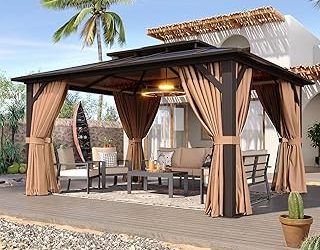
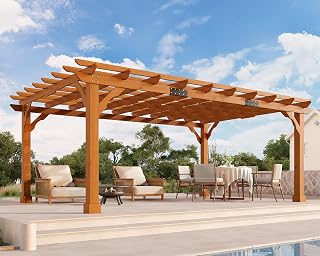
The most complete package here, and the one I’d point a first-time buyer toward. The trellis roof carries a genuine high-wind rating, the cedar arrives pre-stained in a warm mid-brown, and the built-in PowerPort is a small detail that quietly solves string lights and speakers without a visible extension cord.
Jocisland 12×16 FT Premium Cedar Pergola
At 12×16 this is the entertaining-scale option, generous enough to hold a long table and a lounge grouping under one roofline. The reddish-brown finish reads warmer and more traditional than the other cedar kits, which suits established gardens better than minimalist hardscape.
MUPATER 10×12 FT All Cedar Wooden Pergola
A clean, well-proportioned all-cedar structure with honest snow and wind support and stakes included in the box. It’s the sensible middle choice, less ornate than the Beaumont but noticeably more refined than budget imports in the same size class.
BlueWish 10′ x 12′ Cedar Patio Pergola
The slatted trellis roof throws a tighter, more graphic shade pattern than most kits in this range, which is worth something if you’re covering a grill station or a dining area with afternoon exposure. Solid framing, straightforward assembly, competitive value.
Heavy Duty Pergola Brackets for 4×4 Lumber
For DIY builders, this rust-proof set with 3-way and 4-way corner brackets is the flexible path: design your own dimensions, buy lumber locally, and skip freight entirely. Pair it with the slanted-roof bracket kit if you need pitch for runoff.
Frequently Asked Questions
How long does a cedar pergola kit take to assemble?
Plan on a full weekend with two people for a 10×12 kit, and closer to two days for a 12×16. Bracket-based builds add time for cutting and finishing lumber.
Do I need a permit?
Freestanding pergolas under a certain square footage are often exempt, but attached structures and anything over roughly 120 square feet frequently aren’t. Call your local building department before ordering.
Will a pergola keep rain off?
Not on its own. An open trellis roof filters sun and breaks up light rain. Add a retractable canopy or polycarbonate panels if you want genuine shelter.
Can a pergola sit on a deck?
Yes, provided the deck framing can carry the load and you use proper post bases rather than stakes. Anchor into joists or beams, never decking boards alone.
Final Thoughts
For most backyards, the Backyard Discovery Beaumont is the safest and best-resolved buy, with real wind engineering and a finish that looks intentional out of the box. Scale up to the Jocisland 12×16 if you entertain regularly and have the ground to give it, or go with the heavy-duty bracket kit if you’d rather design your own dimensions and spend the savings on lumber and lighting.