Key takeaways
- Match BTU to insulation, not square footage: A trailer with R-7 walls behaves like a room two or three times its size. Budget roughly 25 to 40 BTU per square foot rather than the 20 recommended for houses, and cool a shaded rig whenever possible.
- Check your amps before your BTUs: A 10,000 BTU unit typically pulls 900 to 1,100 watts at startup surge. On a 30-amp hookup that is fine; on a 2,000-watt generator or a modest battery bank, it is the whole budget.
- Plan the exhaust path first: Single-hose units need somewhere to vent hot air. Sill-mount designs solve this elegantly; floor models need a window kit adapted to a slider or a vent cutout, and an unvented “cooler” will only add humidity.
- Decide how you handle condensate: Self-evaporating and gravity-drain models spare you the nightly bucket. If you boondock, a continuous drain routed to a gray tank is worth the extra fifteen minutes of install.
- Weigh noise against proximity: In a camper you sleep four feet from the compressor. Variable-speed compressors and dedicated sleep modes make a measurable difference; a rated decibel figure taken in an open room does not.
What's inside
A camper heats like a greenhouse. Thin aluminum walls, a wraparound band of single-pane glass, and maybe forty square feet of usable floor — by two in the afternoon the interior has stopped being a room and started being an oven. The frustrating part is that most cooling solutions were designed for stick-built houses: they assume a double-hung window, a 200-amp panel, and somewhere to hide a condensate line. Inside a travel trailer or van build, none of those assumptions hold. And unlike a spare bedroom, a camper gives you no forgiving corner to stash a bulky white box. Whatever you bring in has to earn its footprint.
This guide looks at portable air conditioners through that lens: cooling capacity measured against real insulation values, power draw measured against a 30-amp pedestal or a 2,000-watt inverter generator, and physical form measured against a galley you still need to walk through. We compare sill-mounted units built specifically for RV windows, compact tent-friendly coolers that pack into a carry bag, higher-BTU floor models that suit larger fifth wheels and cabins, and one rooftop replacement worth knowing about if you are ready to upgrade permanently. Below are the models we would actually put in a build.
As an Amazon Associate we earn from qualifying purchases.


How to Choose a Portable Air Conditioner For Campers (2026)
- Match BTU to insulation, not square footage: A trailer with R-7 walls behaves like a room two or three times its size. Budget roughly 25 to 40 BTU per square foot rather than the 20 recommended for houses, and cool a shaded rig whenever possible.
- Check your amps before your BTUs: A 10,000 BTU unit typically pulls 900 to 1,100 watts at startup surge. On a 30-amp hookup that is fine; on a 2,000-watt generator or a modest battery bank, it is the whole budget.
- Plan the exhaust path first: Single-hose units need somewhere to vent hot air. Sill-mount designs solve this elegantly; floor models need a window kit adapted to a slider or a vent cutout, and an unvented “cooler” will only add humidity.
- Decide how you handle condensate: Self-evaporating and gravity-drain models spare you the nightly bucket. If you boondock, a continuous drain routed to a gray tank is worth the extra fifteen minutes of install.
- Weigh noise against proximity: In a camper you sleep four feet from the compressor. Variable-speed compressors and dedicated sleep modes make a measurable difference; a rated decibel figure taken in an open room does not.
The Best Portable Air Conditioner For Campers (2026)s Reviewed
Ivation 6,500 BTU Over-the-Window Sill AC
This is the most camper-native design in the group — it straddles the window sill rather than occupying the floor, which keeps your walkway clear and puts the exhaust exactly where it belongs. At 6,500 BTU with dehumidifier and fan modes, digital control, timer, and a genuinely quiet sleep setting, it suits most single-axle trailers and caravans without overloading a 30-amp service.
6000 BTU Portable AC for Tents and RVs
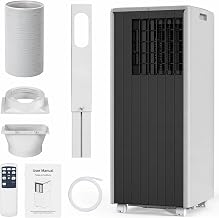
Built for people who move: it packs into an included carry bag and is sized for tents, vans, cabins, and small offices as readily as an RV. Cooling output is modest, so treat it as a way to make a shaded tent or van genuinely sleepable rather than a whole-rig solution.
Furrion Chill Cube 18K Non-Ducted RV AC
Not portable in the strict sense, but the honest answer for anyone tired of workarounds. The variable-speed compressor ramps rather than cycling, which is why it runs quieter and stays comfortable in all-climate conditions, and it will start on a 2,000-watt generator — note the air distribution box is a separate purchase.
SereneLife 10,000 BTU Portable AC with WiFi
A strong pick for larger fifth wheels, park models, and cabins, covering up to 450 square feet with cooling, fan, and dehumidifier modes. App control is more useful than it sounds on the road: you can pre-cool the interior from the trailhead before you walk back in.
Garvee 14,000 BTU 3-in-1 Portable AC
The heavyweight here, rated for 750 square feet with a Follow Me remote that reads temperature at your seat rather than at the unit. Reserve it for large rigs on full hookups or seasonal setups — it needs the amperage and the floor space to justify itself.
Frequently Asked Questions
Can I run a portable AC on a generator?
A 2,000-watt inverter generator will typically start and run units up to about 10,000 BTU, and the Furrion Chill Cube is specifically rated for that class. Larger 14,000 BTU models generally want 3,000 watts or a shore connection.
Do I need to vent it outside?
Yes, if it uses a compressor. Air conditioners move heat rather than destroying it, so an unvented unit will warm and humidify your camper. Evaporative coolers are the exception, and they only work in dry climates.
How does this compare to a rooftop RV unit?
Rooftop units cool more efficiently and free your floor entirely, but they add height, weight, and installation cost. Portable and sill-mount models make sense for rentals, tents, older rigs, and anyone who wants cooling without cutting into a roof.
Will it work in a tent?
With a sealed port for the exhaust hose and a power source, yes. Smaller units like the 6,000 BTU carry-bag model are designed for exactly that, though results depend heavily on shade and how well the tent closes up.
Final Thoughts
For most campers, the Ivation 6,500 BTU sill unit is the smartest first move — it cools competently while leaving your floor plan intact, which is the whole design problem in miniature. If you are working out of a tent or van, the 6,000 BTU carry-bag model travels better than anything else here, and if you have decided to solve the heat permanently, the Furrion Chill Cube 18K is the quiet, all-climate endpoint worth saving for.