Key takeaways
- Read SACC, not just BTU: Seasonally Adjusted Cooling Capacity reflects real-world output, which is why a unit marketed at 12,000 BTU may deliver closer to 8,000 SACC. Compare like with like, and treat square-footage claims as optimistic ceilings for well-insulated, average-ceiling rooms.
- Check how it heats: Most combo units use electric resistance heating, which is reliable in mild-to-moderate cold. Heat-pump models are more efficient but lose output as outdoor temperatures drop, so match the method to your winter climate rather than the wattage on the spec sheet.
- Plan the exhaust before you buy: Every self-contained portable needs a window vent. Measure sash width, check whether your windows slide horizontally, and confirm the included kit fits. Casement and awning windows almost always need an aftermarket panel.
- Decide how much you care about noise: Compressor and blower sit inside the room, so expect 50 to 56 dB at full tilt. If the unit lives in a bedroom, prioritize a genuine sleep or low-fan mode over peak capacity.
- Look at drainage and controls: Self-evaporating operation reduces tank emptying in cooling mode, while continuous-drain ports matter in humid basements. Wi-Fi and app scheduling are the difference between a room that is already comfortable and one you wait twenty minutes for.
What's inside
Most homes have at least one room that refuses to cooperate. The converted attic that bakes in August and turns arctic by November. The garden-level studio, the sunroom, the office above the garage. Adding ductwork is rarely worth the cost, and stacking a window unit against a space heater means storing two bulky machines and swapping them twice a year. It is a design problem as much as a comfort one.
A portable air conditioner with a heat function solves both halves with one footprint. This guide looks at the units worth owning in 2026, what separates a genuinely capable dual-season machine from a rebadged cooler with a resistive coil bolted on, and how to match capacity to the room you actually have rather than the one on the box.
As an Amazon Associate we earn from qualifying purchases.


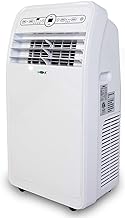

How to Choose a Portable Air Conditioner Heater Combination (2026)
- Read SACC, not just BTU: Seasonally Adjusted Cooling Capacity reflects real-world output, which is why a unit marketed at 12,000 BTU may deliver closer to 8,000 SACC. Compare like with like, and treat square-footage claims as optimistic ceilings for well-insulated, average-ceiling rooms.
- Check how it heats: Most combo units use electric resistance heating, which is reliable in mild-to-moderate cold. Heat-pump models are more efficient but lose output as outdoor temperatures drop, so match the method to your winter climate rather than the wattage on the spec sheet.
- Plan the exhaust before you buy: Every self-contained portable needs a window vent. Measure sash width, check whether your windows slide horizontally, and confirm the included kit fits. Casement and awning windows almost always need an aftermarket panel.
- Decide how much you care about noise: Compressor and blower sit inside the room, so expect 50 to 56 dB at full tilt. If the unit lives in a bedroom, prioritize a genuine sleep or low-fan mode over peak capacity.
- Look at drainage and controls: Self-evaporating operation reduces tank emptying in cooling mode, while continuous-drain ports matter in humid basements. Wi-Fi and app scheduling are the difference between a room that is already comfortable and one you wait twenty minutes for.
The Best Portable Air Conditioner Heater Combinations (2026) Reviewed
BLACK+DECKER Smart 12,000 BTU Portable AC with Heat
The most complete package here: 8,000 BTU SACC cooling paired with 9,000 BTU of heating, app and voice control, and a rated coverage up to 550 square feet. Build quality and parts support are a step above the category average, which matters for a machine you will run across two seasons every year.
SereneLife 14,000 BTU Portable AC & Heater
Pick this one when the room is genuinely large or poorly insulated and you would rather have headroom than a slim silhouette. Wi-Fi control, dehumidifier and fan modes round out the four-in-one setup, though the clean white cabinet is bigger than the 8,000 BTU version and needs a real corner to live in.
Shinco 10,000 BTU Portable AC with Heater
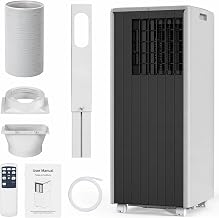
A well-judged middle capacity for rooms up to 400 square feet, and the grey finish is a quiet win in spaces where glossy white plastic reads as appliance rather than furniture. Controls are straightforward remote-and-panel, which suits anyone who would rather not add another device to an app.
Uhome 12,000 BTU Portable AC with Heater
Covers up to 450 square feet with cooling, heating, dehumidifier and fan modes, and arrives with the window kit and remote in the box. It is the value play in the 12,000 BTU class, best suited to a home office or den where you want capacity without paying for smart features.
SereneLife 8,000 BTU Portable AC & Heater with WiFi
The right choice for a bedroom, nursery or small office up to 350 square feet, where an oversized unit would short-cycle and leave the air clammy. Wi-Fi control and a 24-hour timer let you pre-condition the room before you walk in, which is most of the appeal of a smart portable.
Frequently Asked Questions
Can one of these replace a furnace or central air?
No. Treat a combo unit as supplemental comfort for a single room. It excels at extending shoulder seasons and fixing one problem space, not conditioning a whole floor plan.
Does the hose have to stay in the window during winter?
Yes for heat-pump models, which still exchange air with the outside. Some electric-resistance units can heat without venting, but check the manual before you pull the kit and seal the window.
How often will I empty the water tank?
In cooling mode, self-evaporating designs vent most condensate through the exhaust, so emptying is occasional. Dedicated dehumidifier mode fills the reservoir far faster, and a continuous drain line is worth setting up in damp rooms.
Where should the unit sit?
Within about six feet of the window, on a hard level surface, with clear space behind the intake. Keeping the hose short and straight measurably improves both cooling and heating performance.
Final Thoughts
For most rooms, the BLACK+DECKER Smart 12,000 BTU is the one to buy: strong dual-season output, credible smart control, and support behind it. Step up to the SereneLife 14,000 BTU if the space is large or leaky, and choose the SereneLife 8,000 BTU with WiFi for bedrooms, where right-sizing beats raw capacity every time.