Key takeaways
- Match the technology to your climate: Evaporative cooling works best where relative humidity sits below roughly 60 percent. In dry inland heat the effect is dramatic; in a humid coastal August, expect a strong breeze with mild cooling rather than refrigerated air.
- Size the tank to your habits: A 1-gallon reservoir needs refilling within an evening. Three-gallon tanks push toward a full day of unattended runtime, which matters enormously for bedrooms and home offices where you don’t want a midnight top-up.
- Read the height, not just the footprint: Tall tower designs around 38 to 45 inches deliver air at torso level and disappear beside a console or bookcase. Compact 24-inch units sit better on a desk or nightstand but throw air lower, so placement gets fussier.
- Check the noise floor honestly: Without a compressor, the fan is the only sound source, and quoted figures near 38 dB usually reflect the lowest speed. Confirm there is a sleep or night mode that dims the display, since a glowing panel undermines a dark bedroom.
- Think about power and control: Remotes with 15-foot range, timers between 7 and 15 hours, and oscillation up to 120 degrees are the features you will actually use daily. DC or battery compatibility is worth paying for if you cool a workshop, garage, or patio without convenient outlets.
What's inside
Every summer, the same design problem lands in my inbox: a beautiful room with the wrong window. Casement panes that crank outward, narrow sliders, historic sashes painted shut, or a lease that forbids anything hanging off the façade. Traditional portable ACs assume a wide double-hung opening and a place to park a fat exhaust hose, and when that assumption fails, the unit becomes an expensive plastic obstacle in the corner.
Hose-free cooling is the workaround, and it deserves a clear-eyed explanation. These machines are evaporative coolers, sometimes called swamp coolers. They pull warm air across a wet media pad and release it several degrees cooler, which means no compressor, no refrigerant, and no window kit, but also no ability to drop the temperature of a sealed room the way a ducted unit can. Used correctly, in a room with some air exchange and moderate humidity, they are quiet, slim, and genuinely comfortable. Below are the models worth your floor space in 2026, plus the buying criteria that actually predict satisfaction.
As an Amazon Associate we earn from qualifying purchases.


How to Choose a Portable Air Conditioner Without Hose (2026)
- Match the technology to your climate: Evaporative cooling works best where relative humidity sits below roughly 60 percent. In dry inland heat the effect is dramatic; in a humid coastal August, expect a strong breeze with mild cooling rather than refrigerated air.
- Size the tank to your habits: A 1-gallon reservoir needs refilling within an evening. Three-gallon tanks push toward a full day of unattended runtime, which matters enormously for bedrooms and home offices where you don’t want a midnight top-up.
- Read the height, not just the footprint: Tall tower designs around 38 to 45 inches deliver air at torso level and disappear beside a console or bookcase. Compact 24-inch units sit better on a desk or nightstand but throw air lower, so placement gets fussier.
- Check the noise floor honestly: Without a compressor, the fan is the only sound source, and quoted figures near 38 dB usually reflect the lowest speed. Confirm there is a sleep or night mode that dims the display, since a glowing panel undermines a dark bedroom.
- Think about power and control: Remotes with 15-foot range, timers between 7 and 15 hours, and oscillation up to 120 degrees are the features you will actually use daily. DC or battery compatibility is worth paying for if you cool a workshop, garage, or patio without convenient outlets.
The Best Portable Air Conditioner Without Hose (2026)s Reviewed
38.6″ Windowless Evaporative Air Cooler with 120° Oscillation
This is the most complete package for a standard bedroom: enough height to move air across a bed, a large tank that survives a full night, and a 12-hour timer with four modes. The 120-degree sweep is the standout, spreading cool air across a seating area instead of aiming it at one unlucky occupant, and the black finish reads as furniture rather than appliance.
DeWalt 20V Battery-Compatible Windowless Air Conditioner
Rated for roughly 600 square feet with a 3-gallon tank and a 15-hour timer, this is the pick for anyone cooling a space where outlets are scarce. Running on AC or a DeWalt 20V Max pack makes it uniquely useful in garages, studios, and covered patios, though the battery is sold separately and runtime depends on the pack you own.
24.4″ Small Evaporative Air Cooler with Ice Packs
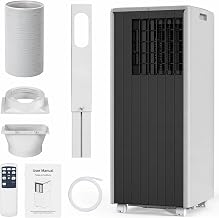
The smart choice for tight rooms, nurseries, and desk-side placement, with three speeds, four modes, and a 7-hour timer in a genuinely unobtrusive white shell. The four included ice packs give the airflow a noticeable extra bite during peak afternoon heat, which partially offsets the smaller reservoir.
Windowless Evaporative Cooler with 3-Gallon Tank
Six fan speeds and a claimed 38 dB floor make this the most tunable option here, and the 3-gallon tank paired with a 12-hour auto-off timer means you can set it and forget it for close to a full day. The 16-foot remote is a small detail that pays off in larger living rooms.
24″ 3-in-1 Ventless Swamp Cooler with Remote
A cooler, fan, and humidifier in one compact white tower, with a 2-gallon tank that strikes a sensible balance between runtime and footprint. Ultra-quiet operation and 120-degree oscillation make it a natural fit for a home office where the machine needs to stay out of the way, visually and acoustically.
Frequently Asked Questions
Do hose-free units cool as well as a real air conditioner?
No, and any listing suggesting otherwise is overselling. Evaporative coolers typically lower the air they discharge by several degrees rather than conditioning an entire sealed room. They excel at making a specific zone comfortable, quietly and without installation.
Will they make my room humid?
They add moisture by design, which is why ventilation matters. Leave a door or window slightly open so humid air can escape, and skip evaporative cooling entirely in rooms that already feel damp.
How much maintenance do they need?
Empty and rinse the tank regularly, clean or replace the cooling media on the manufacturer’s schedule, and let the unit dry before storage. Neglecting this is the main cause of musty odors and mineral scale.
Are ice packs worth using?
Yes, for short bursts. Frozen packs chill the water and sharpen the output for an hour or two, which is useful during a heat spike but not a substitute for adequate airflow.
Final Thoughts
For most bedrooms, the 38.6-inch oscillating tower is the best balance of reach, runtime, and quiet operation. Choose the DeWalt 20V-compatible model if you need cooling where power is unreliable, and the 24.4-inch compact cooler if floor space is the real constraint. Set expectations around evaporative physics rather than marketing copy, and any of the three will earn its corner.