Key takeaways
- Cooling method first: Evaporative coolers need zero venting and use a fraction of the electricity, but they lower temperature rather than refrigerate. Compressor units cool aggressively and dehumidify, yet must exhaust hot air somewhere. Decide which compromise you can live with before comparing specs.
- Your local humidity: Evaporative cooling shines in dry heat — Phoenix, Denver, inland California — where it can shave 10 to 15 degrees off the airstream. In Houston or Miami, where indoor humidity already sits high, expect modest relief and a slightly damper room.
- Tank capacity versus your patience: Larger reservoirs run overnight untouched; personal-sized tanks may need refilling every few hours. If you want to sleep through the night without getting up, prioritize tank volume and a timer that shuts things down on schedule.
- Sound at sleeping distance: Evaporative coolers are inherently quieter — no compressor cycling on and off. If you’re placing a compressor unit in a bedroom, look for a dedicated low or sleep mode and accept that it will be audible.
- Alternative venting routes: Before ruling out refrigerated cooling, check for a sliding door track, a dryer vent, a drop ceiling, or a wall you’re permitted to core. Many “windowless” rooms have one of these, which opens up the far more powerful compressor category.
What's inside
Every summer, a certain kind of email lands in my inbox: the loft bedroom with a fixed skylight, the garden-level rental with crank-out casements, the converted garage studio where the only opening is a roll-up door. These spaces get genuinely hot, and their occupants have all discovered the same frustrating truth — most “portable” air conditioners aren’t portable at all. They’re compressor units that need a place to dump heat, and without an opening for the exhaust hose, they simply reheat the room they’re meant to cool.
This guide separates the two categories that get lumped together under one search term. Evaporative coolers genuinely need no window, drawing air across a water-soaked medium to drop temperatures by several degrees while adding humidity. Compressor units deliver real refrigerated cooling but require venting — which, importantly, doesn’t always mean a window. Below, I’ve assessed both paths so you can match the machine to the room you actually have, not the room the marketing assumes.
As an Amazon Associate we earn from qualifying purchases.


How to Choose a Portable Air Conditioner Without Window Access (2026)
- Cooling method first: Evaporative coolers need zero venting and use a fraction of the electricity, but they lower temperature rather than refrigerate. Compressor units cool aggressively and dehumidify, yet must exhaust hot air somewhere. Decide which compromise you can live with before comparing specs.
- Your local humidity: Evaporative cooling shines in dry heat — Phoenix, Denver, inland California — where it can shave 10 to 15 degrees off the airstream. In Houston or Miami, where indoor humidity already sits high, expect modest relief and a slightly damper room.
- Tank capacity versus your patience: Larger reservoirs run overnight untouched; personal-sized tanks may need refilling every few hours. If you want to sleep through the night without getting up, prioritize tank volume and a timer that shuts things down on schedule.
- Sound at sleeping distance: Evaporative coolers are inherently quieter — no compressor cycling on and off. If you’re placing a compressor unit in a bedroom, look for a dedicated low or sleep mode and accept that it will be audible.
- Alternative venting routes: Before ruling out refrigerated cooling, check for a sliding door track, a dryer vent, a drop ceiling, or a wall you’re permitted to core. Many “windowless” rooms have one of these, which opens up the far more powerful compressor category.
The Best Portable Air Conditioners Without Window Access (2026), Reviewed
25.3″ Windowless Evaporative Air Cooler with Remote
This is the one I recommend most often for small bedrooms and home offices, largely because of its proportions — at just over two feet tall, it tucks beside a nightstand or under a desk without dominating the room. The included ice packs meaningfully sharpen the output on hot afternoons, and 90-degree oscillation spreads air across a bed rather than blasting a single spot.
38.6″ Windowless Evaporative Cooler, Black
The taller sibling, and the better choice for living rooms and open-plan spaces where you need air moving at seated and standing height. The larger tank and 12-hour timer make it a genuine set-and-forget unit, and the matte black finish reads more like a floor lamp than an appliance.
Serantzon 4-in-1 Evaporative Cooler
A desktop-scale unit for personal cooling — think a студio corner, a dorm desk, or a nursery glider. The 1200ml tank means frequent refills, so treat it as a targeted comfort device rather than a room solution; the LED lighting is a pleasant touch for late-night work.
Shinco 12,000 BTU Portable AC
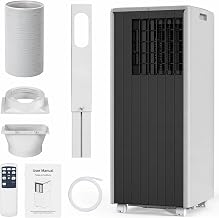
If you can route the exhaust through a sliding door gap or wall vent, this is real refrigerated cooling with dehumidifier and fan modes for rooms up to 450 square feet. Note the 7,500 BTU SACC rating — that’s the honest, standardized figure, and it’s the number to compare against competitors.
12,000 BTU 3-in-1 Self-Evaporating Portable AC
Rated for up to 550 square feet, this is the pick for larger vented spaces like converted garages or basement rec rooms. Self-evaporating operation means you’re not emptying a drain pan constantly, which matters when the unit lives somewhere inconvenient to reach.
Frequently Asked Questions
Can an air conditioner truly cool a room with no window at all?
An evaporative cooler can lower the temperature without any opening, most effectively in dry climates. A compressor-based unit cannot — physics requires the extracted heat to leave the space, so venting is non-negotiable.
Do evaporative coolers work in humid regions?
They work, but less dramatically. In high humidity you’ll feel primarily the moving-air effect plus a few degrees of cooling, and the room will get slightly damper. Running one in a space with a cracked door helps.
What counts as venting if I have no window?
Sliding door tracks, dryer vents, drop ceilings, wall penetrations, and even door transoms have all been used successfully. Renters should confirm permissions before drilling anything.
How often will I refill the water tank?
It depends on capacity and fan speed. Large-tank floor models typically run 8 to 12 hours; compact personal units may need topping off every two to four hours.
Final Thoughts
For a genuinely window-free bedroom, the 25.3″ evaporative cooler hits the best balance of footprint, quiet operation, and ice-pack-boosted output, while the 38.6″ model is the stronger choice for larger living areas. If you discover you do have a venting route — a sliding door, a wall vent — the Shinco 12,000 BTU unit delivers the real refrigerated cooling that no evaporative design can match.