Key takeaways
- Match BTU to square footage, not ambition: Roughly 20 BTU per square foot is the working rule. Oversizing cools the air fast, shuts off early, and leaves the room clammy because the unit never runs long enough to pull out humidity.
- Read the sash, not just the sill: Measure window width, height, and the depth of the interior trim before buying. U-shaped units need a sash that closes down onto the middle of the chassis, which rules out most casement and sliding windows.
- Weigh mechanical against digital honestly: Dial controls cost less and fail less. Digital panels with 24-hour timers and remotes cost more but let you pre-cool a bedroom before you’re in it, which is worth real money over a summer.
- Check CEER, then check the sleep noise: Combined Energy Efficiency Ratio predicts your bill; decibel rating at low fan speed predicts whether you’ll actually use the thing overnight. Anything near or below 45 dB on low is genuinely liveable.
- Factor the install cost into the price: A unit with a proper mounting bracket, foam side panels, and a reusable washable filter saves you a hardware run and years of replacement cartridges. That’s part of the true purchase price.
What's inside
Window air conditioners occupy an awkward place in the home. They live in the one architectural feature you actually chose the apartment for, they run for months at a stretch, and they’re usually bought in a hurry during the first genuinely unbearable week of summer. That rush is where the money goes sideways. Shoppers either overspend on a 12,000 BTU unit for a 130-square-foot bedroom, or they grab the cheapest box on the shelf and spend two seasons listening to it rattle against the sash. Neither outcome has anything to do with getting a good price.
This guide approaches the category the way we’d approach any fixture that becomes part of a room’s visual language: what it costs to run, how loud it is at 2 a.m., how much daylight it steals, and whether the price reflects real engineering or just a lower BTU number. Below are six window units worth considering in 2026, spanning compact mechanical models under 5,000 BTU through U-shaped and remote-controlled designs built for open-plan living areas. Each one earns its place for a specific room type and a specific budget.
As an Amazon Associate we earn from qualifying purchases.



How to Choose a Price For Window Air Conditioner (2026)
- Match BTU to square footage, not ambition: Roughly 20 BTU per square foot is the working rule. Oversizing cools the air fast, shuts off early, and leaves the room clammy because the unit never runs long enough to pull out humidity.
- Read the sash, not just the sill: Measure window width, height, and the depth of the interior trim before buying. U-shaped units need a sash that closes down onto the middle of the chassis, which rules out most casement and sliding windows.
- Weigh mechanical against digital honestly: Dial controls cost less and fail less. Digital panels with 24-hour timers and remotes cost more but let you pre-cool a bedroom before you’re in it, which is worth real money over a summer.
- Check CEER, then check the sleep noise: Combined Energy Efficiency Ratio predicts your bill; decibel rating at low fan speed predicts whether you’ll actually use the thing overnight. Anything near or below 45 dB on low is genuinely liveable.
- Factor the install cost into the price: A unit with a proper mounting bracket, foam side panels, and a reusable washable filter saves you a hardware run and years of replacement cartridges. That’s part of the true purchase price.
The Best Price For Window Air Conditioner (2026)s Reviewed
Frigidaire 5,000 BTU Window-Mounted Air Conditioner
The most predictable pick here, and that’s the compliment. Frigidaire’s 5,000 BTU unit covers up to 150 square feet with two fan speeds, effortless temperature control, and an auto-restart that recovers your setting after an outage — a small feature that matters enormously if you leave pets home during a brownout. Its clean white housing disappears against standard trim better than most.
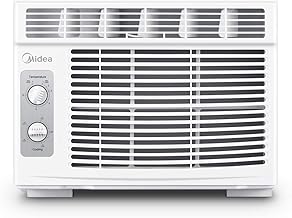
Midea 5,000 BTU EasyCool
Stripped back to mechanical controls and a reusable filter, this is the value benchmark for a small bedroom, home office, or guest room under 150 square feet. There’s no app, no display, and nothing to fail — just a dial and a washable screen you rinse once a month.
Electactic 8,000 BTU Window AC Unit
An 8,000 BTU chassis with six operating modes, a 24-hour timer, and full remote control, rated for rooms up to 350 square feet. The programmability is the real draw: set it to spin down after you fall asleep and you’ll notice the difference on your utility statement.
BLACK+DECKER 12,000 BTU Window Unit
The heavy hitter, handling up to 550 square feet across three cooling speeds with a fan-only setting for shoulder-season days. This is the right call for a studio, a converted attic, or a living room that opens into a kitchen — but confirm your window can carry the weight before ordering.
Tehanld 10,000 BTU U-Shaped Window Air Conditioner
The design-led choice. The U-shaped chassis lets the sash close through the middle of the unit, which cuts compressor noise dramatically and preserves a full, unobstructed view through the upper pane — a genuine gain in a small room where that window is the only source of daylight.
Frequently Asked Questions
Is a higher BTU rating always better?
No. An oversized unit short-cycles, leaving a room cold but humid and sticky. Size to your actual square footage, then add roughly 10 percent for sun-facing rooms or spaces with high ceilings.
Are U-shaped units really quieter?
Meaningfully so. Closing the window between the compressor and the room puts a pane of glass between you and the loudest component, typically shaving several decibels compared to a conventional chassis of the same capacity.
How much does a window AC add to a power bill?
A 5,000 BTU unit running eight hours nightly is modest; a 12,000 BTU model running continuously is not. Timers and eco modes are the practical lever, since reducing runtime beats chasing marginal efficiency gains.
Can I install one myself?
Most 5,000 to 8,000 BTU units are a straightforward one-person job with the included bracket and side panels. At 10,000 BTU and above, get a second pair of hands — these are heavy, and a dropped unit is worse than a warm room.
Final Thoughts
For small rooms, the Midea EasyCool delivers the honest floor price with nothing superfluous, while the Frigidaire 5,000 BTU earns a modest premium through auto-restart and a tidier finish. If you’re cooling an open living space and care how the window looks afterward, the Tehanld U-shaped model is the one worth stretching for.