Key takeaways
- Published decibels, at the lowest fan speed: Anything at or under 40 dB reads as room-appropriate. Around 33 dB you get something closer to a refrigerator hum. Check whether the number quoted is the quiet setting or the maximum, because brands rarely say.
- Capacity matched to the room, not the house: A 20 to 25 pint unit suits a bedroom or single bath. Thirty-five pints covers open main floors. Reserve 70 pints and up for damp basements, where oversizing actually helps because the unit cycles off sooner.
- Continuous drainage as the default plan: A gravity hose to a floor drain or sump removes the loudest part of ownership, which is you lifting a full tank across a carpet. Confirm the port location and whether a hose is included.
- Night behavior: Look for a true sleep mode that drops the fan and dims or kills the display. Wi-Fi and voice control matter here too, since adjusting from your phone beats crossing a dark room to press buttons.
- Cabinet and filter design: Rounded corners, recessed handles, and a matte shell disappear into a room. A washable filter keeps long-term running cost near zero and prevents the airflow restriction that makes older units sound strained.
What's inside
A dehumidifier earns its place in a room the way a floor lamp does: quietly, and only if it looks and sounds like it belongs. The trouble is that most units are engineered for garages, not for the corner of a bedroom next to a linen chair. Buyers end up with 55 decibels of compressor drone in a space they chose for calm, a glowing panel that lights the ceiling at 2 a.m., and a tank that needs emptying right when the room is finally settled. The humidity goes down; the livability goes with it.
This guide looks at dehumidifiers through that lens. We weighed measured sound output, how the machine behaves at night, how honestly it handles drainage, and whether the cabinet reads as furniture or as equipment. Below are the picks worth putting in a finished room, plus a short framework for matching capacity to square footage so you are not running an oversized unit at full tilt in a space that needed half the effort.
As an Amazon Associate we earn from qualifying purchases.


How to Choose a Quiet Dehumidifier (2026)
- Published decibels, at the lowest fan speed: Anything at or under 40 dB reads as room-appropriate. Around 33 dB you get something closer to a refrigerator hum. Check whether the number quoted is the quiet setting or the maximum, because brands rarely say.
- Capacity matched to the room, not the house: A 20 to 25 pint unit suits a bedroom or single bath. Thirty-five pints covers open main floors. Reserve 70 pints and up for damp basements, where oversizing actually helps because the unit cycles off sooner.
- Continuous drainage as the default plan: A gravity hose to a floor drain or sump removes the loudest part of ownership, which is you lifting a full tank across a carpet. Confirm the port location and whether a hose is included.
- Night behavior: Look for a true sleep mode that drops the fan and dims or kills the display. Wi-Fi and voice control matter here too, since adjusting from your phone beats crossing a dark room to press buttons.
- Cabinet and filter design: Rounded corners, recessed handles, and a matte shell disappear into a room. A washable filter keeps long-term running cost near zero and prevents the airflow restriction that makes older units sound strained.
The Best Quiet Dehumidifiers of 2026, Reviewed
Deye Smart Dehumidifier, 36 Pints
The 33 dB rating is the quietest credible figure in this class, and the dual LED display gives you actual and target humidity without guesswork. Auto restart after a power blip makes it the right choice for a basement you would rather not think about.
Midea 22 Pint Dehumidifier
Sized correctly for bedrooms, nurseries, and en suites up to about 1,500 square feet, which is why it stays on low and stays quiet. The reusable filter and continuous drain option keep maintenance down to a rinse every few weeks.
Midea Cube 35 Pint
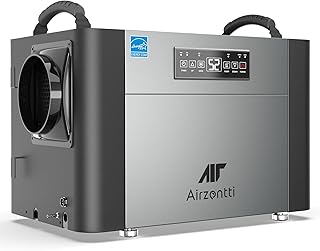
The Cube is the rare unit that solves a design problem: the body expands to hold a much larger reservoir, so it can sit in a finished space without a hose trailing to a drain. Coverage up to 3,500 square feet makes it a genuine main-floor machine.
Waykar 80 Pints
Built for the wet end of the spectrum, with 5,000 square feet of coverage, a 90 degree auto swing louver to move dry air across a room, and auto defrost for cool basements. Set humidity between 30 and 80 percent and let it cycle rather than run flat out.
ToLife Dehumidifier, 1000 Sq Ft
A compact, well-mannered option for bathrooms, closets, and small bedrooms, with a sleep mode that quiets the fan and a 95 ounce tank that shuts the unit off when full. The seven-color LED is a nice touch, and it can be switched off entirely.
Frequently Asked Questions
What counts as quiet for a dehumidifier?
Under 45 dB is tolerable in a living space, 40 dB or lower is comfortable, and low to mid 30s is genuinely unobtrusive. Compressor units cannot go silent, so the goal is a steady low hum rather than a cycling clatter.
Where should I place it?
Six to twelve inches off walls and furniture on all sides, with nothing blocking the intake or exhaust. Central placement in the room works better than tucking it in a corner, and a hard floor transmits less vibration than a hollow platform.
Is it expensive to run overnight?
An ENERGY STAR certified unit on a humidity setpoint rather than continuous mode uses far less than most people expect, because it idles once the room hits target. Setting 50 percent instead of 40 percent cuts runtime noticeably.
Do I need a desiccant model?
Only for cold spaces below roughly 60 degrees, where compressors lose efficiency and ice up. For small sealed items, purpose-built dryers like the Redux hearing aid dehumidifier handle moisture that a room unit never reaches.
Final Thoughts
For most finished rooms, the Deye 36 pint is the pick, with the lowest verified noise floor and controls you can manage from bed. Choose the Midea Cube 35 Pint if you want main-floor coverage without a drain hose in sight, and the Waykar 80 Pint if the real problem is a damp basement that needs volume more than subtlety.