Key takeaways
- Headrest range and motor quality: A power headrest is only useful if it moves through a wide enough arc to support upright reading and deep recline without motor lag. Look for independent headrest control—shared motors force awkward compromises between back angle and neck position.
- Upholstery matched to your household: Full-grain leather ages beautifully but demands periodic conditioning. Faux leather and performance fabrics resist pet claws and spills better, though they trade long-term patina for short-term convenience. Choose based on who (and what) shares the room.
- Frame and weight capacity: Kiln-dried hardwood frames outlast particleboard by decades. If you are shopping for a big-and-tall or plus-size fit, verify the stated capacity and check the seat width—nominally “oversized” chairs sometimes pad the claim with wider arms rather than a genuinely broader seat pan.
- Wall clearance and footprint: “Wall hugger” designs need roughly four to six inches of clearance, while traditional recliners demand eighteen inches or more. Measure twice, especially in smaller living rooms or RVs where every inch counts.
- Extra features worth paying for: USB-C charging ports, lumbar support, heat, and massage add genuine daily value. Cupholders and storage pockets sound nice but rarely justify a price jump if the core reclining mechanism is mediocre.
What's inside
Shopping for a recliner today means sorting through a sea of vague specs, recycled marketing copy, and chairs that promise premium comfort but ship with a headrest that tilts about two degrees. The power headrest specifically—once a luxury add-on reserved for high-end theater seating—has quietly become the feature that separates a recliner you actually love from one you tolerate. It matters because neck alignment changes the moment you recline, and a fixed backrest that felt fine sitting upright suddenly forces your chin toward your chest.
This guide cuts through the noise. We evaluated six current-generation recliners with power headrests across build quality, mechanism smoothness, upholstery durability, and real-world livability. Below you will find our top five picks, a no-nonsense buying guide, and answers to the questions that tend to surface after you click “Add to Cart” but before the freight driver shows up.
As an Amazon Associate we earn from qualifying purchases.


How to Choose a Recliner With Power Headrest (2026)
- Headrest range and motor quality: A power headrest is only useful if it moves through a wide enough arc to support upright reading and deep recline without motor lag. Look for independent headrest control—shared motors force awkward compromises between back angle and neck position.
- Upholstery matched to your household: Full-grain leather ages beautifully but demands periodic conditioning. Faux leather and performance fabrics resist pet claws and spills better, though they trade long-term patina for short-term convenience. Choose based on who (and what) shares the room.
- Frame and weight capacity: Kiln-dried hardwood frames outlast particleboard by decades. If you are shopping for a big-and-tall or plus-size fit, verify the stated capacity and check the seat width—nominally “oversized” chairs sometimes pad the claim with wider arms rather than a genuinely broader seat pan.
- Wall clearance and footprint: “Wall hugger” designs need roughly four to six inches of clearance, while traditional recliners demand eighteen inches or more. Measure twice, especially in smaller living rooms or RVs where every inch counts.
- Extra features worth paying for: USB-C charging ports, lumbar support, heat, and massage add genuine daily value. Cupholders and storage pockets sound nice but rarely justify a price jump if the core reclining mechanism is mediocre.
The Best Recliner With Power Headrest (2026)s Reviewed
Watson & Whitely Oversized Genuine Leather Power Recliner
This navy-blue wall hugger is built for bigger frames without looking like medical furniture. The genuine leather upholstery develops character over time, the dual power motors (headrest and recline) operate independently with minimal noise, and the integrated charging ports sit exactly where your phone naturally lands. If you need a recliner that accommodates a larger body without sacrificing a living-room aesthetic, this is the one to start with.
Flexsteel Crew Transitional Power Recliner
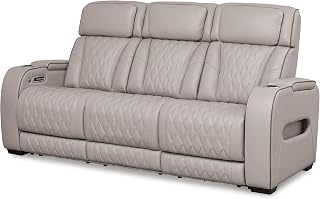
Flexsteel’s reputation for durable mechanisms is earned, not borrowed. The Crew pairs a power headrest and lumbar with light-tan leather that reads modern without feeling sterile. It bridges transitional and contemporary interiors smoothly, and the steel-reinforced frame gives it a solidity that cheaper alternatives simply do not match. This is the pick when long-term reliability outranks flashy features.
Watson & Whitely Genuine Leather Recliner in Grey
A swivel-glider-rocking-recliner hybrid with genuine leather at a price that typically undercuts comparable models. The USB-C charger is a thoughtful touch, and the three-hundred-sixty-degree swivel base makes it equally useful in a nursery, reading nook, or main living area. It punches above its weight class in finish quality for the category.
Pet Friendly Leather Power Recliner
Down-filled cushions, scratch-resistant waterproof faux leather, and side pockets—this chair was designed with real-life households in mind. The zero-wall-hugger profile works well in tighter spaces and RVs, and the faux leather genuinely holds up against cat claws and toddler spills in a way that bonded leather never could. A practical choice that does not look practical.
Korser Oversized Dual Motor Power Lift Recliner
Much more than a recliner for older adults: the lift mechanism, massage, heat, cupholder, and built-in storage box make it a self-contained comfort station. The adjustable headrest is wider than average, the dual motors run quietly, and both USB and Type-C ports keep devices charged. If mobility assistance is part of the equation, this eliminates the stigma that often accompanies lift chairs.
Frequently Asked Questions
What is the difference between a power headrest and a manual headrest?
A power headrest uses a motorized mechanism controlled by a button, letting you adjust neck angle while fully reclined without reaching behind you. Manual headrests require physical force and usually lock into one or two positions, which limits comfort as you shift between activities.
Are power recliners worth the extra cost over manual recliners?
For most people, yes—especially if the chair is a primary seating spot. Independent power control over recline, headrest, and sometimes lumbar means you find a precise position rather than settling for a preset. The added cost also tends to reflect better internal construction, which extends the chair’s lifespan.
How much clearance does a wall-hugger recliner really need?
Most wall-hugger designs require between four and six inches between the back of the chair and the wall, though the exact figure depends on the recline angle. Measure from the point where the backrest is fully upright, not the outermost edge of the arms, to get an accurate number.
Can a power recliner work during a power outage?
Some models include a battery backup or can accept a portable battery pack, but many do not. If uninterrupted operation matters to you—particularly for lift chairs—check whether the specific model supports an external battery before purchasing.
Final Thoughts
For most living rooms, the Watson & Whitely Oversized Genuine Leather Power Recliner offers the best balance of space, durability, and style. Shoppers prioritizing long-term mechanical reliability should look at the Flexsteel Crew, while anyone dealing with pets or small children will find the Pet Friendly Leather Power Recliner hard to beat on practicality. Each one earns its place through genuine build quality rather than marketing fluff.