Key takeaways
- Rear clearance, not just width: Standard recliners need 12 to 18 inches behind the frame. Wall-hugger designs cut that to roughly 3 to 5 inches by sliding the seat forward as it opens — the single most useful spec for a small room. Measure your wall-to-walkway distance before anything else.
- Console or no console: A fixed center console adds 8 to 12 inches of width you can’t reclaim. Flip-up consoles give you cup holders and storage when you want them and a continuous seat when you don’t. Skip the console entirely if you need to fit under 58 inches.
- Manual versus power: Manual pull mechanisms cost less, need no outlet, and don’t fail electronically. Power recline offers infinite stop positions and easier operation for anyone with limited mobility or wrist strength, but requires cord routing and adds depth at the back panel.
- Upholstery that suits the room: Chenille and flannel read warm and forgiving in small, light-starved spaces. Leathaire and faux leather wipe clean and visually recede, which helps a compact room feel less crowded. Velvet adds depth but shows wear on high-traffic arms.
- Assembly and doorways: Most compact reclining loveseats ship in two or three boxes with interlocking backs — a genuine advantage over one-piece sofas if you’re navigating stairwells or a 30-inch apartment door. Confirm box dimensions, not just assembled dimensions.
What's inside
Square footage has a way of exposing bad furniture decisions. A reclining sofa that looks compact in a warehouse showroom can swallow an apartment living room whole, and the real culprit usually isn’t width — it’s the eighteen inches of clearance a traditional recliner demands behind it before the footrest will budge. Add a bulky center console, oversized rolled arms, and a frame depth built for a suburban great room, and suddenly the walkway to your kitchen is a shuffle.
The good news: manufacturers finally caught up. Wall-hugger mechanisms, flip-up consoles, and loveseat-scale frames in the 55 to 68 inch range have turned reclining seating into something you can actually place against a wall in a studio, a narrow rental, or an RV. This guide covers the reclining loveseats worth considering for tight footprints in 2026, what specs matter when inches are the constraint, and how to weigh comfort features like heat, massage, and power against the space they cost you.
As an Amazon Associate we earn from qualifying purchases.


How to Choose a Reclining Sofa For Small Spaces (2026)
- Rear clearance, not just width: Standard recliners need 12 to 18 inches behind the frame. Wall-hugger designs cut that to roughly 3 to 5 inches by sliding the seat forward as it opens — the single most useful spec for a small room. Measure your wall-to-walkway distance before anything else.
- Console or no console: A fixed center console adds 8 to 12 inches of width you can’t reclaim. Flip-up consoles give you cup holders and storage when you want them and a continuous seat when you don’t. Skip the console entirely if you need to fit under 58 inches.
- Manual versus power: Manual pull mechanisms cost less, need no outlet, and don’t fail electronically. Power recline offers infinite stop positions and easier operation for anyone with limited mobility or wrist strength, but requires cord routing and adds depth at the back panel.
- Upholstery that suits the room: Chenille and flannel read warm and forgiving in small, light-starved spaces. Leathaire and faux leather wipe clean and visually recede, which helps a compact room feel less crowded. Velvet adds depth but shows wear on high-traffic arms.
- Assembly and doorways: Most compact reclining loveseats ship in two or three boxes with interlocking backs — a genuine advantage over one-piece sofas if you’re navigating stairwells or a 30-inch apartment door. Confirm box dimensions, not just assembled dimensions.
The Best Reclining Sofa For Small Spaces (2026)s Reviewed
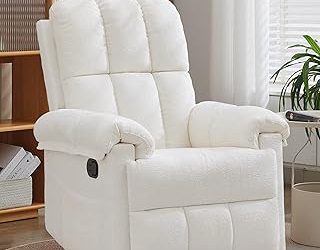
GUEAPY 55″ Chenille Reclining Loveseat
At 55 inches wide with no center console, this is the most genuinely small-space option here — it fits walls where a 68-inch model simply won’t. The chenille upholstery and wide armrests give it more visual softness than its footprint suggests, and side storage pockets handle remotes without adding bulk.
Redlife Power Loveseat Recliner with Heat & Massage
Power recline paired with eight-point massage and lumbar heat puts this closer to a home theater seat than a standard loveseat, and the soft flannel in blue keeps it from reading like a recliner in a room where design matters. Plan for outlet access and check rear clearance carefully, since the power mechanism sits at the back of the frame.
68″ Velvet Reclining Loveseat with Flip-Up Console
The wall-hugger mechanism is the headline: it needs only a few inches of rear clearance, which makes the 68-inch width workable in rooms that couldn’t host a conventional recliner. The flip-up console is the right compromise — cup holders when you’re watching something, a bench seat when you have a guest.
Redlife Leathaire Loveseat Recliner with Console
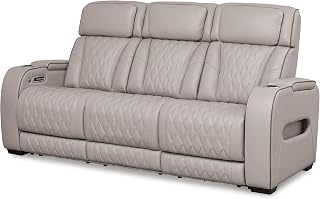
This one is built for people who want their sofa to do everything: heat, massage, USB and standard outlets, Bluetooth speakers, and a storage drawer, all in a wipe-clean Leathaire that suits pet households. The manual pull mechanism keeps the price sensible, and the grey finish is neutral enough to disappear into most palettes.
Massage Reclining Loveseat with USB, No Console
A smart pick if you want tech without sacrificing width — you get massage, USB charging, storage, and cup holders in a console-free wall-hugger frame. It’s the most flexible layout on this list for narrow rooms and RV slide-outs.
Frequently Asked Questions
How much space does a reclining loveseat actually need?
A traditional model needs 12 to 18 inches behind it plus 18 to 24 inches in front for the extended footrest. Wall-hugger designs reduce the rear requirement to about 3 to 5 inches, so budget roughly 90 inches of total front-to-back depth for a standard recliner and around 75 inches for a wall hugger.
Are wall-hugger recliners less comfortable?
The recline angle is slightly shallower than a full-lay-flat mechanism, so they’re better for lounging and watching than for sleeping. For most small-space buyers, that tradeoff is worth the two feet of floor you get back.
Is power recline worth the extra cost?
It’s worth it if you value infinite positioning, plan to use the sofa daily for long stretches, or anyone in the household finds a manual pull handle difficult. Otherwise, manual mechanisms are simpler, cheaper, and have fewer failure points.
Do these fit in RVs and campers?
Many are marketed for RV use, and the console-free 55-inch models are the most likely to fit standard slide-outs. Measure your slide depth in both retracted and extended positions, and confirm the shipping box will clear the entry door.
Final Thoughts
If your wall clearance is the binding constraint, the GUEAPY 55″ chenille loveseat is the easiest fit and the least likely to crowd a small room. For a more finished look with real theater-seat comfort, the Redlife power recliner with heat and massage earns its footprint, while the 68-inch velvet wall hugger with flip-up console strikes the best balance between seating space and flexibility for rooms that can spare a few extra inches of width.