Key takeaways
- Recline clearance, not just footprint: Measure the sofa’s closed dimensions, then add 12 to 18 inches behind each reclining seat and roughly 18 inches in front for extended footrests. Wall-hugger mechanisms reduce the rear allowance considerably, which matters in narrow rooms.
- Manual versus power: Manual levers are mechanically simpler and cost less to maintain, but require a pull-and-shift motion that some users find awkward. Power units offer infinite positioning and often bundle USB ports and LED accents, at the cost of needing an outlet nearby.
- Upholstery language: “Air leather” and “faux leather” are polyurethane-coated fabrics — easy to wipe down, cooler-looking, but prone to surface wear at high-friction points over several years. Woven polyester and linen blends breathe better and hide creasing, though they hold pet hair and need occasional fabric cleaner.
- Chaise orientation and modularity: Confirm whether the chaise is left- or right-facing as you look at the sofa, and whether the configuration is reversible. Reversible designs are worth a premium if you expect to rearrange or move.
- Console utility: A center console adds storage and drink stability but consumes eight to twelve inches of seating. If you regularly host, a flip-down middle backrest gives you the console when you want it and a full seat when you don’t.
What's inside
Reclining sectionals occupy an awkward spot in the furniture market. They promise the deep, sink-in comfort of a theater seat and the footprint efficiency of a corner sofa, but the two goals pull against each other. Recline mechanisms add bulk to the back and arms, consoles eat into seat width, and a piece that photographs beautifully in a staged 400-square-foot showroom can swallow an actual living room whole. Add the fact that most listings describe upholstery in vague terms and measure width without accounting for the arc of a fully extended footrest, and it becomes very easy to buy a sofa that fits the floor plan on paper and nowhere else.
This guide approaches the category the way a curator would: looking at proportion, material honesty, and how the mechanism affects the silhouette when the sofa is closed, since that is how it will look ninety percent of the time. Below are six reclining sectionals worth considering in 2026, spanning manual and power configurations, fabric and leather-look upholstery, and layouts built around storage consoles, cup holders, and USB charging. After the picks, there is a short framework for choosing, reviews of the standouts, and answers to the questions that come up most often before checkout.
As an Amazon Associate we earn from qualifying purchases.


How to Choose a Sectional Reclining Sofa (2026)
- Recline clearance, not just footprint: Measure the sofa’s closed dimensions, then add 12 to 18 inches behind each reclining seat and roughly 18 inches in front for extended footrests. Wall-hugger mechanisms reduce the rear allowance considerably, which matters in narrow rooms.
- Manual versus power: Manual levers are mechanically simpler and cost less to maintain, but require a pull-and-shift motion that some users find awkward. Power units offer infinite positioning and often bundle USB ports and LED accents, at the cost of needing an outlet nearby.
- Upholstery language: “Air leather” and “faux leather” are polyurethane-coated fabrics — easy to wipe down, cooler-looking, but prone to surface wear at high-friction points over several years. Woven polyester and linen blends breathe better and hide creasing, though they hold pet hair and need occasional fabric cleaner.
- Chaise orientation and modularity: Confirm whether the chaise is left- or right-facing as you look at the sofa, and whether the configuration is reversible. Reversible designs are worth a premium if you expect to rearrange or move.
- Console utility: A center console adds storage and drink stability but consumes eight to twelve inches of seating. If you regularly host, a flip-down middle backrest gives you the console when you want it and a full seat when you don’t.
The Best Sectional Reclining Sofa (2026)s Reviewed
Manual Reclining L-Shaped Sectional with Center Console (Brown)
A dependable baseline for the category: an L-shaped manual layout with a center console, hidden cup holders, and interior storage, wrapped in a warm brown that reads more traditional than trend-driven. The manual mechanism keeps the price and the maintenance burden low, making this a sensible choice for a family room that sees heavy daily use.
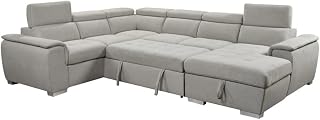
Fabric L-Shaped Manual Recliner, 5-Seater (Grey)
The padded headrests are the differentiator here — they support the neck properly rather than pushing the head forward, which is a common failure in oversized recliners. The grey woven upholstery is forgiving with creasing and dust, and five seats plus storage make it well suited to households that actually use the whole sofa at once.
Power Reclining Corner Sectional with LED Lighting (Beige)
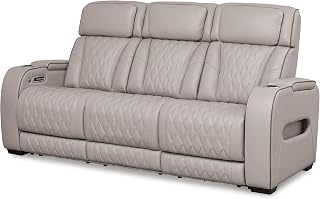
Built explicitly for media rooms: power recline, an LED accent strip, cup holders, and a storage console in a light beige air leather that keeps a dark room from feeling cavernous. The wipe-clean surface is a practical advantage around snacks, though it will show wear sooner than a woven fabric.
Dresegmt Manual Recliner Sectional with Flip Backrest (Grey & Chocolate)
The flip-down middle backrest is the smartest detail on this list, converting the console into a usable seat when guests arrive. The two-tone grey linen and chocolate leather treatment also breaks up the visual mass, which helps a five-seater feel less monolithic in a mid-sized room.
Power Reclining Sectional with LED Light (Brown Faux Leather)
A more restrained take on the lit-and-powered theater sofa, with two power recline seats, cup holders, and a storage console in a brown faux leather that suits transitional interiors. Position it within reach of an outlet and confirm your wall clearance before ordering.
Frequently Asked Questions
How much clearance does a reclining sectional need behind it?
Plan on 12 to 18 inches from the wall for standard mechanisms. Wall-hugger designs can operate in as little as three to four inches, but the specification should be stated explicitly in the listing — do not assume it.
Is power recline worth the extra cost?
It is if anyone using the sofa has limited grip or mobility, or if you want incremental positioning rather than two or three fixed stops. For everyone else, manual mechanisms are more affordable and have fewer components that can fail.
How durable is faux or air leather?
Expect several years of good service with routine wiping and no direct sun exposure. Coated upholstery eventually cracks at seat edges and armrests, so keep it away from heat vents and windows.
Do these sofas arrive assembled?
Almost always partial. Sections typically ship in separate boxes and connect with brackets or interlocking hardware. Backrests may attach on site. Plan for two people and check that your doorways and stair turns accommodate the largest single carton.
Final Thoughts
For most living rooms, the Dresegmt Manual Recliner Sectional offers the best balance of flexibility and visual restraint, thanks to the flip-down backrest and two-tone upholstery. Households prioritizing all-day comfort should look at the Fabric L-Shaped 5-Seater in Grey for its headrest support and forgiving fabric, while dedicated media rooms are best served by the Power Reclining Corner Sectional with LED Lighting. Measure your clearances first, then choose the mechanism that matches how you actually live in the room.