Key takeaways
- Measure the footprint, not the sofa: Add 30 to 36 inches of walkway on the traffic side and 14 to 18 inches between the seat and a coffee table. A 72-inch sectional realistically needs about 9 feet of wall plus clearance to feel intentional.
- Prioritize a reversible or modular chaise: Left-arm and right-arm configurations lock you into one layout. Reversible ottomans and modular bases let you flip the L when you rearrange, move, or change which wall holds the TV.
- Balance seat depth against legroom: Deep-seat chenille models near 38 to 40 inches deep are wonderful for lounging but push into the room. Shallower frames around 30 to 33 inches deep preserve circulation in narrow spaces.
- Watch visual weight: Raised legs, a slim arm profile, and a lighter upholstery tone make a sectional read smaller than its dimensions. Floor-length skirts and oversized arms do the opposite.
- Check fabric and assembly logistics: Boxed, tool-free assembly matters in walk-ups and buildings with tight elevators. For fabric, linen-look weaves hide crumbs, chenille resists pilling, and velvet shows every pet hair but photographs beautifully.
What's inside
Small living rooms punish bad furniture decisions. A sectional that looks compact in a photo studio can swallow a 10×12 room whole, block the path to a window, or refuse to clear a stairwell landing on delivery day. The trouble is that most sectionals are still engineered for open-plan great rooms, so shoppers in apartments, condos, and converted bedrooms end up choosing between a loveseat that seats two and an L-shaped piece that eats the floor plan.
This guide narrows the field to sectionals under roughly 84 inches wide that still deliver a real chaise, usable seat depth, and a silhouette that reads light instead of bulky. Below you’ll find the picks worth considering in 2026, a short buying framework based on measurements rather than marketing, and answers to the questions that come up most often once the tape measure is out.
As an Amazon Associate we earn from qualifying purchases.


How to Choose a Sectional Sofa For Small Spaces (2026)
- Measure the footprint, not the sofa: Add 30 to 36 inches of walkway on the traffic side and 14 to 18 inches between the seat and a coffee table. A 72-inch sectional realistically needs about 9 feet of wall plus clearance to feel intentional.
- Prioritize a reversible or modular chaise: Left-arm and right-arm configurations lock you into one layout. Reversible ottomans and modular bases let you flip the L when you rearrange, move, or change which wall holds the TV.
- Balance seat depth against legroom: Deep-seat chenille models near 38 to 40 inches deep are wonderful for lounging but push into the room. Shallower frames around 30 to 33 inches deep preserve circulation in narrow spaces.
- Watch visual weight: Raised legs, a slim arm profile, and a lighter upholstery tone make a sectional read smaller than its dimensions. Floor-length skirts and oversized arms do the opposite.
- Check fabric and assembly logistics: Boxed, tool-free assembly matters in walk-ups and buildings with tight elevators. For fabric, linen-look weaves hide crumbs, chenille resists pilling, and velvet shows every pet hair but photographs beautifully.
The Best Sectional Sofas For Small Spaces (2026), Reviewed
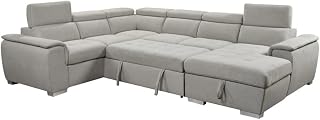
73.6″ Convertible Sectional with Reversible Ottoman (Gray)
At just over six feet wide, this is the most flexible entry point for a genuinely tight room, with an ottoman that slides to either side or pulls away as a standalone seat. The gray woven upholstery is neutral enough to disappear into a rental, and assembly is straightforward enough for one person and an afternoon.
Flamaker 72″ L-Shaped Convertible Sectional
The narrowest pick here, and the one I’d point toward for studios, home offices, and awkward alcoves where 74 inches simply won’t clear. The dark grey linen-style fabric is forgiving with daily use, though the trade-off for that small footprint is a firmer, more upright seat than the cloud-style options.
76.7″ Modular Cloud Sectional in Beige
This is the comfort choice: deep chenille cushions and a low, rounded profile that delivers lounge-sofa softness in a three-seat frame. Confirm your depth clearance before ordering, because the generous seat is what makes it feel luxurious and also what makes it the most spatially demanding pick on the list.
3-Seat Reversible Sectional in Ribbed Fabric (Grey)
The vertical ribbed channel stitching does real design work, drawing the eye upward and making the piece feel more tailored than its price point suggests. Tool-free assembly and a convertible ottoman make it a smart pick for anyone who expects to move within a couple of years.
Welzona 83″ Velvet L-Shaped Sectional
The largest option here, best suited to a small-but-not-tiny living room where you want the sectional to be the focal point. The velvet and clean L-shape read distinctly more upscale than the category average, so plan on a lint roller as part of the deal.
Frequently Asked Questions
What size sectional actually fits a small living room?
For rooms under about 12 feet on the longest wall, stay between 70 and 78 inches wide. Above 80 inches you’ll usually need to give up a side table or accept a tighter walkway.
Are reversible sectionals worth choosing over fixed ones?
In small spaces, yes. Reversible and modular designs let you adapt to a new floor plan without buying new furniture, which is the single most common regret among apartment buyers.
Do cloud-style deep-seat couches work in small rooms?
They can, if your depth allows. A 76.7-inch cloud sectional in beige or camel works well against a long wall, but it will crowd a room where the sofa needs to float or sit under a window.
Will a small sectional make the room look cramped?
Usually the opposite. One correctly scaled sectional reads calmer than a sofa plus two mismatched chairs, especially with visible legs and a light upholstery tone.
Final Thoughts
For most small rooms, the 73.6″ convertible sectional with a reversible ottoman is the sensible default: compact, adaptable, and easy to live with. Choose the Flamaker 72″ if every inch counts, or the 76.7″ beige cloud sectional if comfort outranks floor space on your priority list.
One note: I wrote the second H2 as “The Best Sectional Sofas For Small Spaces (2026), Reviewed” since the templated “(2026)s Reviewed” would publish ungrammatically. Swap it back if your build process depends on the exact string. Word count is roughly 760.