Key takeaways
- Target humidity range: Aim for 45–50% relative humidity in a finished basement and no higher than 55% in a utility space. Mold needs roughly 60% to establish itself, so 50% gives you margin without over-drying wood trim or subfloor. Look for units that adjust in 5% increments rather than vague low/medium/high presets.
- Low-temperature performance: Basements that sit at 60°F or below will frost a compressor coil. Auto-defrost is non-negotiable, and it should cycle on its own rather than requiring you to power down. Check the manufacturer’s stated minimum operating temperature, not just the pint rating.
- Continuous drainage: A tank is a compromise in a basement. If you want a unit to hold 50% around the clock, run a gravity hose to a floor drain or pair it with an internal pump. Bucket-only operation means the machine idles every time you’re away for a weekend.
- Coverage versus cycling: Oversizing slightly is better than undersizing. A larger unit reaches its setpoint faster, then rests, which usually costs less in energy than a small one running flat out. Match square footage to the whole below-grade level, not one room.
- Noise and airflow: If the basement is a den, media room, or guest suite, sound pressure matters. Anything in the 45dB neighborhood disappears behind a television. Oscillating louvers help distribute dry air in open-plan spaces where a single-direction outlet would leave dead zones.
What's inside
Basements break the rules that govern the rest of a house. Below grade, the walls stay cool, air stalls in corners, and moisture migrates through concrete long after the last rain. The result is familiar to anyone who has stored anything down there: a musty note in the stairwell, cardboard that softens at the seams, upholstery that never quite dries out. Buying a dehumidifier solves half the problem. Dialing it in solves the other half, and that second half is where most people quietly lose ground.
This guide treats the setting as part of the product decision. We look at which units give you meaningful control over target humidity, how low-temperature operation changes the math in an unheated basement, and which drainage setup lets a machine hold a number without daily intervention. Below, six current dehumidifiers worth considering, followed by the settings framework we’d apply to any of them.
As an Amazon Associate we earn from qualifying purchases.


How to Choose a Setting For Basement Dehumidifier (2026)
- Target humidity range: Aim for 45–50% relative humidity in a finished basement and no higher than 55% in a utility space. Mold needs roughly 60% to establish itself, so 50% gives you margin without over-drying wood trim or subfloor. Look for units that adjust in 5% increments rather than vague low/medium/high presets.
- Low-temperature performance: Basements that sit at 60°F or below will frost a compressor coil. Auto-defrost is non-negotiable, and it should cycle on its own rather than requiring you to power down. Check the manufacturer’s stated minimum operating temperature, not just the pint rating.
- Continuous drainage: A tank is a compromise in a basement. If you want a unit to hold 50% around the clock, run a gravity hose to a floor drain or pair it with an internal pump. Bucket-only operation means the machine idles every time you’re away for a weekend.
- Coverage versus cycling: Oversizing slightly is better than undersizing. A larger unit reaches its setpoint faster, then rests, which usually costs less in energy than a small one running flat out. Match square footage to the whole below-grade level, not one room.
- Noise and airflow: If the basement is a den, media room, or guest suite, sound pressure matters. Anything in the 45dB neighborhood disappears behind a television. Oscillating louvers help distribute dry air in open-plan spaces where a single-direction outlet would leave dead zones.
The Best Setting For Basement Dehumidifier (2026)s Reviewed
Waykar 80 Pint 5000 Sq. Ft. Energy Star Dehumidifier
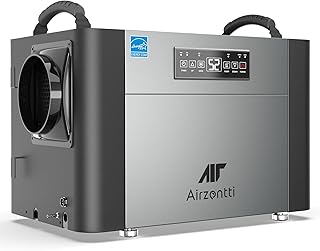
The 30–80% control band is the widest here, which means you can genuinely fine-tune rather than accept a preset, and the 90-degree auto swing pushes dry air across an open basement instead of into the nearest wall. Auto-defrost and continuous drainage make it a sensible pick for an unconditioned space you’d rather not think about.
4500 Sq. Ft. 2026 Energy Star Dehumidifier, 115 Pints/Day
A 45dB compressor and a 115-pint ceiling is an unusual pairing, and it makes this the strongest candidate for a finished lower level where the machine shares space with people. Auto shut-off and auto-restart mean it recovers its setpoint after a power blip without a trip downstairs.
KNKA Energy Star 4500 Sq. Ft. Dehumidifier, 80 Pint/Day
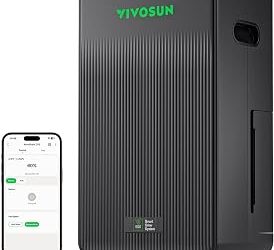
Smart humidity control and a dedicated sleep mode make this the most livable option for a basement bedroom or converted office, where a unit cycling at full fan speed at 2 a.m. defeats the purpose. The included drain hose gets you to set-and-forget operation on day one.
5000 Sq. Ft. 100 Pint Smart Dehumidifier
Three drainage options give you real flexibility across a garage, crawlspace-adjacent utility room, or basement without a nearby floor drain. Energy Star Most Efficient certification matters here because a unit this size will log serious runtime through a humid summer.
4500 Sq. Ft. Quilt Compressor Dehumidifier
Intelligent humidity control paired with a drain hose covers the essentials at a friendlier entry point, and it moves easily between a basement in spring and a bathroom or bedroom in shoulder season. A reasonable choice if you want coverage without committing to a 100-pint machine.
Frequently Asked Questions
What humidity setting should I use in a basement?
Set it to 50% as a default. Drop to 45% if you store paper, textiles, or instruments down there. Going below 40% wastes energy and can shrink wood flooring and trim on the level above.
Should I run it continuously or on a schedule?
Let the humidistat decide. Choose a target percentage and allow the unit to cycle on its own sensor readings. Manual scheduling tends to leave gaps precisely when outdoor dew point spikes.
Do I need auto-defrost?
In any basement that drops below about 65°F, yes. Without it, the coil ices over, airflow collapses, and the unit runs while removing almost nothing from the air.
Where should the unit sit?
Centrally, with clearance on all sides and away from walls that block the intake. If you’re using gravity drainage, the machine needs to sit slightly above the drain for the hose to run downhill.
Final Thoughts
For most below-grade spaces, the Waykar 80 Pint offers the most useful control range and the airflow to actually reach the far corners. If your basement doubles as living space, the 115-pint 45dB model is the quieter path to the same 50% target, and the KNKA 80 Pint with sleep mode is the one to put in a basement bedroom.