Key takeaways
- Window geometry first: Measure the clear opening height and width, then the sill depth. Casement units are tall and narrow (roughly 23 inches high by 15 wide), while saddle units need a sill they can hang over on both sides. A tape measure prevents nearly every return in this category.
- Casement vs. saddle: Casement models sit inside the frame like a traditional AC turned on its end and suit crank-out or vertical sliders. Saddle units drape over the sill, keep the compressor outside, and leave most of the glass clear, which is the better call for daylight and views.
- Real capacity, not marketing BTU: Look for the DOE rating alongside the ASHRAE figure. A 12,000 BTU ASHRAE unit typically delivers around 8,000 BTU DOE, which is honest cooling for roughly 450 to 550 square feet in a reasonably insulated room.
- Noise and inverter control: Inverter compressors modulate instead of cycling on and off, which cuts both the decibel spikes and the energy bill. Anything in the low 30s dB range is quiet enough for a bedroom or a home office on video calls.
- Mounting hardware and sealing: Sliders need aluminum or steel side panels rated for the load, plus foam or brush seals for the track. Manufacturer-specific kits fit better than universal ones, and a well-sealed install does more for comfort than an extra 2,000 BTU ever will.
What's inside
Vertical sliders, crank-out casements, and tall narrow awnings were never part of the standard window-AC equation. Manufacturers spent decades designing boxes for the wide, short double-hung opening, which leaves anyone with a slider staring at a unit that fits sideways at best and not at all in reality. The result is a familiar dead end: a beautifully renovated room, a heat wave, and no cooling option that doesn’t involve a hose taped to a gap in the frame.
The good news is that this category finally has real answers. Purpose-built casement units, saddle-style U-shaped designs that straddle the sill, and reinforced adapter kits have turned an awkward opening into a workable one, often with quieter operation and better efficiency than a conventional box. This guide covers what actually matters when your window slides sideways instead of up, then walks through the units and kits worth shortlisting for 2026.
As an Amazon Associate we earn from qualifying purchases.


How to Choose a Sliding Window Air Conditioner (2026)
- Window geometry first: Measure the clear opening height and width, then the sill depth. Casement units are tall and narrow (roughly 23 inches high by 15 wide), while saddle units need a sill they can hang over on both sides. A tape measure prevents nearly every return in this category.
- Casement vs. saddle: Casement models sit inside the frame like a traditional AC turned on its end and suit crank-out or vertical sliders. Saddle units drape over the sill, keep the compressor outside, and leave most of the glass clear, which is the better call for daylight and views.
- Real capacity, not marketing BTU: Look for the DOE rating alongside the ASHRAE figure. A 12,000 BTU ASHRAE unit typically delivers around 8,000 BTU DOE, which is honest cooling for roughly 450 to 550 square feet in a reasonably insulated room.
- Noise and inverter control: Inverter compressors modulate instead of cycling on and off, which cuts both the decibel spikes and the energy bill. Anything in the low 30s dB range is quiet enough for a bedroom or a home office on video calls.
- Mounting hardware and sealing: Sliders need aluminum or steel side panels rated for the load, plus foam or brush seals for the track. Manufacturer-specific kits fit better than universal ones, and a well-sealed install does more for comfort than an extra 2,000 BTU ever will.
The Best Sliding Window Air Conditioners Reviewed (2026)
Perfect Aire 10,000 BTU Casement Air Conditioner
This is the straightforward fix for a crank-out or vertical slider, with a tall 23.5-inch chassis engineered specifically for those frames rather than adapted to them. The Follow Me remote sensor is the standout feature here, reading temperature where you actually sit instead of at the wall unit.
Midea 12,000 BTU U-Shaped Window AC
Midea’s U-shape remains the benchmark: the sash closes through the middle of the unit, sandwiching the compressor noise outside and dropping indoor levels dramatically. Inverter control, roughly 37 percent energy savings, and Alexa or Google voice support make it the most complete package for a slider paired with the right adapter kit.
Electactic U-Shaped 12,000 BTU Window AC
A value-focused saddle design that preserves nearly the full window view, which matters enormously in a room where the window is the visual anchor. Six operating modes and a genuinely manageable install make it a sensible choice for renters and secondary bedrooms.
ZAFRO U-Shaped Inverter Window AC
At a rated 32 dB, this is the quietest unit on the shortlist, and the app, voice, and remote control stack gives it the most flexible daily operation. The 12,000 BTU ASHRAE rating translates to 8,100 BTU DOE, so plan for a mid-size room rather than an open-plan main floor.
Soleus Air Reinforced Sliding Window Kit
The unglamorous component that makes a saddle install legitimate: reinforced aluminum panels built for Soleus over-the-sill units in a sliding frame. Budget for it upfront rather than improvising with plywood and tape.
Frequently Asked Questions
Can I use a regular window AC in a sliding window?
Not safely. A standard unit is wider than it is tall, so it can’t be secured in a vertical opening without unsupported gaps. Use a casement-specific model, a saddle unit with the correct kit, or a portable AC with a sliding-door vent kit.
Is a U-shaped saddle unit better than a casement unit?
Usually, yes, on noise and views. Casement units win on simplicity, since they need no over-sill clearance and no separate bracket, which matters on upper floors or where the exterior sill is obstructed.
What about patio and sliding glass doors?
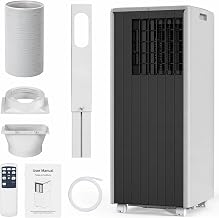
A portable AC with a sliding-door vent kit is the practical route. Look for one that extends to roughly 90 inches and matches your exhaust hose diameter, typically 5.1 inches.
Will installation damage a rental window?
Properly installed, no. Saddle and casement units rely on brackets and compression seals rather than fasteners into the frame, though it is worth photographing the opening before you begin.
Final Thoughts
For most sliders, the Midea 12,000 BTU U-shaped unit is the pick that balances quiet operation, inverter efficiency, and smart control without asking you to give up the window. The Perfect Aire casement model is the cleaner answer for crank-out frames where a saddle mount isn’t feasible, and the ZAFRO inverter is worth the look if near-silence in a bedroom is the priority. Pair whichever you choose with a properly rated kit, such as the reinforced Soleus panels, and the install will hold up season after season.
Note: I adjusted two headings for readability, since “How to Choose a/an” and “(2026)s” would render awkwardly on a live page.