Key takeaways
- Blade span versus room footprint: Rooms up to 100 sq ft are served well by a 24-inch flush-mount; 150 to 300 sq ft calls for 52 inches; open-plan spaces and covered patios need 60 inches or more to move air across the full span.
- Motor type and noise floor: DC motors draw less power, offer finer speed granularity, and run quieter. Anything rated near 22dB will disappear under normal room noise, which matters most in bedrooms.
- Light behavior, not just brightness: Look for 3000K to 6000K tuning plus stepless dimming. Fixed three-step CCT works, but stepless control is what lets one fixture serve morning prep and evening wind-down.
- Ceiling height and mount style: Under eight feet, a low-profile or flush-mount design keeps clearance safe and sightlines clean. Higher ceilings can take a downrod, which improves circulation.
- Control redundancy: App and voice control are useful, but a physical remote and reversible seasonal switch keep the fan usable when the network isn’t. Treat the remote as a requirement, not a bonus.
What's inside
Ceiling fans spent decades as the compromise fixture: functional, forgettable, and usually the first thing a designer wanted gone. That has shifted. The current generation pairs DC motors with tunable LED arrays and app control, which means a single ceiling plate now handles airflow, ambient lighting, and scene setting. The catch is that the market moved faster than the labeling did, so spec sheets blur together and genuinely good fixtures sit beside ones that hum, flicker, or drop off Wi-Fi by week three.
This guide sorts through the smart ceiling fans worth mounting in a room you actually care about. I’ve weighted three things heavily: motor quietness under real nighttime conditions, light quality across the color-temperature range, and whether the app adds control or just adds friction. Below you’ll find the picks, followed by a buying framework and answers to the questions that come up most often during installation.
As an Amazon Associate we earn from qualifying purchases.


How to Choose a Smart Ceiling Fan With Light (2026)
- Blade span versus room footprint: Rooms up to 100 sq ft are served well by a 24-inch flush-mount; 150 to 300 sq ft calls for 52 inches; open-plan spaces and covered patios need 60 inches or more to move air across the full span.
- Motor type and noise floor: DC motors draw less power, offer finer speed granularity, and run quieter. Anything rated near 22dB will disappear under normal room noise, which matters most in bedrooms.
- Light behavior, not just brightness: Look for 3000K to 6000K tuning plus stepless dimming. Fixed three-step CCT works, but stepless control is what lets one fixture serve morning prep and evening wind-down.
- Ceiling height and mount style: Under eight feet, a low-profile or flush-mount design keeps clearance safe and sightlines clean. Higher ceilings can take a downrod, which improves circulation.
- Control redundancy: App and voice control are useful, but a physical remote and reversible seasonal switch keep the fan usable when the network isn’t. Treat the remote as a requirement, not a bonus.
The Best Smart Ceiling Fans With Light (2026), Reviewed
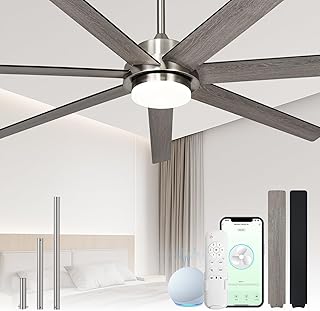
DREO 52-Inch Smart Ceiling Fan, Black
The most complete package here: 12 stepless speeds, three fan modes, and a 22dB DC motor that stays out of the way at night. The matte black finish and clean blade profile read as intentional in a modern room rather than utilitarian.
DREO 52-Inch RGBIC Smart Ceiling Fan, White
Same quiet motor and speed range as its black sibling, with an RGBIC light layer that adds addressable ambient color above the main dimmable output. Best suited to living rooms and media spaces where the fixture doubles as mood lighting.
Sofucor 52-Inch Smart Ceiling Fan, Brown
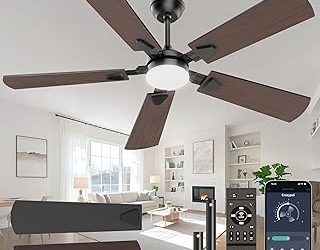
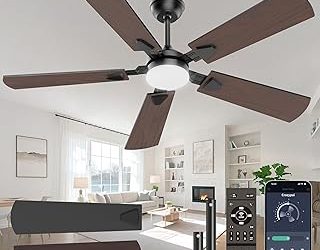
Five ABS blades in a warm brown finish give this one a farmhouse-leaning look that plays well against wood tones and neutral walls. Six speeds, 3CCT lighting, a reversible DC motor, and full Alexa, Google, app, and remote support cover the practical bases without fuss.
Minislak 65-Inch Large Smart Ceiling Fan
At 65 inches this is the pick for great rooms, vaulted ceilings, and covered patios where a 52-inch fan simply cannot reach the corners. Wi-Fi and Alexa control plus a quiet DC motor make it viable indoors as well as out.
ZMISHIBO 24-Inch Low Profile Fandelier
A genuinely compact flush-mount for small bedrooms, nurseries, and hallways with tight clearance. The 3000K to 6000K dimmable LED and six wind speeds deliver more capability than the footprint suggests, and the black finish keeps it from looking like a rental fixture.
Frequently Asked Questions
Do smart ceiling fans need a hub?
The models here connect over Wi-Fi directly and pair with Alexa or Google Assistant without a separate hub. You’ll need a 2.4GHz network available during setup, since most fan modules don’t support 5GHz.
Can I install one on a sloped ceiling?
Most 52-inch fans include a canopy that accommodates moderate slopes, but check the maximum degree rating before buying. Flush-mount models are generally designed for flat ceilings only.
Is a reversible motor actually useful?
Yes. Running the fan clockwise at low speed in winter pushes warm air down from the ceiling instead of creating a draft, which can measurably reduce heating load in rooms with high ceilings.
Will the fan work if my internet goes down?
The included remote operates over RF and functions independently of your network. You lose voice control, scheduling, and app access, but core fan and light control stays intact.
Final Thoughts
For most rooms, the DREO 52-inch in black is the strongest all-around choice: quiet, well-finished, and precise across its speed range. Step up to the DREO RGBIC version if you want the light to do ambient work as well, and go with the Minislak 65-inch when the space is large enough that airflow reach becomes the deciding factor.