Key takeaways
- Measure before you commit: Record interior drawer depth, width, and height, then subtract a few millimeters for clearance. Tray sets and racks that nearly fit will rattle, and the ones that overhang will keep a drawer from closing.
- Match format to tool type: Loose hardware belongs in a compartmented cabinet, wrenches in a labeled magnetic rack, pliers in a slotted holder. Mixing categories into one bin is what created the mess in the first place.
- Look at wall thickness: Thin, flexible plastic bows under socket sets and cracks in cold garages. Extra-thick walls and reinforced corners hold their shape through years of drawer slams.
- Plan for reconfiguration: Modular trays and interlocking dividers let you rebuild a layout as your kit grows. Fixed-cavity inserts lock you into the tool collection you own today.
- Consider grip and finish: Non-slip bases keep organizers planted during transport, and a matte black finish reads as intentional rather than utilitarian when the drawer is open in a shared space.
What's inside
Anyone who has knelt in front of an open tool chest, sifting through a shifting pile of sockets and stray fasteners, knows the real problem is not the tools. It is the empty space around them. Drawers are designed as generous rectangles, and gravity turns that generosity into chaos every time the chest rolls across a garage floor. A workshop can be beautifully outfitted and still feel unusable when a five-second reach becomes a five-minute excavation.
Storage design has caught up with how people actually use their homes: garages double as studios, basements host side businesses, and the workbench sits in view of the living space more often than it used to. This guide looks at the organizers worth building a system around, from wall-hung small parts cabinets to modular trays and magnetic racks, with notes on materials, sizing, and the details that separate a lasting layout from a temporary tidy-up.
As an Amazon Associate we earn from qualifying purchases.




How to Choose a/an Tool Box Organizer (2026)
- Measure before you commit: Record interior drawer depth, width, and height, then subtract a few millimeters for clearance. Tray sets and racks that nearly fit will rattle, and the ones that overhang will keep a drawer from closing.
- Match format to tool type: Loose hardware belongs in a compartmented cabinet, wrenches in a labeled magnetic rack, pliers in a slotted holder. Mixing categories into one bin is what created the mess in the first place.
- Look at wall thickness: Thin, flexible plastic bows under socket sets and cracks in cold garages. Extra-thick walls and reinforced corners hold their shape through years of drawer slams.
- Plan for reconfiguration: Modular trays and interlocking dividers let you rebuild a layout as your kit grows. Fixed-cavity inserts lock you into the tool collection you own today.
- Consider grip and finish: Non-slip bases keep organizers planted during transport, and a matte black finish reads as intentional rather than utilitarian when the drawer is open in a shared space.
The Best Tool Box Organizer (2026)s Reviewed
IRIS USA 44-Drawer Small Parts Storage Cabinet
This is the piece that solves the fastener problem permanently: 44 clear pull-out drawers in a black frame that mounts to a wall, sits on a shelf, or stacks with a second unit as your inventory grows. Made in the USA with crisp molding and smooth drawer action, it earns its place in a workshop that people actually see.
75 Drawer Parts Storage Cabinet
When you are sorting a lifetime of screws, bolts, anchors, and washers, drawer count matters more than footprint, and 75 compartments gives you room to separate by both size and thread type. It works best as a dedicated hardware station near the bench rather than a general catch-all.
60 pcs Magnetic Modular Wrench Organizer
Magnetic bases hold each wrench in place while metric and SAE labels let you spot the right size without lifting a thing, which is the entire point of an organized drawer. The modular design means you can spread the holders across two drawers or consolidate them into one tight row.
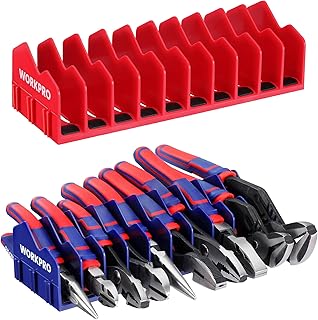
WORKPRO 2-Pack Plier Organizer Rack
Twenty slots across two racks handle a serious plier and cutter collection, and the high-strength plastic body with a non-slip rubber base stays put in a rolling chest. The extendable design is the quiet advantage here, letting each rack size itself to the drawer instead of the other way around.
A-LuGei 69 PCS Tool Box Organizer Tray Divider Set
Sixty-nine bins across five sizes in a uniform black finish let you tile an entire drawer with almost no wasted space, then rearrange the grid whenever your kit shifts. It is equally at home in a rolling tool cart, a workbench drawer, or a desk that needs the same discipline.
Frequently Asked Questions
How many drawers do I actually need in a parts cabinet?
Count your current hardware categories and add roughly a third for growth. Most people underestimate, which is why the 44-drawer and 75-drawer formats tend to outlast smaller units.
Will tray dividers slide around when I move my tool chest?
Snug sizing does most of the work, and a non-slip base handles the rest. If a gap remains along one edge, a thin strip of shelf liner stops the drift.
Can I mount a small parts cabinet to drywall?
Only into studs or with appropriate anchors rated well above the loaded weight, since hardware gets heavy fast. Wall mounting also frees up bench surface, which is often the scarcer resource.
Are magnetic wrench holders safe for my tools?
Yes. The magnets are not strong enough to affect steel hand tools, though keep them away from digital measuring devices and storage media.
Final Thoughts
For a workshop you want to keep organized for years, start with the IRIS USA 44-Drawer Cabinet for hardware and the A-LuGei 69 PCS Tray Divider Set to bring order to your drawers, then add the 60 pcs Magnetic Wrench Organizer once you are ready to give your wrench collection a permanent, labeled home.