Key takeaways
- Mobility versus permanence: If your work happens in one spot, a wall-mounted rack gives you the best storage-per-square-foot ratio and keeps the floor clear. If tools move with you, prioritize a stacking system or a rolling chest with a telescoping handle and wheels rated for gravel and thresholds, not just smooth concrete.
- Load rating, checked honestly: Manufacturer weight limits describe the shelf, not the wall. A rack rated for 600 or 800 pounds only performs that way anchored into studs with the supplied hardware. Verify your framing before you buy at the top of the range.
- Weather and dust resistance: Unconditioned garages swing 60 degrees between seasons and humidity rusts unprotected steel. Look for gasketed lids, water-resistant seals, and powder-coated finishes if your space isn’t climate controlled.
- Charging integration: The most useful upgrade of the last few years is a rack with built-in power strips. Batteries charge where they’re stored, which eliminates the loose-charger tangle and the dead-battery surprise on a Saturday morning.
- Interoperability: Modular platforms let you add drawers, deep bins, and shallow trays over time on a common footprint. Buying into an established system beats accumulating mismatched boxes that stack badly and open awkwardly.
What's inside
Tool storage is the last frontier of a well-designed home. Kitchens get islands, bedrooms get built-ins, and then there’s the garage: a graveyard of grocery bags full of extension cords, drill batteries scattered across a workbench, and a socket set living permanently in the trunk of a car. The frustration isn’t a lack of tools. It’s that nothing has an address. Most buyers end up cycling through cheap plastic totes for years before admitting that storage is infrastructure, not an accessory, and that the right system pays for itself the first time a project doesn’t stall over a missing bit driver.
This guide looks at tool storage the way we’d approach any other piece of functional furniture: does it hold up, does it work with the room, and will it still make sense in five years. We’ve grouped the picks into two camps that solve different problems. Mobile systems, meaning stackable boxes and rolling chests, travel between the truck, the basement, and the job site. Wall-mounted racks reclaim vertical space and put cordless tools on display where you can actually see them. Below, our current recommendations, plus the specs that genuinely matter and the ones that are marketing noise.
As an Amazon Associate we earn from qualifying purchases.


How to Choose a Tool Storage (2026)
- Mobility versus permanence: If your work happens in one spot, a wall-mounted rack gives you the best storage-per-square-foot ratio and keeps the floor clear. If tools move with you, prioritize a stacking system or a rolling chest with a telescoping handle and wheels rated for gravel and thresholds, not just smooth concrete.
- Load rating, checked honestly: Manufacturer weight limits describe the shelf, not the wall. A rack rated for 600 or 800 pounds only performs that way anchored into studs with the supplied hardware. Verify your framing before you buy at the top of the range.
- Weather and dust resistance: Unconditioned garages swing 60 degrees between seasons and humidity rusts unprotected steel. Look for gasketed lids, water-resistant seals, and powder-coated finishes if your space isn’t climate controlled.
- Charging integration: The most useful upgrade of the last few years is a rack with built-in power strips. Batteries charge where they’re stored, which eliminates the loose-charger tangle and the dead-battery surprise on a Saturday morning.
- Interoperability: Modular platforms let you add drawers, deep bins, and shallow trays over time on a common footprint. Buying into an established system beats accumulating mismatched boxes that stack badly and open awkwardly.
The Best Tool Storage (2026)s Reviewed
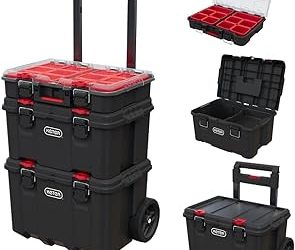
Keter Stack N Rolling Tool Box, 3-Piece Modular System
The most versatile mobile setup here: three interlocking units on all-terrain wheels with a telescoping handle, so a full kit rolls across a lawn or up a curb without a second trip. The weatherproof construction and heavy-duty latches make it a genuine outdoor-capable option, and it breaks down into individual boxes when you only need the small stuff.
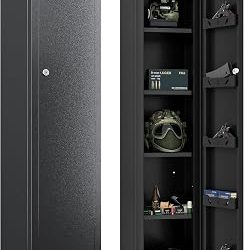
POKIPO 49″ Power Tool Organizer Wall Mount
Four steel shelves, a 12-drill capacity, and an 800-pound load rating turn a bare wall into an organized command center. At just over four feet wide it demands real estate, but the payoff is every cordless tool visible at a glance and a dedicated battery shelf that ends the hunt for a charged pack.
DEWALT TSTAK Extra Large Tool Box (DWST17806)
The workhorse base of the TSTAK ecosystem, with enough volume for full-size tools and a removable tray that keeps fasteners and small hand tools from sinking to the bottom. Water and debris resistance is solid, and it clicks cleanly into other TSTAK units for a stack that actually stays together in transit.
POKIPO Large Power Tool Organizer with Charging Station
A more compact take on the wall rack, this one bundles four power strips and eight drill holders into a 600-pound-rated frame, so charging and storage happen in the same footprint. It’s the smartest pick for a single-bay garage where a 49-inch unit won’t fit.
DEWALT TSTAK Double Drawer Organizer (DWST17804)
Drawers beat lids for anything you reach for constantly, and this two-drawer unit gives you sorted access without unstacking the tower. The 16.5-pound capacity per configuration is modest, so keep it to bits, blades, and hardware rather than heavy power tools.
Frequently Asked Questions
Is a wall rack or a rolling box the better first purchase?
Buy for where the work happens. Homeowners with a dedicated garage bay get more from a wall rack, since it clears the floor and makes inventory visible. Anyone renting, or anyone who works across multiple properties, should start with a mobile stacking system.
How do I mount a heavy rack safely?
Locate studs with a reliable finder, anchor into at least two of them using the included lag hardware, and skip drywall anchors entirely for any rack rated above a couple hundred pounds. Load the bottom shelves heaviest and keep the top shelf light.
Do tool boxes really need to be waterproof?
Water resistance matters more than most buyers expect. Boxes ride in open truck beds, sit on damp basement floors, and live in garages where condensation forms on cold mornings. Gasketed lids protect metal tools and battery contacts from slow corrosion.
Can I mix brands in a modular stack?
Generally no. Latch geometry is proprietary, so cross-brand stacks sit unstable and can separate when carried. Commit to one platform for the boxes that travel together, and use other brands for stationary storage.
Final Thoughts
For most homes, the Keter Stack N Rolling system is the best all-around investment: weatherproof, genuinely mobile, and expandable without buying into an expensive ecosystem. If your tools stay put, the POKIPO 49″ wall mount delivers the biggest visual and practical transformation per dollar, while the DEWALT TSTAK Extra Large box remains the right foundation for anyone building a modular kit they’ll carry for the next decade.