Key takeaways
- Wheels: first to fail. Housings crack, casters develop flat spots, and grit gets into the bearings.
- Telescoping handle: second to fail. The locking mechanism wears and the handle starts collapsing under load.
- Zippers: third. Sliders lose tension; the tape abrades at the corners where the bag is overstuffed.
- Shell or fabric: rarely the cause of replacement. Cosmetic damage accumulates but structural failure is uncommon.
- Interior lining and dividers: the last thing to matter, and the first thing marketing talks about.
For most travelers, the right Travelpro set comes down to three numbers: 22 × 14 × 9 inches for a domestic carry-on, 45 linear inches for the regional-jet limit, and 62 linear inches for the checked-bag ceiling most airlines enforce. Add one decision — softside or hardside — and one budget band, and the choice mostly makes itself. A Maxlite 5 21-inch expandable carry-on spinner plus a 25-inch checked spinner covers the majority of domestic trips at the lowest weight penalty Travelpro sells. A Platinum Elite 21-inch carry-on with a 25-inch and 29-inch companion is the buy-once answer if you fly often enough that wheels, handles, and warranty terms matter more than the sticker. And if you mostly drive, the carry-on math is irrelevant — buy the largest 29-inch spinner and a soft tote, and ignore everything else on this page.
What follows is a size-by-size, material-by-material comparison of the Travelpro lines that actually exist in 2026, with the measurements you need to make the call: exterior dimensions including wheels and handles, expanded depth, empty weight, usable packing volume, shell construction, wheel geometry, and the trip lengths each piece genuinely suits.
Our top picks
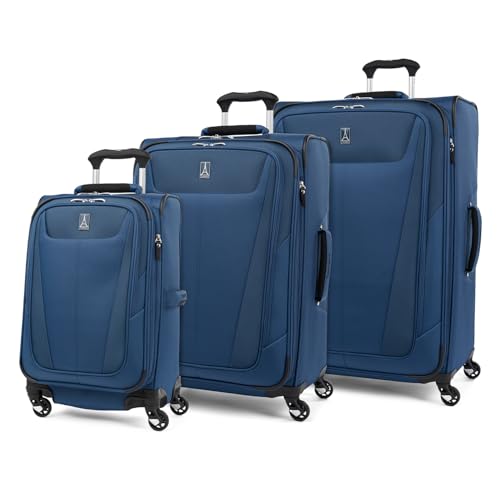

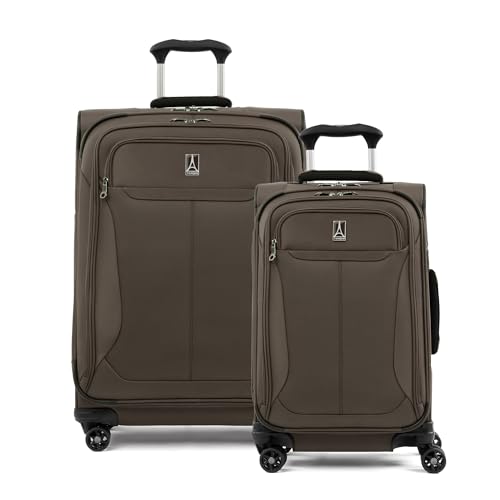

As an Amazon Associate we earn from qualifying purchases at no extra cost to you.
How to match a Travelpro set to trip length before you look at price
Trip length is the wrong first question. The right first question is how many bags you are willing to carry, because that determines whether you need a set at all. Travelpro sells three-piece sets, but a set only saves money if you will actually use all three pieces on different trips. Plenty of buyers would be better served by a two-piece configuration — one carry-on and one mid-size checked bag — plus a tote for the personal item slot.
Here is the honest mapping between trip length and capacity, using real numbers rather than marketing language. Packing volume is measured in liters, and a liter holds roughly one rolled t-shirt, or one pair of rolled jeans, or two rolled shirts of lighter fabric.
| Trip length | Nights | Realistic packing volume | Travelpro size that fits | Empty weight to expect |
|---|---|---|---|---|
| Overnight / personal item only | 1–2 | 20–28 L | Rolling underseat carry-on (14–16 in) | 4.5–6 lb |
| Short domestic carry-on | 2–4 | 35–42 L | 19–21 in expandable carry-on spinner | 5.5–8.5 lb |
| Week to ten days, carry-on plus checked | 5–10 | 65–75 L (checked) + 40 L (carry-on) | 25 in expandable spinner | 8–11 lb |
| Two weeks or cold-weather packing | 10–16 | 95–110 L | 28–29 in expandable spinner | 9.5–13 lb |
| Family of four, one vehicle | Any | 200 L+ across pieces | Two 29 in + two 21 in carry-ons | Varies |
Two things break this table in practice. First, expansion. Nearly every softside Travelpro expands by roughly 2 inches of depth, which adds about 15–20% volume but pushes the bag past carry-on depth limits the moment you unzip it. An expanded 21-inch carry-on measures about 11 inches deep and will not fit a sizer on most US carriers. Expansion is a checked-bag feature that happens to exist on carry-ons; treat it as emergency capacity, not planning capacity.
Second, weight. Airlines in the US generally do not weigh carry-ons, but international and regional carriers do, and a fully packed 25-inch spinner can run 45–50 lb. Most economy checked allowances cap at 50 lb (23 kg); premium cabins often go to 70 lb (32 kg). Buying a lighter bag does not change the allowance, but it does buy you 3–5 lb of packing headroom before you hit the limit, which is the real reason the Maxlite line exists.
The three Travelpro tiers, and what each one actually buys you
Travelpro’s catalog is easier to read once you accept that it is three tiers wearing a dozen collection names.
Tier 1: Platinum Elite and Platinum Elite LX
This is the flagship. The differentiators are the wheel design, the handle, the fabric, and the warranty. Platinum Elite softside pieces use a high-denier ballistic nylon with a water-repellent coating, a telescoping handle with two locking stops (roughly 38 in and 42.5 in), and self-aligning spinner wheels that are designed to straighten themselves as you roll rather than splaying outward. The LX variant updates trims, interior organization, and in some cases the wheel housing, but the underlying construction and warranty terms are close enough that you should choose between them on price and color availability rather than on capability. Platinum Elite is covered by Travelpro’s Worry Free limited lifetime warranty, which is the single most valuable thing in this tier.
Tier 2: Crew Classic, Crew VersaPack, and FlightCrew
The Crew family is built for people who travel for work and beat their bags up: flight crews, consultants, sales teams. Crew Classic is the traditional softside rollaboard-and-spinner lineup. Crew VersaPack is the modular version — the bags are built around removable packing cubes and a drop-in system so you can pull one cube out at a hotel without unpacking the whole bag. FlightCrew is the professional crew line, sized around airline crew requirements rather than passenger allowances; it is excellent gear but its dimensions are tuned to crew lockers, not to overhead bins on a passenger ticket, so check the numbers before you buy.
Crew pieces generally carry the same limited lifetime warranty as Platinum Elite, and in practice they are the most durable softside bags Travelpro makes because they are designed around a use case with no margin for failure.
Tier 3: Maxlite, Maxlite Air, Pathways, Runway, Bold, Pilot Air
This is the volume tier and where most buyers land. Maxlite 5 is the softside lightweight line — the 21-inch carry-on spinner weighs under 6 lb, which is remarkable for a bag with a lifetime warranty. Maxlite Air is the hardside counterpart, using a polycarbonate shell and a lighter frame. Pathways, Runway, Bold, and Pilot Air are value-oriented collections that trade some fabric weight, wheel smoothness, and interior detailing for a lower price. They are legitimate bags; they simply will not feel the same after five years of monthly flying as a Platinum Elite will.
Carry-on dimensions: the numbers that decide whether you gate-check
The domestic standard of 22 × 14 × 9 inches is a marketing convention as much as a rule. Every major US carrier publishes a limit close to it, and most measure the bag including wheels and handles, which is where the surprises happen. A bag sold as “21 inches” is often 23 inches tall once you include the wheel housings and the extended handle. Travelpro’s published dimensions generally include wheels and handles, which is the honest way to do it — but always verify against the specific spec sheet, because the same collection can vary by an inch between sizes.
| Airline (published limits, verify before flying) | Carry-on maximum | Personal item maximum |
|---|---|---|
| American Airlines | 22 × 14 × 9 in | 18 × 14 × 8 in |
| Delta Air Lines | 22 × 14 × 9 in | Must fit under the seat; no fixed published size |
| United Airlines | 22 × 14 × 9 in | 17 × 10 × 9 in |
| Southwest Airlines | 24 × 16 × 10 in | 18.5 × 13.5 × 8.5 in |
| Alaska Airlines | 22 × 14 × 9 in | Must fit under the seat |
| JetBlue | 22 × 14 × 9 in | 17 × 13 × 8 in |
| Spirit Airlines | 22 × 18 × 10 in | 18 × 14 × 8 in |
| Frontier Airlines | 24 × 16 × 10 in | 18 × 14 × 8 in |
| Ryanair (Europe) | 55 × 40 × 20 cm (21.7 × 15.7 × 7.9 in) | 40 × 20 × 25 cm |
| easyJet (Europe) | 56 × 45 × 25 cm (22 × 17.7 × 9.8 in) | 45 × 36 × 20 cm |
The practical takeaway: a 21-inch Travelpro carry-on at 9 inches deep clears every US carrier’s sizer with a little room. A 22-inch bag at 10 inches deep clears Southwest and Frontier but is at risk on American, Delta, and United. A 23-inch bag at 10.5 inches deep is a gate-check candidate on most of them. If you fly a mix of carriers, the 21-inch dimension is the safe purchase, and the extra inch of height you give up is worth about 4 liters of packing volume — less than one extra outfit.
European low-cost carriers are a different regime entirely. Ryanair’s 55 × 40 × 20 cm allowance is smaller in depth than the US standard, so a US-spec 21-inch carry-on will not fit the free cabin allowance; it fits the paid priority allowance instead. If you fly European budget carriers regularly, a 19-inch international-size carry-on is the correct buy, not a 21-inch.
Shell materials: the real trade-off table
Softside versus hardside is not a style question. It is a question about what you pack, how you pack it, and what you are willing to sacrifice when the bag gets thrown.
| Construction | What it is | Empty-weight penalty | Impact behavior | Access while packed | Where it shows up |
|---|---|---|---|---|---|
| Polycarbonate hardside | Molded shell, usually with a lined interior divider | Light to moderate (6.5–11 lb for 20–28 in) | Flexes and springs back; can dent and stay dented at corners | Poor — must open fully | Maxlite Air, Platinum Elite Hardside |
| Polypropylene / polycarbonate blend hardside | Lower-cost molded shell | Light | Stiffer, more likely to crack than flex at very low temperatures | Poor | Value hardside collections (Runway, Bold) |
| Ballistic nylon softside (high denier) | Woven fabric with a water-repellent finish over a frame | Moderate to heavy | Absorbs impact; fabric can abrade but rarely fails structurally | Excellent — front pockets and top-lid access | Platinum Elite, Crew Classic, Crew VersaPack |
| Polyester softside (mid denier) | Lighter woven fabric, thinner coating | Lowest | Absorbs impact; more prone to scuffs and seam stress | Very good | Maxlite 5, Pathways, Pilot Air |
| Softside with external expansion zipper | Same as above plus a 2 in expansion gusset | Adds 0.3–0.6 lb | Unchanged | Best — the expansion is usable mid-trip | Nearly all Travelpro softside |
The decision rule that actually holds up: if you pack clothes and shoes and want to add a jacket at the airport, softside wins because of the expansion zipper and the exterior pockets. If you pack fragile items, liquids, or anything that needs a rigid shell around it, hardside wins. If you fly to cold destinations in winter, softside has an edge because polycarbonate gets noticeably more brittle below freezing and a drop onto a frozen tarmac is the worst case for any hard shell.
One more material reality worth knowing: the thing that fails first on a softside bag is almost never the fabric. It is the zipper, the wheel housing, or the handle. On a hardside bag, it is the wheel housing, the telescoping handle, or a corner crack. This is why warranty coverage matters more than shell material — a lifetime warranty that covers wheels and handles is worth more than a marginally tougher shell with a two-year term.
Wheels, handles, and the parts that wear out first
Travelpro’s wheel story has three tiers. The flagship self-aligning spinner wheels use a caster geometry that pulls the bag back into line as you roll, which reduces the constant steering corrections that make four-wheel bags tiring on long concourses. The mid-tier spinner wheels are conventional dual-caster designs — perfectly good, just less self-correcting. The value tier uses smaller-diameter wheels with simpler housings that are more sensitive to pavement seams and carpet transitions.
Wheel diameter matters more than people expect. A 2-inch wheel rolls over a 1-inch threshold without much drama; a 1.5-inch wheel catches. If you regularly navigate cobblestones, brick sidewalks, or the transition strips in older airports, wheel size is a legitimate reason to move up a tier.
Handles: Travelpro uses a two-stop telescoping handle on most premium pieces, with stops around 38 inches and 42.5 inches. The two-stop design matters if you are tall or short — a single-stop handle forces tall users to stoop and short users to drag. The handle is also the second-most-common failure point after wheels, so check that the replacement parts are covered.
- Wheels: first to fail. Housings crack, casters develop flat spots, and grit gets into the bearings.
- Telescoping handle: second to fail. The locking mechanism wears and the handle starts collapsing under load.
- Zippers: third. Sliders lose tension; the tape abrades at the corners where the bag is overstuffed.
- Shell or fabric: rarely the cause of replacement. Cosmetic damage accumulates but structural failure is uncommon.
- Interior lining and dividers: the last thing to matter, and the first thing marketing talks about.
Practical consequence: buy the tier with the warranty and the wheel design you want, not the tier with the nicest interior. A 21-inch carry-on with premium wheels and a plain interior will outlast a bag with a beautiful interior and cheap casters by years.
Decision matrix: match the set to your situation
| Your situation | What to buy | Why |
|---|---|---|
| Fly 4–10 domestic round trips a year, mostly 2–4 nights | Maxlite 5 21 in expandable carry-on spinner | Under 6 lb, lifetime warranty, clears every US sizer at 9 in deep |
| Fly monthly or more, carry-on only | Platinum Elite 21 in expandable carry-on spinner | Self-aligning wheels and two-stop handle reduce fatigue; premium warranty covers the parts that fail |
| One checked bag, 5–10 night trips | Maxlite 5 25 in or Platinum Elite 25 in expandable spinner | 65–75 L is the sweet spot; stays under 50 lb packed for most people |
| Two-week trips, cold weather, or a family’s worth of clothes | 28–29 in expandable spinner | 95–110 L; accept that you will be near the 50 lb limit and pack accordingly |
| Frequent European budget-carrier flying | 19 in international-size carry-on | Fits the 55 × 40 × 20 cm cabin allowance that a 21 in US bag misses |
| Business travel with suits or dresses | Carry-on bi-fold garment bag plus a 21 in spinner | Garment bags keep formalwear flat; the spinner takes everything else |
| Road trips and driving holidays | 29 in spinner plus a soft tote | No size limits; the tote handles the overflow and the hotel-to-car shuffle |
| Crew, consultants, and weekly commuters | Crew Classic or Crew VersaPack 21 in | Built for abuse; VersaPack’s removable cubes speed up hotel stays |
| Underseat-only travel | Rolling underseat carry-on (14–16 in) | Fits under the seat in front of you; no overhead-bin competition |
Travelpro sets and pieces, by role
The sections below cover each collection and size as a distinct buying decision. Where two pieces in the same collection differ only in capacity, they share a section — but each size gets its own numbers, because the size is usually the decision.
Platinum Elite 21-inch expandable carry-on spinner
This is the reference point for the whole catalog. Travelpro lists it at roughly 21.75 × 14 × 9 inches including wheels and handles, with an empty weight in the 8–9 lb range — heavy for its size, and that weight is the price of the ballistic nylon, the wheel housings, and the handle assembly. Expanded, it adds about 2 inches of depth, taking it to roughly 11 inches and out of carry-on compliance on most US carriers.
Packing volume lands around 38–40 L unexpanded. That is enough for four to five days of warm-weather clothing if you pack with any discipline: five rolled shirts, two pairs of trousers, a week of socks and underwear, a Dopp kit, a laptop, and a pair of shoes. It is not enough for a week of cold-weather clothing, and no amount of compression cubes fixes that.
The self-aligning spinner wheels are the real differentiator. On a long concourse they track straighter than conventional casters, which means less wrist and shoulder work. The two-stop telescoping handle at roughly 38 and 42.5 inches accommodates a wide range of heights. The exterior has a front-access pocket sized for a laptop or tablet, which is genuinely useful at security.
Who it is for: anyone flying often enough that a cheaper bag’s wheels would annoy them within two years. Who it is not for: someone who flies twice a year and would rather spend the difference on the trip. The Maxlite 5 does 85% of the job at two-thirds of the weight.
Platinum Elite 25-inch expandable spinner
The 25-inch is the workhorse checked bag in the line. Travelpro lists it around 25.5 × 17.75 × 10.5 inches with an empty weight near 10.5 lb, and a packing volume in the 65–70 L range before expansion. Expanded, it gains roughly 2 inches of depth and about 15% volume.
Sixty-five to seventy liters is the number to hold onto. For a five-to-ten-night trip in temperate weather, that is one checked bag per person, no carry-on required. For a two-week trip it is tight but workable if you do laundry once. For a family of four, two 25-inch bags plus carry-ons will cover a week.
Weight discipline matters here. The bag itself eats 10.5 lb of your 50 lb allowance. Pack 35–38 lb of contents and you are at the limit with room for a souvenir. Weigh the packed bag on a luggage scale before you leave; it is the single most common cause of an expensive airport repack.
The 25-inch also sits in an awkward spot for some international carriers: it is over the carry-on limit but under the size most airlines consider “large,” which means it usually checks as a standard bag without an oversize fee. That is a mild advantage over the 29-inch.
Platinum Elite 29-inch expandable spinner
The 29-inch is the maximum practical checked bag. Travelpro lists it around 29 × 20 × 12 inches, empty weight near 12.5–13 lb, packing volume around 100–110 L before expansion. Fully packed, it will very often exceed 50 lb, which means either a lighter packing strategy or a premium-cabin allowance.
This is a road-trip and long-haul bag, not a domestic-weekend bag. Its real value is in two scenarios: a two-week international trip where you want one bag instead of two, and a driving holiday where weight limits do not apply. In any other scenario, two 25-inch bags are easier to handle, easier to fit in a rental car trunk, and less likely to trigger an overweight fee.
The practical downside nobody mentions: a fully packed 29-inch spinner weighs 45–55 lb, and lifting that into an overhead bin is not happening — you will check it, so you lose the carry-on advantage entirely. If you have any history of back trouble, two 25-inch bags beat one 29-inch bag every time, because each lift is roughly half the weight.
Platinum Elite compact / regional carry-on spinner
Travelpro sells a shorter carry-on in the Platinum Elite family aimed at regional jets and international carriers with tighter overhead bins. It lands in the 19-inch range with a depth around 9 inches, and it is the correct bag if you routinely fly regional aircraft where standard 21-inch spinners get gate-checked.
The trade-off is capacity: expect roughly 32–35 L instead of 38–40 L, which is about one outfit less. For a two-to-three-night trip that is irrelevant. For a four-night trip it means wearing the same pair of shoes twice.
If your home airport is a hub for a carrier that runs a lot of regional jets, this is worth the capacity loss. Gate-checking a bag is not the end of the world, but it costs you 20 minutes at each end and puts the bag in the hands of a ramp crew.
Platinum Elite LX: what the upgrade actually changes
The LX treatment updates trims, hardware finishes, and interior organization relative to standard Platinum Elite. In capability terms — shell material, wheel design, handle geometry, warranty terms — the two are close enough that the decision should be made on availability and price rather than on a spec-sheet advantage. If the LX is discounted below the standard Platinum Elite in the size you want, buy it. If it is priced above, you are paying for aesthetics and interior detailing, which is a legitimate thing to pay for but is not a durability upgrade.
The place LX genuinely differs is interior layout. The LX pieces tend to have more deliberate compartmentalization, which helps if you like to keep categories of clothing separated and hurts if you prefer one big cavity. If you pack with cubes, the extra dividers are mostly wasted.
Platinum Elite Hardside: the polycarbonate flagship
Travelpro’s premium hardside line uses a polycarbonate shell with the same wheel and handle hardware philosophy as the softside Platinum Elite. It is available in the familiar 21-inch carry-on, 25-inch, and 28–29-inch checked sizes, with empty weights that run a little lighter than the equivalent softside pieces because there is no fabric frame.
Polycarbonate flexes on impact and returns to shape, which is why it is the standard for premium hardside. It also scratches, and on light-colored shells the scratches are visible immediately. If scratch visibility bothers you, buy a darker shell or accept that a hardside bag looks used after three trips.
The access trade-off is the real cost. A hardside bag opens into two flat halves, which means opening it fully to get anything out. In a small hotel room with no luggage rack, that is a genuine annoyance. The compensation is that a hardside shell protects liquids, electronics, and anything crushable far better than fabric, and it does not absorb odors the way fabric can.
Crew Classic 21-inch expandable carry-on spinner
Crew Classic is the traditional professional line. The 21-inch carry-on spinner is a softside expandable bag in the same size band as the Platinum Elite, with slightly more utilitarian detailing and, in most configurations, the same limited lifetime warranty. It is built around the assumption that it will be thrown into a crew van and gate-checked weekly.
The differences from Platinum Elite are subtle: Crew Classic tends to favor exterior pocket configurations over interior organization, and the fabric and hardware are chosen for repairability. If you are hard on bags, that repairability matters — a bag that can have its wheels replaced rather than thrown away is a better long-term purchase.
For a leisure traveler, Crew Classic is usually the wrong buy only because Platinum Elite is more comfortable to roll and often similarly priced on promotion. For anyone who travels weekly, it is a legitimate alternative worth comparing side by side.
Crew VersaPack 21-inch expandable carry-on spinner
VersaPack is the modular system. The bags are built around removable packing cubes and a drop-in architecture, so you can lift a cube out at the hotel and put it in a drawer without unpacking the rest of the bag. If you stay in a different hotel every night, this is a real time saver. If you stay in one place for a week, it is a marginal convenience.
In size terms, the 21-inch VersaPack carry-on sits in the same band as the rest of the 21-inch spinners — roughly 22 × 14 × 9 inches, with expansion adding about 2 inches of depth. The modular interior costs a little packing volume compared to a plain cavity, maybe 2–3 L, because the cube system has its own structure.
The strongest argument for VersaPack is that the system scales. Buy the carry-on, then add the matching checked piece and tote, and the cubes move between all three. The weakest argument is that proprietary packing systems lock you into one brand’s accessories, and if you already own a set of cubes you like, you gain nothing.
Maxlite 5 21-inch expandable carry-on spinner
This is the value proposition of the entire Travelpro catalog: a 21-inch expandable carry-on spinner that weighs under 6 lb, which is roughly 2.5–3 lb lighter than the equivalent Platinum Elite piece. Travelpro lists it around 21.75 × 14 × 9 inches including wheels and handles, so it clears every US carrier’s sizer at 9 inches deep.
Where the weight comes from: lighter fabric, thinner wheel housings, and a lighter handle assembly. The consequence is a bag that feels less substantial in the hand and whose wheels are less self-correcting. It is not a fragile bag — it carries a limited lifetime warranty — but it is a lighter-duty bag, and after five years of monthly flying the difference between it and a Platinum Elite will be obvious.
For the traveler who flies a handful of times a year, the weight advantage is worth more than the durability difference, because the bag will never accumulate the miles needed to expose the gap. Under 6 lb also means you can pack 3 lb more before your shoulder notices, and on international carriers with cabin weight limits, that headroom is worth real money.
Maxlite 5 25-inch expandable spinner
Travelpro lists the 25-inch Maxlite 5 spinner at roughly 25 × 18 × 11 inches with an empty weight in the 7.5–8 lb range and packing volume around 65–70 L, expandable by about 2 inches of depth. Against the Platinum Elite equivalent, you save roughly 2.5 lb of empty weight.
That 2.5 lb matters more on a checked bag than people assume. On a 50 lb allowance, it is the difference between fitting your clothes and leaving a jacket behind. Over a decade of travel, it also means less fatigue hauling the bag off a carousel and up hotel stairs.
The trade-off is the same as the carry-on: lighter fabric, lighter wheels, less structural rigidity. The bag will still roll, but on rough pavement the smaller wheels transmit more vibration, and the frame will flex more when the bag is packed to the limit. For infrequent flyers and road trips, none of this is a problem. For weekly flyers, it is the reason the Platinum Elite and Crew lines exist.
Maxlite 5 29-inch expandable spinner
The largest Maxlite 5 spinner runs roughly 29 × 20.5 × 12 inches, weighs about 9–9.5 lb empty, and holds around 100–105 L before expansion. That empty weight is the headline: it is roughly 3.5 lb lighter than a comparable flagship 29-inch bag, which is a meaningful chunk of a 50 lb allowance.
This is the right choice for the traveler who wants one big checked bag and does not want to spend flagship money on a piece that will mostly sit in a car trunk or a hotel closet. It is also the right choice for anyone who has to lift the bag themselves, because the empty weight is what you feel when you haul it off the carousel.
The caution is the same as with every 29-inch bag: packed to capacity, it exceeds 50 lb easily, and the lighter shell means less resistance to being crushed in a full cargo hold. Pack it to about 80% and it performs well; pack it to the zipper and it will show stress at the corners within a few trips.
Maxlite 5 rolling underseat carry-on (14–16 inch)
The smallest piece in the line is a rolling underseat bag sized to fit beneath the seat in front of you, roughly 14–16 inches tall with a depth around 8–9 inches. It holds roughly 20–25 L and weighs around 5 lb.
This is the bag for overnight and two-night trips where you refuse to compete for overhead bin space, and for the second-bag role on longer trips where you want your laptop and a change of clothes accessible. It is not a substitute for a 21-inch carry-on on a four-night trip; 20–25 L is genuinely small once you add a laptop, a charger, and a Dopp kit.
The underseat format has one underrated advantage: on full flights, you board last, put the bag under the seat, and never worry about bin space. On regional jets with tiny overheads, that is worth more than the capacity you give up.
Maxlite Air 20-inch hardside expandable carry-on spinner
Maxlite Air is Travelpro’s lightweight hardside line, using a polycarbonate shell. The 20-inch carry-on lands around 22 × 14 × 9 inches including wheels, with an empty weight in the 6.5–7 lb range and a packing volume around 38–40 L. It carries a shorter warranty than the softside flagship lines, which is the main structural difference between the tiers.
Polycarbonate is the right hardside material at this price: it flexes rather than cracks, which matters in cold weather and on rough handling. The interior is a simple two-half split with a divider and compression straps, which is standard and adequate.
Who it is for: travelers who pack liquids, fragile items, or anything that benefits from a rigid shell, and who want the lightest possible hardside carry-on. Who it is not for: travelers who need exterior pockets, mid-trip expansion, or the ability to open the bag partially in a tight hotel room. Hardside carry-ons are also the most likely to be gate-checked if a gate agent decides your bag looks too deep — a 9-inch hardside with a slightly proud wheel housing reads as bigger than it is.
Maxlite Air 25-inch and 28-inch hardside spinners
The larger Maxlite Air pieces follow the same formula: polycarbonate shells, dual spinner wheels, and empty weights that run roughly 8.5–11 lb across the 25-inch and 28-inch sizes, with packing volumes around 65–70 L and 95–100 L respectively.
The advantage over softside at these sizes is protection and, to a lesser degree, weather resistance. A polycarbonate shell keeps contents dry in rain and does not absorb the smell of a cargo hold. The disadvantage is access and the two-half packing geometry: you cannot wedge one more item into a hardside bag the way you can into a softside bag with an expansion zipper.
For checked bags specifically, hardside has one more argument in its favor: a rigid shell distributes compression loads better than fabric, so a hardside bag at the bottom of a stack tends to arrive with its contents in the same shape they left in. If you check a bag regularly on full flights, that is not a trivial point.
Travelpro Pathways: the value softside line
Pathways occupies the step below Maxlite in price, using lighter fabrics and simpler wheel assemblies. The 21-inch carry-on and 25-inch checked spinner are the core pieces, with dimensions in the same 21 × 14 × 9 inch and 25-inch bands as everything else in the catalog.
What you give up: fabric denier, wheel smoothness, and some interior structure. What you keep: the overall shape, the expansion zipper, and a usable warranty. For a traveler who takes two or three trips a year and stores the bag in a closet the rest of the time, Pathways is a rational buy — the durability gap only opens up under frequent use.
The one thing to check before buying any value-tier piece is the warranty term. If it is materially shorter than the Maxlite term and the price difference is small, the Maxlite is the better buy even at a higher sticker price.
Travelpro Runway: value hardside
Runway is the hardside counterpart in the value tier, using a molded shell that is stiffer and less forgiving than premium polycarbonate. The 20-inch carry-on and 25-inch checked spinner are the common sizes, with empty weights in the 7–9 lb range.
The practical caution with stiffer shells is cold-weather brittleness. A stiffer shell that would shrug off a warm-weather drop can crack at the corner in freezing conditions. If you fly to cold destinations in winter, pay up for a more flexible polycarbonate shell or buy softside.
For warm-weather, drive-to-the-airport, twice-a-year travel, Runway does the job at a lower price and looks tidy doing it. Just do not expect the wheel assemblies to feel like the flagship line — they are the most noticeable downgrade in any value hardside.
Travelpro Bold: budget hardside with a wider size range
Bold is another value hardside collection, typically sold in nested sets and in a wider spread of sizes than the premium lines. The shells are molded composite, the wheels are conventional spinners, and the empty weights are competitive for the price.
The reason to consider a set like this is straightforward: if you need three bags at once — a carry-on for one traveler and two checked bags for a family — buying a nested set is cheaper per piece than buying flagship bags individually. The reason to avoid it is equally straightforward: the value tier is where warranty terms shrink and where wheel and handle failures show up earliest.
If you buy a value set, spend the savings on a luggage scale and a set of packing cubes. Those two accessories will improve your trips more than the next tier of bag would.
Travelpro Pilot Air: lightweight entry-level
Pilot Air is the lightest entry in the catalog, aimed at travelers whose primary concern is empty weight. The pieces use thin fabrics and simple hardware, and the carry-on lands in the 5–6 lb range with dimensions in the standard 21-inch band.
The honest framing: this is a bag for occasional travel where weight matters — say, a traveler with back trouble who needs the lightest possible loaded bag, or someone flying a carrier with a strict cabin weight limit. It is not a bag for weekly flyers, and it is not a bag you should expect to pass down.
Travelpro carry-on bi-fold garment bag
Garment bags solve a problem no spinner solves: keeping a suit or a dress flat. Travelpro’s bi-fold carry-on garment bag folds in half along a center crease, which means one fold across the garment rather than the multiple folds a spinner imposes. Dimensions land close to carry-on size, and the bag typically has a small packing section for shoes and accessories.
Use it in combination with a 21-inch spinner rather than instead of one. The garment bag takes formalwear and anything that creases; the spinner takes everything else. Used alone, a garment bag has poor capacity-to-footprint efficiency — it is wide and shallow, and it does not hold much besides hanging clothes.
Travelpro soft tote and weekender pieces
The tote and weekender pieces in the Maxlite and Crew lines are the unsung part of a Travelpro set. A soft tote in the 20–25 L range slides under the seat, carries a laptop and a change of clothes, and can be stacked on top of a spinner using the pass-through sleeve on the back.
The pass-through sleeve is the feature to check for. A tote without one has to be carried separately, which defeats the point of a set. A tote with one rides on the spinner’s handle and turns a two-bag carry into a one-handed roll.
For road trips, a tote is more useful than a third suitcase because it compresses into gaps in a trunk. For flights, it is the personal item that keeps your essentials out of the overhead bin.
Three real set configurations, and what each costs
Configuration 1: The infrequent flyer, two pieces
Maxlite 5 21-inch expandable carry-on spinner plus Maxlite 5 25-inch expandable spinner. This covers a two-to-four-night trip on the carry-on and a five-to-ten-night trip with the checked bag. Combined empty weight is roughly 14 lb. Market range for the pair is typically $300–$450 depending on promotions and colorway.
This is the configuration most people should buy. It covers the vast majority of trips, it is light enough to manage alone, and if one piece is damaged, the other still works.
Configuration 2: The frequent flyer, three pieces
Platinum Elite 21-inch carry-on, 25-inch spinner, and 29-inch spinner. The carry-on handles short trips, the 25-inch handles medium ones, and the 29-inch handles long-haul and family trips. Combined empty weight is roughly 31 lb, which sounds like a lot until you realize you never carry all three at once. Market range for the trio is typically $900–$1,400.
The justification for spending this much is the warranty and the wheels. If you fly more than twenty segments a year, you will replace a value-tier set within four or five years, and the math flips in favor of the flagship set.
Configuration 3: The family, four pieces plus totes
Two 29-inch spinners, two 21-inch carry-ons, and two soft totes. Each adult rolls one spinner and one carry-on; each child carries a tote. This is the configuration that survives a two-week trip with four people without doing laundry every third day. Market range depends entirely on tier: a value-tier version of this runs typically $600–$900, a flagship version typically $1,600–$2,400.
The critical detail for families is color coding. Buy each traveler a distinct colorway, because the single biggest time sink in family travel is identifying whose bag is whose on a carousel.
Packing capacity math worth doing before you buy
Marketing liters and real packing liters are different numbers, usually by 15–20%, because the marketing figure is the shell volume and the real figure is what you can fit around the handle housing, the wheel wells, and the interior frame. A “40 L” carry-on typically holds about 33–35 L of actual contents.
Useful conversions for planning:
- One rolled t-shirt ≈ 1 L
- One rolled pair of jeans ≈ 2.5 L
- One folded sweater ≈ 3–4 L
- One pair of shoes (packed heel-to-toe) ≈ 4–5 L
- A typical Dopp kit ≈ 3 L
- A 15-inch laptop plus charger ≈ 4 L
- A lightweight jacket ≈ 4 L
Run the arithmetic against the capacity of the bag you are considering. A 35 L usable carry-on minus a Dopp kit (3 L), a laptop (4 L), shoes (4 L), and a jacket (4 L) leaves 20 L for clothing — that is roughly eight rolled t-shirts and three pairs of trousers. That is a four-day trip. This is why “carry-on only for a week” works for some people and not others: it depends on whether your bag is 35 L or 42 L and whether you are carrying a laptop.
The same math on a 25-inch checked bag at roughly 60 L usable: subtract nothing (no laptop, no Dopp kit if you put it in the carry-on) and you have 60 L for clothing, which is roughly fifteen days of temperate-weather clothing. That is the honest reason the 25-inch is the most popular checked size.
Durability realities: what a decade of Travelpro ownership looks like
The realistic service life of a Travelpro bag depends almost entirely on annual segments, not on tier.
| Annual flight segments | Value tier (Pathways, Runway, Bold, Pilot Air) | Maxlite 5 / Maxlite Air | Platinum Elite / Crew |
|---|---|---|---|
| 4–10 | 6–10 years | 8–12 years | 12+ years |
| 10–25 | 3–5 years | 5–8 years | 8–12 years |
| 25–50 | 2–3 years | 3–5 years | 6–9 years |
| 50+ (crew-level use) | Not recommended | 1–2 years | 4–6 years |
These ranges assume the bag is checked about half the time and stored indoors when not in use. Bags stored in hot garages or damp basements degrade faster — polycarbonate can yellow, and fabric coatings can delaminate in humid conditions.
The first thing to fail on a softside bag is the wheel housing or the telescoping handle lock. The first thing to fail on a hardside bag is the wheel housing or a corner. Both are covered under the flagship lifetime warranty and typically not covered as generously under value-tier terms. That coverage gap, more than any material difference, is the strongest argument for buying up a tier if you fly often.
Frequently asked questions
Is a 21-inch Travelpro carry-on actually 21 inches?
Usually not exactly. Travelpro’s published dimensions generally include wheels and handles, so a bag marketed as 21 inches often measures around 21.5–22 inches tall on the spec sheet. What matters for airline compliance is the total, and the depth figure — 9 inches — is the one that most often decides whether a bag fits a sizer. Always read the spec sheet’s stated dimensions rather than the product name.
Do Travelpro sets save money versus buying pieces separately?
Sometimes, but not consistently. Nested sets in the value tier usually offer a real per-piece discount. Flagship sets are often assembled from individually priced pieces, and the discount is smaller or nonexistent. If a set is priced at more than the sum of its parts during a promotion, buy the pieces separately — the set box adds nothing functional.
Softside or hardside for checked bags?
Hardside for protection and weather resistance; softside for capacity, exterior pockets, and expansion. If you check a bag more than a few times a year and pack crushable or spillable items, hardside. If you consistently pack to the limit and want the expansion zipper to save you, softside. Neither is universally better.
How much does a Travelpro carry-on weigh empty?
Roughly 5.5–6 lb for the Maxlite 5 21-inch spinner, 6.5–7 lb for the Maxlite Air 20-inch hardside, and 8–9 lb for the Platinum Elite 21-inch softside spinner. The difference between the lightest and heaviest is about 3 lb, which is roughly one pair of shoes.
Can I carry on an expanded Travelpro spinner?
Generally no on US domestic carriers. Expansion adds roughly 2 inches of depth, taking a 9-inch bag to about 11 inches, which exceeds the standard 9-inch carry-on depth limit. Treat the expansion zipper as checked-bag capacity.
What size Travelpro bag for a two-week trip?
A 25-inch expandable spinner plus a 21-inch carry-on, or a single 28–29 inch spinner if you are checking one bag. A 25-inch bag at 60–65 L usable holds roughly fifteen