Key takeaways
- Match it to your climate: Evaporative cooling performs best below roughly 60% relative humidity. If you live somewhere arid or semi-arid, expect a noticeable temperature drop. In coastal or subtropical air, treat it as air movement plus mild relief and crack a door or window so moisture can escape.
- Tank capacity over headline claims: A 2-gallon reservoir typically runs an evening; 3-gallon or dual-tank designs get you closer to a full day without refilling. Larger tanks matter most in bedrooms, where waking up to a dry pad defeats the purpose.
- Airflow geometry: Oscillation range and cabinet height determine whether cooled air reaches you or the wall. Taller tower forms with 120-degree sweep cover a seating area or bed; shorter 24-inch units are better on a desk-adjacent surface or beside a chair.
- Noise and sleep behavior: Look for three or more fan speeds, a sleep or natural mode that steps down output over time, and a long timer. A quiet lowest setting is the difference between a bedroom appliance and a living-room-only one.
- Power flexibility and upkeep: Battery-compatible models untether you from outlets on patios and job sites. Whatever you buy, plan on rinsing the filter pad regularly and emptying the tank between uses; standing water is the main maintenance risk with this category.
What's inside
Every summer, the same design problem lands in my inbox: a beautiful room with the wrong window. Casement panes that swing outward, awning windows in a basement office, a landmark building that forbids anything protruding from the façade, a rental agreement that treats drilling as a capital offense. A conventional portable AC needs a hose and a window kit, and in these rooms there is simply nowhere for that hose to go. So buyers start searching for a ventless unit, and quickly run into a second problem: conflicting claims about what these machines actually do.
Here is the honest version. A hoseless unit is an evaporative cooler, sometimes called a swamp cooler. It pulls warm air across a water-saturated pad and drops the temperature of the airstream through evaporation rather than refrigerant compression. In dry or moderately humid air it delivers a genuinely cool, moving breeze at a fraction of the energy draw and none of the installation. In a sealed, humid room it behaves more like a very good fan. This guide covers the models worth considering in 2026, the specs that actually change the experience, and how to tell whether your space is a good candidate before you spend a cent.
As an Amazon Associate we earn from qualifying purchases.


How to Choose a Ventless Portable Air Conditioner Without Hose (2026)
- Match it to your climate: Evaporative cooling performs best below roughly 60% relative humidity. If you live somewhere arid or semi-arid, expect a noticeable temperature drop. In coastal or subtropical air, treat it as air movement plus mild relief and crack a door or window so moisture can escape.
- Tank capacity over headline claims: A 2-gallon reservoir typically runs an evening; 3-gallon or dual-tank designs get you closer to a full day without refilling. Larger tanks matter most in bedrooms, where waking up to a dry pad defeats the purpose.
- Airflow geometry: Oscillation range and cabinet height determine whether cooled air reaches you or the wall. Taller tower forms with 120-degree sweep cover a seating area or bed; shorter 24-inch units are better on a desk-adjacent surface or beside a chair.
- Noise and sleep behavior: Look for three or more fan speeds, a sleep or natural mode that steps down output over time, and a long timer. A quiet lowest setting is the difference between a bedroom appliance and a living-room-only one.
- Power flexibility and upkeep: Battery-compatible models untether you from outlets on patios and job sites. Whatever you buy, plan on rinsing the filter pad regularly and emptying the tank between uses; standing water is the main maintenance risk with this category.
The Best Ventless Portable Air Conditioners Without a Hose (2026), Reviewed
3-in-1 Evaporative Cooler with 4 Ice Packs and 7H Timer
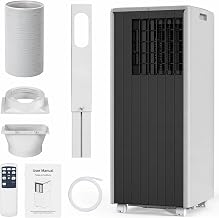
The most sensible entry point in the category: cooling, fan, and humidifying in one white cabinet that disappears against most interiors, with four ice packs to sharpen output on the hottest afternoons. The 70-degree oscillation is narrower than the tower models, so place it within a few feet of where you sit.
DeWalt 20V Max Compatible Windowless Cooler
The one genuinely different machine here. AC/DC operation with 20V battery compatibility makes it viable on a covered porch, in a garage, or anywhere a cord is a nuisance, and the 3-gallon tank plus 15-hour timer backs up the 600 sq ft claim in dry conditions. The battery is sold separately, which is worth budgeting for.
24″ 3-in-1 Portable AC with Remote and 120° Oscillation
My pick for a home office. The compact 24-inch body tucks beside a desk, the wide sweep keeps air circulating across a work zone, and the ultra-quiet low speed stays out of the way on calls. A 2-gallon tank and 15-hour timer cover a full workday.
38.6″ Tower Evaporative Cooler with Large Tank
The strongest choice for a bedroom or open living area, largely because of height. Cooled air is delivered at torso level rather than ankle level, and the large reservoir plus 12-hour timer means you set it once at bedtime. The black finish reads as intentional next to modern furniture.
Dual-Tank Cooler with 28ft Remote and Smart Timer
Built around a single problem: refilling. Two reservoirs stretch runtime toward 24 hours, and the long-range remote means you are not getting up to adjust it. Three modes and three speeds give you enough granularity for both daytime and overnight use.
Frequently Asked Questions
Do ventless portable air conditioners actually cool a room?
They cool the air passing through them, typically by several degrees, and that effect is real and measurable in dry air. They do not lower the temperature of an entire sealed room the way a compressor-based unit does, because they add moisture rather than removing heat from the space.
Will one make my room humid?
Somewhat, by design. Keep a door or window slightly open so humid air can exit, which also improves cooling performance. In already-damp rooms, a dehumidifier plus a fan is often the better pairing.
Do I need to use the ice packs?
No, but they help. Frozen packs in the reservoir chill the water feeding the pad, which sharpens the output for the first hour or two. Think of them as a boost, not the primary cooling mechanism.
How much maintenance is involved?
Rinse the filter pad every week or two during heavy use, empty the tank when you store the unit, and wipe the interior dry. Neglecting this is what causes the musty smell people occasionally report.
Final Thoughts
For most rooms, the 38.6″ tower is the one I recommend first: its height, sweep, and tank size make it the closest thing to a set-and-forget bedroom appliance in a hoseless format. The 24″ 3-in-1 with remote is the smarter buy for desks and smaller offices, and the DeWalt-compatible model is worth the premium if you need cooling where no outlet exists. Choose based on your humidity and your floor plan, and this category delivers exactly what it should.