Key takeaways
- Purification method: Look for steam distillation stated plainly on the label. Purified, spring, filtered, and reverse-osmosis water all retain some mineral content, and in a humidifier that content becomes visible residue.
- Bottle size versus routine: Small humidifier tanks pair well with 12 oz and 16.9 oz bottles — one bottle, one fill, no leftover water sitting open. Larger bedside tanks are better served by 20 oz bottles.
- Pack count and honest supply math: A 24-pack sounds generous until you divide by tank capacity. Estimate your nightly draw first, then buy the count that covers a few weeks without crowding a shelf.
- Materials and seal quality: BPA-free plastic and a leakproof cap matter more than they sound. A single seeped bottle in a suitcase or a drawer undoes the convenience these packs exist to provide.
- Travel readiness: If the humidifier moves with you, TSA-compliant sizing and rigid bottle walls save real frustration. Sturdier bottles also survive being stacked in a linen closet.
What's inside
The humidifier is one of the few appliances that quietly shapes how a room feels — the softness of the air, the way a walnut console holds its finish, whether the linen curtains hang or crackle. And yet the thing most people get wrong isn’t the machine. It’s the water. Tap water carries dissolved calcium and magnesium, and when that mist evaporates it leaves the minerals behind: a chalky film on your nightstand, a gritty crust inside the tank, and over time a unit that sputters instead of hums. That fine white dust settling on a matte black dresser isn’t dust at all. It’s rock.
Distilled water solves it by subtraction. Steam-purified and condensed back to liquid, it carries virtually nothing that can precipitate out — no scale, no mineral haze, no premature filter fatigue. This guide looks at the pre-bottled distilled water worth keeping in a cabinet or a nightstand drawer, most of it built originally for CPAP humidifier chambers and equally suited to bedroom and desktop humidifiers. Below you’ll find what separates a good multi-pack from a mediocre one, honest notes on five options, and answers to the questions that come up once you start reading labels closely.
As an Amazon Associate we earn from qualifying purchases.



How to Choose a/an Water To Put In Humidifier (2026)
- Purification method: Look for steam distillation stated plainly on the label. Purified, spring, filtered, and reverse-osmosis water all retain some mineral content, and in a humidifier that content becomes visible residue.
- Bottle size versus routine: Small humidifier tanks pair well with 12 oz and 16.9 oz bottles — one bottle, one fill, no leftover water sitting open. Larger bedside tanks are better served by 20 oz bottles.
- Pack count and honest supply math: A 24-pack sounds generous until you divide by tank capacity. Estimate your nightly draw first, then buy the count that covers a few weeks without crowding a shelf.
- Materials and seal quality: BPA-free plastic and a leakproof cap matter more than they sound. A single seeped bottle in a suitcase or a drawer undoes the convenience these packs exist to provide.
- Travel readiness: If the humidifier moves with you, TSA-compliant sizing and rigid bottle walls save real frustration. Sturdier bottles also survive being stacked in a linen closet.
The Best Water To Put In Humidifier (2026)s Reviewed
Distilled Water for CPAP Machines & Humidifiers, 6-Pack 20 oz
Steam purified, filtered, BPA-free and made in the USA, this six-pack of 20 oz bottles hits the sweet spot for a nightstand humidifier: enough volume to fill most tanks in one pour, without a half-empty bottle left over. Rated at roughly a 12-day supply, it’s a sensible starting point if you’re switching away from tap for the first time.
Distilled Water 24-Pack, 16.9 oz Travel Bottles
The 24-count case is the value play here, with familiar 16.9 oz bottles that slot easily into a drawer, a tote, or a hotel mini fridge. Sized for ResMed and Respironics chambers, it works just as cleanly in compact desktop and bedroom humidifiers where a full 20 oz would overfill the reservoir.
Dura Cleanse Distilled Water, 6-Pack 20 oz
Dura Cleanse leans into the details that matter on the road: TSA-compliant sizing, leakproof caps, and firmer bottle walls that resist crushing in a packed bag. Same 12-day math as other 20 oz six-packs, with a build that inspires more confidence when the bottles travel.
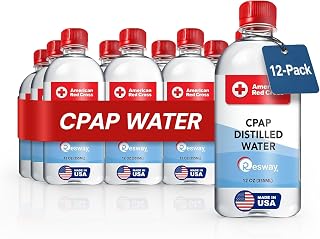
American Red Cross CPAP Distilled Water, 12-Pack 12 oz
Twelve 12 oz bottles make this the most forgiving option for smaller tanks — one bottle per fill, nothing decanted and nothing wasted. The Red Cross association brings a level of labeling transparency that’s genuinely reassuring in a category where terminology gets slippery.
Snugell Distilled Water, 12-Pack 12 oz
Snugell stretches a 12-pack of 12 oz bottles to roughly 15 days, which is the longest run per case among the smaller-format options here. Made in the USA and explicitly multi-use, it’s the pick if you want one supply that serves a humidifier, a travel kit, and a steam iron.
Frequently Asked Questions
Can I just use tap water in my humidifier?
You can, but expect consequences. Dissolved minerals become white dust on surrounding surfaces and scale inside the tank, which shortens the life of the unit and gives bacteria more texture to cling to.
Is purified water the same as distilled?
No. Purified simply means contaminants were reduced to a standard, which can be achieved by filtration or reverse osmosis while leaving minerals intact. Distillation removes them, which is why it’s the safer choice for misting appliances.
Does distilled water mean I can skip cleaning?
It reduces scale, not biofilm. Empty and dry the tank daily, and wipe it down weekly per your manufacturer’s instructions, regardless of what you fill it with.
Why buy bottled instead of a gallon jug?
Portion control and portability. Single-serve bottles stay sealed until use, pour without spilling, and travel cleanly — advantages an opened gallon jug can’t match.
Final Thoughts
For most bedside setups, the 6-Pack 20 oz Distilled Water is the straightforward answer: correct purification, correct volume, no fuss. Choose the 24-Pack 16.9 oz case if you want the deepest supply at the lowest per-bottle cost, or Snugell’s 12-Pack if a smaller tank and a longer run between reorders describe your situation better. Any of the three keeps the mineral haze off your furniture, which is ultimately the point.