Key takeaways
- Match water to mist type: Ultrasonic and warm-mist units vaporize whatever you pour in, minerals included, so distilled is close to mandatory. Evaporative wick models trap minerals in the filter, which makes tap water workable.
- Read for “steam distilled,” not “purified”: Purified, spring, and filtered waters still carry dissolved solids. Distillation is the process that actually removes them, and the label should say so plainly.
- Size the bottle to the tank: Small travel bottles are tidy and portable but tedious against a 4L reservoir. Reserve them for CPAP chambers and compact bedside units; buy gallons for large-room humidifiers.
- Confirm BPA-free packaging and USA bottling: You are inhaling the output. Domestic bottling and BPA-free plastic are baseline expectations, not premium features.
- Plan for travel and storage: Leakproof caps and TSA-friendly volumes matter if the unit moves with you. Single-serve bottles also stay sterile longer than a half-empty gallon jug under the sink.
What's inside
Every well-composed room has an invisible layer: the air. You can style a bedroom down to the linen weave and the lamp glow, then undo it all with a humidifier that coats your nightstand in fine white grit. That chalky film is not dust from the street — it is dissolved mineral content from your tap water, aerosolized and redeposited on every surface within a few feet of the mist. Buyers usually blame the machine. The machine is rarely the problem.
This guide looks at the water itself, which is the single variable most owners overlook. We cover why distilled water matters more for some humidifier designs than others, how to read a bottle label so you are not paying for filtered tap water, and which ready-to-pour options make sense for nightstands, nurseries, travel bags, and CPAP chambers. We also flag two humidifiers whose engineering changes the calculation entirely.
As an Amazon Associate we earn from qualifying purchases.




How to Choose a/an Water To Use In Humidifier (2026)
- Match water to mist type: Ultrasonic and warm-mist units vaporize whatever you pour in, minerals included, so distilled is close to mandatory. Evaporative wick models trap minerals in the filter, which makes tap water workable.
- Read for “steam distilled,” not “purified”: Purified, spring, and filtered waters still carry dissolved solids. Distillation is the process that actually removes them, and the label should say so plainly.
- Size the bottle to the tank: Small travel bottles are tidy and portable but tedious against a 4L reservoir. Reserve them for CPAP chambers and compact bedside units; buy gallons for large-room humidifiers.
- Confirm BPA-free packaging and USA bottling: You are inhaling the output. Domestic bottling and BPA-free plastic are baseline expectations, not premium features.
- Plan for travel and storage: Leakproof caps and TSA-friendly volumes matter if the unit moves with you. Single-serve bottles also stay sterile longer than a half-empty gallon jug under the sink.
The Best Water To Use In Humidifier (2026)s Reviewed
Distilled Water 6-Pack Travel Bottles, 20 oz
Steam-purified and filtered in the USA, these 20 oz bottles cover roughly twelve nights of CPAP humidification and slot neatly into a small bedside humidifier without decanting. The larger bottle size is the differentiator here — fewer refills, less plastic churn, and no gallon jug crowding your nightstand.
Dura Cleanse Distilled Water, 6-Pack
Built specifically around ResMed and Philips chambers, this six-pack is TSA-compliant and genuinely leakproof, which is more than most travel water can claim. It doubles well as a clean source for compact ultrasonic humidifiers when you want zero white dust and zero guesswork.
American Red Cross CPAP Distilled Water, 12-Pack
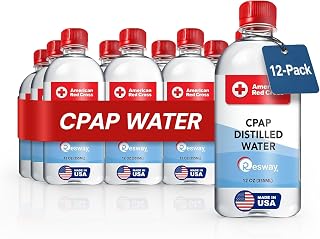
Twelve 12 oz bottles give you close to two weeks of coverage at a portion size that matches most humidifier chambers exactly, so nothing sits open and stagnant. The Red Cross association also brings a level of quality-control confidence that off-brand bottled water rarely earns.
Snugell Distilled Water, 12-Pack
Snugell stretches to roughly fifteen days per pack and markets itself as multi-use, which is accurate — it works equally well for sleep therapy equipment, tabletop humidifiers, and steam irons. If you want one case that serves several devices, this is the efficient buy.
LAVIEAIR 5L Evaporative Humidifier
This is the workaround for anyone tired of buying water: an evaporative design that produces no white dust because minerals stay locked in the wick rather than becoming airborne. With a 5L top-fill tank, up to 48 hours of runtime, and 300 sq ft of coverage, it runs on tap water and asks only that you change the filter on schedule.
Frequently Asked Questions
Can I use tap water in my humidifier?
In an evaporative unit, yes — the wick captures minerals. In an ultrasonic or warm-mist unit, tap water will produce white dust and mineral scale inside the tank, so distilled is the better choice.
Is filtered or bottled water the same as distilled?
No. Filtering removes particulates and some chemicals but leaves dissolved minerals behind. Only distillation reliably eliminates them, so look for “steam distilled” on the label.
Does distilled water stop bacterial growth?
It slows mineral buildup, which bacteria colonize, but it is not a disinfectant. Empty, rinse, and dry the tank daily and deep-clean weekly regardless of water type.
Do large-tank humidifiers change the answer?
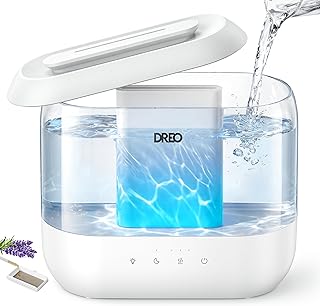
Somewhat. A 4L unit like the DREO HM311 will consume distilled water quickly, so either budget for gallon jugs or choose an evaporative model that tolerates tap.
Final Thoughts
For CPAP chambers and compact bedside units, the Distilled Water 6-Pack in 20 oz bottles offers the best balance of volume and convenience, while the American Red Cross 12-Pack is the pick for portion control and dependable sourcing. If you would rather solve the problem structurally than restock it monthly, the LAVIEAIR 5L evaporative humidifier eliminates white dust on tap water alone.