Key takeaways
- Clean every two to three months in soft-water areas, monthly in hard-water areas, and always after the machine sits unused for more than a week.
- Never store scoops inside the bin. A room-temperature scoop introduces bacteria on every return trip.
- Leave the lid propped open for an hour after cleaning so the interior dries fully before you restart production.
- Keep the machine four to six inches off the wall. Restricted airflow makes cycles longer, and longer cycles mean more scale contact time.
What's inside
An ice maker is one of the few appliances that produces something you put directly in your mouth, and yet it’s the one most of us never open. Mineral scale creeps across the evaporator plate, a thin biofilm settles in the reservoir, and slowly the cubes start tasting like the inside of a water pitcher left out overnight. Cloudy ice, cubes that fuse into a single block, longer freeze cycles, a faint musty note in a glass of sparkling water — those are all the same story told four different ways.
The good news: cleaning an ice maker is a twenty-minute job, not a weekend project, and the method barely changes between a countertop nugget machine, a built-in undercounter unit, and the ice compartment in a French-door fridge. Below is the sequence that actually works, what to use instead of vinegar-and-hope, and how to build a rhythm so you never taste your own neglect again. Our recommended picks are grouped just below.
As an Amazon Associate we earn from qualifying purchases.




Start With a Full Drain and Dry Run
Unplug the machine, empty the ice bin completely, and drain the reservoir — most countertop units have a rubber plug underneath, and forgetting it means you’ll be cleaning your counter next. Toss any existing ice. It has absorbed whatever is living in the basin, and it will re-contaminate a clean machine within a cycle. Pull out every removable part: bin, scoop, water tank lid, drip tray, and the small strainer basket if your model has one. Wipe the interior walls with a damp cloth first to lift loose debris, because descaler works chemically on scale, not mechanically on sludge.
Use a Nickel-Safe Descaler, Not Vinegar
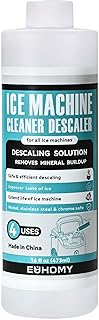
This is the single decision that separates a clean machine from a shortened one. Evaporator plates are commonly nickel-plated, and household vinegar or generic acid cleaners can pit the plating, which then seeds scale faster than before. Purpose-built formulas are pH-balanced for food contact and rinse clean without residual taste. Tablets are the tidiest option for home use — the Ice Machine Cleaner and Descaler 24 Tablets and the ACTIVE Ice Machine Cleaner Descaler, 24 Tablets are both nickel-safe and dosed per cycle, so there’s no measuring cup involved. The 36-Pack Ice Machine Cleaner Descaler Tablets is the value play if you’re maintaining two machines or cleaning monthly. For liquid, Affresh Ice Machine Cleaner is the easy pick for refrigerator ice makers and hard-water households, and EUHOMY Ice Machine Cleaner Descaler doubles as an espresso machine descaler, which earns it cabinet space in small kitchens. If you’re running a commercial or high-output unit, the Nickel Safe 1 gal Ice Maker & Machine Cleaner meets Manitowoc spec GES-6 and costs less per use at volume.
Run the Clean Cycle — or Fake One
Fill the reservoir to the fill line with cool water, add your tablet or the labeled dose of liquid, and press the self-clean button if your model has one. If it doesn’t, simply run a normal ice-making cycle, then discard the ice it produces. Let the solution sit in the reservoir for five to ten minutes before the cycle starts; dwell time does most of the descaling work. Heavily scaled machines may need a second pass. You’ll know it’s working when the water in the basin turns faintly cloudy — that’s dissolved mineral, not soap.
Rinse Twice, Then Sanitize Surfaces
Drain the cleaning solution and run two full water-only cycles, discarding all ice both times. Skipping the second rinse is the most common reason people say descaler “made the ice taste weird.” Meanwhile, wash removable parts in warm soapy water, rinse, and air-dry fully. Wipe seals and gaskets with a cloth dampened in a food-safe sanitizer, paying attention to the fold where the bin lid meets the housing — that crease is where mold shows up first.
Address the Water, Not Just the Machine
Scale is a water problem wearing an appliance costume. If your tap runs above roughly 120 ppm hardness, filtered or filtered-and-remineralized water will roughly double the interval between cleanings and produce clearer cubes. For plumbed refrigerator units, replacing the inline filter on schedule matters more than any cleaner you buy.
Tips
- Clean every two to three months in soft-water areas, monthly in hard-water areas, and always after the machine sits unused for more than a week.
- Never store scoops inside the bin. A room-temperature scoop introduces bacteria on every return trip.
- Leave the lid propped open for an hour after cleaning so the interior dries fully before you restart production.
- Keep the machine four to six inches off the wall. Restricted airflow makes cycles longer, and longer cycles mean more scale contact time.
Frequently Asked Questions
How often should I clean my ice maker?
Every one to three months, depending on water hardness and how heavily you use it. Cloudy ice, cubes sticking together, or slower cycles are your real cue regardless of the calendar.
Is vinegar a safe substitute?
It’s usable in a pinch on plastic-only components, but it can damage nickel-plated evaporator plates over time and leaves a lingering taste. A nickel-safe descaler costs a few dollars per cycle and protects the part that’s expensive to replace.
Do I have to throw out the first batch of ice?
Yes — the first two batches after cleaning, actually. Ice absorbs trace residue readily, and discarding it is the difference between neutral ice and chemically ice.
Why does my ice still taste off after cleaning?
Usually incomplete rinsing, a stale water reservoir, or the ice absorbing odors from an open bin near strong-smelling food. Check the gasket folds too; residual biofilm there survives a clean cycle.
Conclusion
A well-maintained ice maker is quietly invisible, which is exactly the point in a considered kitchen — it produces clear, neutral ice and disappears into the routine. Pair a nickel-safe descaler with filtered water and a standing seasonal reminder, and you’ll spend twenty minutes a quarter instead of shopping for a replacement machine in three years.