Key takeaways
- Yield and pulp dryness are linked: a drier pulp ball means less juice left behind, so judge a juicer by the pulp it ejects.
- Wide feed chutes (about 5.8 to 6.5 inches in several listings) cut chopping time, while narrow chutes, such as the Omega’s 3-inch hopper, trade prep time for compact size.
- Cleanup time depends on the number of parts and the screen design; mesh-free or simple-screen models are faster.
- Hands-free models load a whole recipe at once and add a high price tier.
- We did not use these machines ourselves; picks come from listing and maker details, so check the maker page for specs you rely on.
The best cold press juicer for most kitchens is the one that squeezes dry pulp and comes apart fast enough that you still use it on a Tuesday. If you want a mainstream, all-round machine, the Ninja NeverClog Cold Press Juicer and the Omega Wide Mouth Juicer cover most households. For the least prep, the hands-free Nama J2 and Kuvings AUTO10 are the premium choices. This guide ranks cold press juicers by what actually decides satisfaction: yield, how dry the pulp comes out, and how long cleanup takes.
A cold press juicer, also called a slow masticating juicer, uses a slowly turning auger to crush produce against a screen instead of shredding it at high speed. Makers say this produces less foam and keeps more of the juice from oxidizing quickly, though the practical gain you will notice is usually more juice from leafy greens and a quieter machine. The price you pay is in prep time and cleaning, which is why those two factors lead this guide.
Our top picks


As an Amazon Associate we earn from qualifying purchases at no extra cost to you.
Key takeaways
- Yield and pulp dryness are linked: a drier pulp ball means less juice left behind, so judge a juicer by the pulp it ejects.
- Wide feed chutes (about 5.8 to 6.5 inches in several listings) cut chopping time, while narrow chutes, such as the Omega’s 3-inch hopper, trade prep time for compact size.
- Cleanup time depends on the number of parts and the screen design; mesh-free or simple-screen models are faster.
- Hands-free models load a whole recipe at once and add a high price tier.
- We did not use these machines ourselves; picks come from listing and maker details, so check the maker page for specs you rely on.
How We Judge Yield, Pulp Dryness and Cleanup Time
Maker pages rarely publish a yield number you can compare across brands, and numbers on listings are not measured the same way. Instead of repeating claims we cannot verify, here is how to read what a listing does tell you and what to watch for when your machine arrives.
| Factor | What a listing tells you | What to look for |
|---|---|---|
| Yield | Often a motor speed (RPM) or an auger description, rarely a measured volume | Slow auger speeds (the Omega 365 lists 65 RPM) and fine screens generally extract more from leafy greens |
| Pulp dryness | Sometimes described as “dry pulp” or “high yield” | A crumbly, near-dry pulp ball means little juice left behind; wet, soggy pulp means loss |
| Cleanup time | Part counts, mesh-free or easy-clean claims, brush included | Fewer parts, a rinse-through design and a cleaning brush in the box save the most time |
| Prep time | Chute width | A chute of roughly 5.8 to 6.5 inches fits many whole fruits; a 3-inch hopper needs more chopping |
| Jug and pulp capacity | Stated in ounces | Ninja lists a 24 oz jug and 36 oz pulp container |
If you want your own yield check after you buy, juice a known weight of carrots, record the juice volume and weigh the pulp. Comparing a pound of produce to the juice you get shows you whether the machine suits your routine, without relying on a maker’s claim.
Best Cold Press Juicer Picks at a Glance
| Pick | Type | Key listing details | Best for |
|---|---|---|---|
| Ninja NeverClog JC151 | Vertical slow juicer | 150W high-torque auger · 24 oz jug · 36 oz pulp container | Fibrous produce, mainstream buyers |
| Omega Wide Mouth Juicer | Compact vertical | 3-inch hopper · 2-speed · slow masticating | Tight counters, trusted brand |
| nutribullet Slow Juicer | Vertical slow juicer | Reverse function · quiet motor · BPA-free | Quiet, simple routine |
| Godspeeds Smoothpress | Wide-chute cold press | 300W · wide chute · easy clean | Whole-fruit prep savings |
| Aeitto 3-in-1 | Cold press plus sorbet and nut milk | 6.0 in. chute · mesh-free easy clean | Juice plus sorbet attachments |
| Kuvings AUTO10 | Hands-free | 100 oz hopper · 240W motor · self-feeding | Batch juicing with minimal prep |
| Nama J2 | Hands-free | Wide mouth hopper fits a whole recipe | Hands-off juicing for a premium budget |
1. Ninja NeverClog Cold Press Juicer JC151: Best for Fibrous Produce
- 150W high-torque auger · built to handle fibrous fruits and vegetables per the listing
- 24 oz juice jug · 36 oz pulp container
- Model JC151 in charcoal
- Check the maker page for feed chute size and cleaning instructions
Best for: Households that juice celery, kale, ginger and carrots and want a recognizable brand with a large pulp bin.
Skip if: You want a hands-free hopper or a very wide chute.
Pros:
- High-torque auger aimed at fibrous produce
- Large pulp container means fewer interruptions on a long juicing session
- Mainstream brand with accessible parts and manuals
Cons:
- Mid-to-premium price tier
- Produce still needs cutting to fit the chute
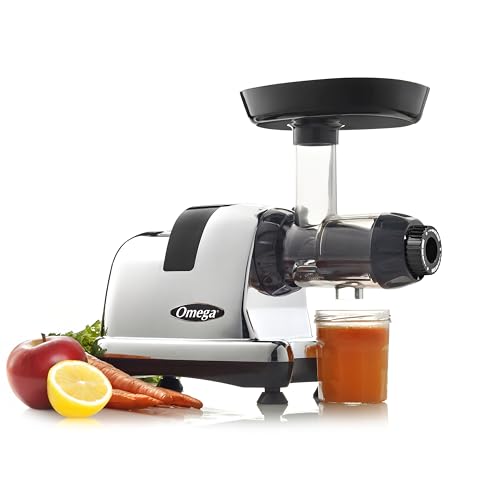
2. Omega Wide Mouth Juicer: Best for Small Counters and a Proven Brand
- Compact vertical cold press · 3-inch hopper · 2-speed slow masticating
- Extractor style that keeps the footprint small
- Check the maker page for motor wattage and the included parts
Best for: Apartment kitchens and buyers who prefer a brand known for slow juicers.
Skip if: You hate chopping, because a 3-inch hopper still needs smaller pieces.
Pros:
- Compact vertical design stores easily
- Two speeds let you tailor the pressing to soft or hard produce
- Established brand with a deep accessory ecosystem
Cons:
- Narrower than the 5.8 to 6.5 inch chutes on other picks
- Moderate cleanup time because of the screen and auger
3. nutribullet Slow Juicer: Best for a Quiet, Simple Routine
- Slow masticating juicer · reverse function · quiet motor
- BPA-free parts per the listing
- Designed for easy cleaning per the listing
- Check the maker page for chute dimensions and capacity
Best for: Households that value low noise and a reverse button to clear jams.
Skip if: You want a hands-free hopper or a mega chute.
Pros:
- Reverse function helps clear stuck produce
- Quiet operation suits early mornings
- Familiar brand for blender users
Cons:
- Prep time depends on the chute size, so check the listing
- Fewer extras than 3-in-1 models
4. Godspeeds Smoothpress: Best for Cutting Prep Time
- Cold press juicer · 300W · wide chute for whole-fruit juicing per the listing
- Easy-clean design
- Check the listing for the exact chute diameter and included brush
Best for: People who want to drop whole apples and oranges after minimal cutting.
Skip if: You prefer a long-established brand with a deep parts catalog.
Pros:
- Wide chute reduces chopping
- Higher motor wattage for tough produce
- Moderate price tier
Cons:
- Newer brand, so check warranty and support terms
- Specs on listings are maker-stated
5. Aeitto 3-in-1 Cold Press Juicer: Best for Juice, Sorbet and Nut Milk
- 3-in-1 cold press juicer · 6.0 in. feed chute · mesh-free easy-clean design
- Juice, sorbet and nut milk functions · recipe guide included per the listing
- Check the listing for which attachments come in the box
Best for: Cooks who want a juicer that also makes frozen fruit sorbet and nut milk.
Skip if: You only juice and would rather have a simpler machine.
Pros:
- Wide chute and mesh-free design aimed at quicker cleanup
- Extra functions broaden use
- Mid price tier
Cons:
- More attachments to wash if you use all functions
- Brand has a shorter track record
6. Kuvings AUTO10: Best Hands-Free Pick for Batch Juicing
- Hands-free cold press juicer · 100 oz hopper · self-feeding
- 240W quiet motor per the listing
- Matte black finish
- Check the maker page for the cleaning routine and warranty
Best for: Households that juice for several people and want to load the hopper and walk away.
Skip if: You juice once or twice a week for one person, or you have limited counter height.
Pros:
- Large hopper reduces prep and feeding
- Quiet motor
- Established premium brand
Cons:
- Highest price tier among the picks
- Large footprint and more parts to rinse
7. Nama J2: Best Hands-Free Alternative With a Wide Mouth Hopper
- Cold press juicer · hands-free · wide mouth hopper fits a whole recipe per the listing
- Black finish · listed as award-winning by the maker
- Check the maker page for hopper capacity and parts
Best for: People who want recipe-level loading and a design that cuts effort between pieces.
Skip if: You are on a mid-range budget, since this is the premium tier.
Pros:
- Hopper handles a whole recipe at once
- Hands-free operation frees you to clean as you go
- Maker positions it around low waste
Cons:
- Premium price tier
- Needs counter space and a larger parts rinse
Also Consider
- Omega Cold Press 365 Vertical (65 RPM): compact slow masticating extractor with a 3-stage auger per the listing · a lower-tier way into the Omega lineup.
- TUUMIIST 3-in-1 Smart Touch Cold Press: 6.5 in. wide chute, touch controls, juice, sorbet and nut milk · check the listing for attachments.
- DASH Deluxe Compact Cold Press Juicer: compact slow masticating juicer with a frozen attachment per the listing · small and budget friendly.
- YPONE 2-in-1 Cold Press Juicer: 5.8 in. large chute, juice and nut milk · easy-clean claim, check the listing.
Cold Press Juicer Cleanup: What Takes the Time
Almost every owner of a masticating juicer reports the same thing: the juicing is quick, and the cleaning is the work. Here is where the minutes go and how to trim them.
- Rinse immediately. Run water through the chute and over the screen right after juicing, before pulp dries.
- Disassemble in order. Follow the manual’s steps for removing the auger, screen and pulp outlet.
- Use the brush. A small brush clears the screen better than a cloth. Most models include one.
- Check dishwasher guidance. Some parts are marked dishwasher-safe in the manual, others are hand-wash only, so read the care page for your model.
- Dry and store. Air-dry parts fully before reassembly so the screen does not hold moisture.
Mesh-free or simple-screen designs, such as the one on the Aeitto, claim to cut this process shorter. Hands-free models generally have more parts in the hopper assembly, so budget extra rinse time even if prep is shorter.
Which Produce Works Best in a Cold Press Juicer
Different produce stresses a juicer in different ways, and matching the machine to what you juice most is a quieter route to satisfaction than chasing the longest spec sheet.
| Produce | Prep | What to expect | Machine trait that helps |
|---|---|---|---|
| Carrots, beets | Cut to chute size, scrub if skin stays on | Dense pulp that should come out fairly dry | Strong motor, slow auger |
| Celery, ginger | Cut celery into short lengths to avoid strings tangling | Fibrous pulp; a good test of the auger | High-torque auger such as the Ninja JC151 |
| Leafy greens (kale, spinach) | Roll into bundles and alternate with firmer produce | Slow juicers tend to extract more than fast ones | Fine screen, reverse function |
| Apples, pears | Quarter or leave whole if the chute is wide | Juicy, often foamy juice | Wide chute (about 5.8 to 6.5 inches on several picks) |
| Citrus | Peel the bitter rind and pith, split segments | Wet pulp; some juicers handle it better than others | Check the manual for citrus guidance |
| Frozen fruit | Use the sorbet attachment if included | Soft-serve texture, not juice | 3-in-1 or frozen attachment models, such as the Aeitto and DASH |
How Much Juice Do You Really Need? Sizing by Household
Juicers are bought for a vision of daily green juice that often shrinks to a few times a week. Sizing the machine to your honest routine is the best way to avoid a gadget that lives in a cabinet.
| Routine | Suggested design | Why |
|---|---|---|
| One person, a glass a day | Compact vertical (Omega Wide Mouth, DASH Deluxe Compact) | Small footprint, fewer parts, quick rinse |
| Two people, several times a week | Mid-size wide-chute model (Ninja JC151, Godspeeds, Aeitto) | Bigger pulp bin and less chopping |
| Family or batch prep for the week | Hands-free hopper (Kuvings AUTO10, Nama J2) | Load once and leave while the machine works |
| Juice plus frozen desserts or nut milk | 3-in-1 (Aeitto, TUUMIIST) | One machine for several jobs |
| Quiet household, shared walls | nutribullet Slow Juicer or Kuvings AUTO10 | Both list quiet motors |
Counter and storage reality
Vertical juicers stand taller than most blenders, so measure the gap between your counter and the underside of your upper cabinets before you buy. A hands-free model with a large hopper needs both height and a stable surface, because its motor and hopper add weight. If you will store the machine in a cabinet, look for a model whose parts nest or whose base fits a shelf, and keep the cleaning brush with it so you do not lose it.
Running costs and upkeep
Beyond the purchase, plan for produce, which is the real recurring cost, and for occasional replacement parts such as screens or seals. Check the maker page for warranty length and whether replacement parts are sold, since a juicer that cannot be repaired becomes waste when one part fails.
Common Cold Press Juicer Problems and Fixes
- Chute clogs on fibrous produce: cut celery and herbs shorter, feed slowly and use the reverse button if your model has one.
- Pulp comes out wet: slow down the feeding rate and alternate soft and hard produce so the auger has something to press against.
- Juice separates quickly: separation is normal with fresh juice. Stir or shake before drinking.
- Stains on parts: carrots and beets can tint plastic. A rinse right after juicing and an occasional soak per the manual helps.
- Machine feels loud: check that the auger and screen are seated properly and that you are not forcing produce down the chute.
When in doubt, read the owner’s manual wording for your model, since each design has different assembly and cleaning steps.
How We Chose
We did not personally use these juicers. We built this list from listing text, maker pages and the way each design handles chute width, pulp capacity and cleaning. We kept the picks to on-intent cold press machines, at most two per brand, and left out renewed units, parts and unrelated bundles. We name only specs stated by the maker or listing and recommend you verify the details you rely on before you buy.
Buying Guide: Choosing a Cold Press Juicer
Chute width and prep time
A 3-inch hopper means you cut apples into quarters and cucumbers into short lengths. A 5.8 to 6.5 inch chute lets you drop whole small fruits. If you juice daily, extra width pays back quickly in saved minutes; if you juice occasionally, a compact machine saves storage space.
Yield and pulp
Look for slow auger speeds and fine screens. After a first batch, check the pulp: dry and crumbly means a good extraction. Run the pulp through a second pass if you want to squeeze out a little more, though it will taste more fibrous.
Hands-free vs standard
Hands-free models, such as the Kuvings AUTO10 and Nama J2, hold a larger volume and feed it automatically. They are worth it for batch juicing for several people. A standard vertical juicer is more economical for one or two people.
Capacity of jug and pulp container
The Ninja JC151 lists a 24 oz jug and a 36 oz pulp container, which supports a couple of glasses before you empty the bin. A small pulp bin means stopping mid-session.
Cleanup
Fewer parts and a mesh-free screen save time. A reverse function helps unclog the chute. Ask yourself whether you will clean it the same day; if not, choose the simplest design.
Noise and motor
Slow juicers run quieter than centrifugal ones, and nutribullet and Kuvings both list quiet motors. If you live in an apartment, this matters.
Extras
Sorbet and nut milk functions on 3-in-1 models add use for the money, but only if you will actually use them. Otherwise, they add attachments to wash and store.
Frequently Asked Questions
What is the difference between a cold press juicer and a regular juicer?
A cold press (slow masticating) juicer crushes produce with a slow auger, while a centrifugal juicer shreds it with a fast spinning blade. Slow juicers tend to extract more from leafy greens and run quieter, and centrifugal models are faster.
Does a cold press juicer give more juice?
Often it does for leafy greens and soft fruit, but yield depends on the machine, produce and how finely you cut it. Check pulp dryness as a practical test.
How long does cleanup take?
It varies by model. Mesh-free and simple-screen designs are quicker, while hands-free models with larger hoppers can take longer because there are more parts. Rinsing right after juicing saves the most time.
How long does cold press juice keep?
Makers and food safety guidance vary. A common recommendation is to refrigerate in a sealed container and drink within a day or two, but follow the guidance on your model’s care page and discard juice that smells off.
Can I juice leafy greens?
Yes, and cold press juicers are generally better suited to leafy greens than fast centrifugal machines. Roll leaves into a bundle and feed them with firmer produce.
Are 3-in-1 juicers worth it?
If you will make sorbet or nut milk, they add use. If you only juice, a dedicated model is simpler to clean.
Are cold press juicers dishwasher-safe?
Some parts are, others are not. Follow the manual’s wording for each part.
Should I peel produce before juicing?
Peel citrus, since the rind and pith turn juice bitter, and remove pits, large seeds and tough stems. Most apples, carrots and cucumbers can go in with the skin on after a good scrub. Check the manual for any produce the maker says to avoid, such as very hard roots or fruit with large stones.
Can I juice ahead for the week?
Fresh juice changes in flavor and texture within a day or two. If you batch juice, fill containers to the top, seal them and keep them cold, and plan to drink them within the window your food safety guidance recommends.
Which One Should You Buy?
- All-round mainstream choice: Ninja NeverClog JC151.
- Small kitchen, trusted brand: Omega Wide Mouth Juicer.
- Quiet and simple: nutribullet Slow Juicer.
- Less chopping on a moderate budget: Godspeeds Smoothpress.
- Juice plus sorbet and nut milk: Aeitto 3-in-1.
- Hands-free for a crowd: Kuvings AUTO10 or Nama J2.
Sources
- Ninja product listing and maker page
- Omega product listings and maker page
- Kuvings product listing
- Nama product listing
- nutribullet, Godspeeds and Aeitto product listings
Last updated: November 2026
More from Amazon
Programs that pair well with the guide above. Offers and eligibility are set by Amazon and may change.
Collect the home and kitchen items you want in one registry that guests can shop from.
Create a wedding registrySet up recurring deliveries of everyday items on eligible products. Terms and savings are set by Amazon.
Explore Subscribe & SaveFree shipping on eligible items, Prime Video and more. Eligible new members can start with a free trial.
Start a Prime free trialAudiobooks and podcasts to listen to on the go. Eligible new members can start with a free trial.
Try Audible freeAs an Amazon Associate we earn from qualifying purchases.