Key takeaways
- Wall depth first: Measure your stud cavity before anything else. Standard 2×4 framing gives you roughly 3.5 inches, and several deep-ember models want more. If you’re working with existing 2×4 walls, prioritize units explicitly rated for that depth or plan a shallow bump-out.
- Flame quality over flame quantity: Thirty color combinations sound impressive, but you’ll settle on one or two. Judge instead the movement pattern, whether the flame tapers naturally at the tips, and how deep the reflected image reads behind the glass.
- Heat as a secondary function: A 1,500W insert is supplemental — think 400 square feet of comfort, not whole-home heating. Look for a real thermostat rather than a simple on/off heater, plus dual 750W/1500W settings for shoulder seasons.
- Trim strategy: Frameless installs look sharper but demand precise drywall work and finished returns. A trim kit forgives rough openings. Decide which you’re committing to before ordering, since retrofitting trim rarely looks intentional.
- Fan noise and placement: Bedroom and media room installs live or die on blower volume. Front-venting units directed away from seating and low-speed fan designs are worth seeking out, especially above 55 inches where the blower works harder.
What's inside
Electric fireplaces have quietly become the most requested feature in the living rooms I help plan, and also the most misunderstood. Buyers arrive with a Pinterest board full of seamless linear flames set into limewash plaster, then discover a marketplace crowded with 6,000 near-identical listings, wattage claims that mean little, and flame effects that look convincing in a studio video and cartoonish in daylight. The gap between a unit that reads as architecture and one that reads as an appliance is real, and it usually comes down to three things: recess depth, ember-bed detail, and how the glass front handles reflection.
This guide narrows the field to five recessed and wall-mounted models that hold up under scrutiny in an actual room — not a dark showroom. I’ve weighted flame realism at low brightness, framing options for drywall and stone installs, heater behavior in open-plan spaces, and whether the smart controls are genuinely useful or a checkbox. Below you’ll find the shortlist, a selection framework, individual assessments, and answers to the questions that come up during install week.
As an Amazon Associate we earn from qualifying purchases.



How to Choose a/an Consumer Reports Best Electric Fireplace (2026)
- Wall depth first: Measure your stud cavity before anything else. Standard 2×4 framing gives you roughly 3.5 inches, and several deep-ember models want more. If you’re working with existing 2×4 walls, prioritize units explicitly rated for that depth or plan a shallow bump-out.
- Flame quality over flame quantity: Thirty color combinations sound impressive, but you’ll settle on one or two. Judge instead the movement pattern, whether the flame tapers naturally at the tips, and how deep the reflected image reads behind the glass.
- Heat as a secondary function: A 1,500W insert is supplemental — think 400 square feet of comfort, not whole-home heating. Look for a real thermostat rather than a simple on/off heater, plus dual 750W/1500W settings for shoulder seasons.
- Trim strategy: Frameless installs look sharper but demand precise drywall work and finished returns. A trim kit forgives rough openings. Decide which you’re committing to before ordering, since retrofitting trim rarely looks intentional.
- Fan noise and placement: Bedroom and media room installs live or die on blower volume. Front-venting units directed away from seating and low-speed fan designs are worth seeking out, especially above 55 inches where the blower works harder.
The Best Consumer Reports Best Electric Fireplace (2026)s Reviewed
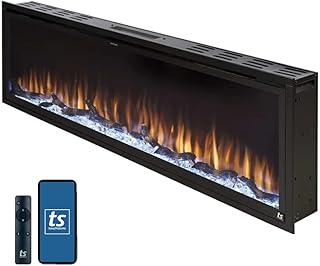
Touchstone Sideline 50″
The most reliably specified unit in this category, and for good reason — the 50-inch width suits a standard media wall without dominating it, and the swappable log and crystal hearths let you shift the mood from lodge to loft. WiFi and Alexa control are genuinely well implemented here, and the built-in thermostat holds temperature rather than cycling on brute force.
Westinghouse 60″ Electric Fireplace
A strong value play at the 60-inch size, with flexible wall-mount or recessed installation and a 24-hour timer that’s more useful than it sounds for morning warm-ups. The color-changing flame skews vivid rather than naturalistic, which works beautifully in contemporary rooms and less so in traditional ones.
Ambe Linear 72″
This is the one that fools people. Real Midwest hardwood logs sit above a deep ember bed, and the hidden vent design removes the visual giveaway that undermines most linear inserts. At 72 inches it’s a genuine architectural commitment — confirm your framing and clearances early, then enjoy the best flame presence on this list.
Touchstone Sideline Elite 60″
Touchstone’s upgraded platform, with 60 color combinations and three hearth media options including driftwood, which reads more coastal and modern than logs. The deeper firebox gives the flame noticeably more dimension than the standard Sideline, making it the pick when the fireplace is the room’s focal point.
R.W.FLAME 60″ Recessed
Notable for fitting 2×6 stud cavities cleanly and for genuinely low blower noise, which makes it my default suggestion for bedrooms and home offices. Touch-screen and remote controls cover the essentials, and adjustable flame speed lets you dial back the flicker to something more believable.
Frequently Asked Questions
Do electric fireplaces need venting or a chimney?
No. They convert electricity to heat and light with no combustion, so there’s no flue, gas line, or clearance-to-combustibles calculation in the traditional sense. You’ll still follow the manufacturer’s spacing guidance for mantels and TVs above the unit.
Can I mount a TV directly above one?
Usually yes, provided you respect the stated minimum clearance — typically 6 to 12 inches above the top vent — and confirm the unit vents forward rather than straight up. Front-venting designs are the safer choice for media walls.
How much does one cost to run?
Flame-only operation draws very little, often comparable to a few LED bulbs. Running the 1,500W heater continuously is the real expense, roughly on par with a space heater, so use the thermostat rather than leaving it on high.
Should I hardwire it or use a standard outlet?
Most of these run on a standard 120V outlet, but a 1,500W heater wants a dedicated circuit to avoid nuisance breaker trips. For recessed installs, have an electrician place a receptacle inside the cavity so no cord is visible.
Final Thoughts
If flame realism is the deciding factor and your wall can accommodate it, the Ambe Linear 72″ is the clear choice — the real hardwood logs and concealed venting put it in a different visual class. For most rooms, the Touchstone Sideline Elite 60″ strikes the best balance of firebox depth, finish options, and smart control, while the Touchstone Sideline 50″ remains the sensible, well-proportioned default for standard media walls.