Key takeaways
- Best for: Produce, spices, small appliances, linens, bar cart use, or as a side table
- Prep ability: Limited; wire shelves need a tray or cutting board on top, metal flat-top versions offer more usable surface
- Storage: High vertical storage in a small footprint, but no enclosed drawers
Kitchen carts on wheels are best chosen by type: tiered carts work for tight spaces and light storage, while butcher block carts work for serious prep and heavier storage, and the right pick comes down to your floor space, how much chopping you actually do, and how much maintenance you want to handle.
Our top picks


As an Amazon Associate we earn from qualifying purchases at no extra cost to you. Ratings are shown as listed on Amazon.
Tiered vs. Butcher Block: The Core Difference
Both are kitchen carts on wheels, but they are built for different jobs. Understanding the construction tells you immediately which will fit your kitchen.
Tiered Carts (2-Tier and 3-Tier)
These are open-frame carts, usually with 2 or 3 shelves made of metal wire, solid metal, or wood. The classic example is a 3-tier metal utility cart with a narrow footprint, similar to designs from IKEA (RASKOG) or Seville Classics. They are lightweight, typically 8 to 18 lbs, and designed for rolling storage rather than heavy chopping. Most models are 13 to 18 inches wide and 30 to 35 inches tall, which lets them slide between a fridge and wall or beside a narrow pantry.
- Best for: Produce, spices, small appliances, linens, bar cart use, or as a side table
- Prep ability: Limited; wire shelves need a tray or cutting board on top, metal flat-top versions offer more usable surface
- Storage: High vertical storage in a small footprint, but no enclosed drawers
Butcher Block Carts
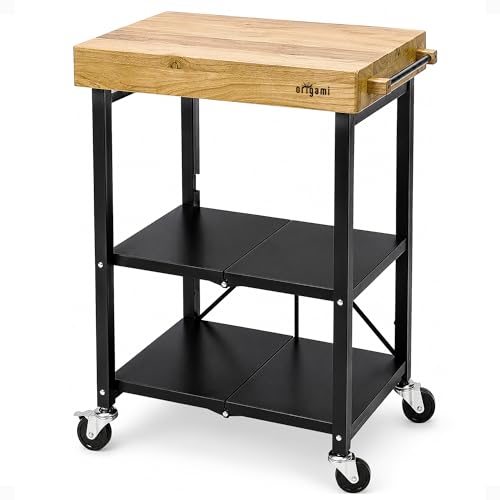
These are heavier kitchen islands on wheels with a thick wood top, often 1.5 to 2 inches thick, plus enclosed storage below like drawers, cabinets, or towel bars. Brands like John Boos, Catskill Craftsmen, and Origami make common versions. They typically measure 24 to 36 inches wide, 18 to 24 inches deep, and 34 to 36 inches tall, which matches standard counter height at 36 inches. Weight is 40 to 90 lbs before you load them, so they stay planted while you chop.
- Best for: Extra counter space, heavy prep, knife work, and storing cookware or knives
- Prep ability: Excellent; solid hardwood top can be used directly as a cutting surface if maintained
- Storage: Less vertical efficiency, but more concealed and weight-bearing storage
Size and Fit: Will It Actually Roll in Your Kitchen?
A cart only saves space if you can move and use it without blocking workflow. Use these real-world clearances before you buy.
| Measurement | Tiered Cart (Typical) | Butcher Block Cart (Typical) | What to Check at Home |
|---|---|---|---|
| Footprint (W x D) | 13″ x 18″ to 18″ x 24″ | 24″ x 18″ to 36″ x 24″ | Tape the footprint on your floor; leave 36″ for main walkways |
| Height | 30″ to 35″ | 34″ to 36.5″ | Standard counter is 36″; dining table is 28-30″. Match cart height to task |
| Gap Needed to Roll Through | 16″ to 20″ minimum | 26″ to 38″ minimum | Measure narrowest point: between fridge handle and opposite counter, or doorway (standard interior doorway is 28-30″) |
| Clearance to Use | 18″ in front to pull items off shelves | 36″ to 42″ in front to open drawers/doors and stand to chop | In a 10×12 ft kitchen, a 30″ wide butcher block cart needs at least half the length of a wall free |
| Weight Capacity (Total) | 45 to 90 lbs (15-30 lbs per shelf) | 150 to 300 lbs (top alone often 50-100 lbs) | Check if you plan to store cast iron, stand mixers (25-30 lbs), or small appliances |
For galley kitchens or apartments under 80 square feet of kitchen area, a tiered cart is often the only option that can be pushed aside when not in use. In kitchens with at least 40 inches between counters, a butcher block cart can live permanently as a small island and still allow two people to pass.
Wheel Stability: Why Some Carts Wobble and Others Don’t
Not all wheels are equal, and this is where cheap carts fail. For kitchen carts on wheels, stability depends on wheel diameter, material, and lock type.
- Wheel Diameter: Tiered carts usually have 1.5 to 2-inch plastic casters. They roll fine on hard floors but catch on grout lines or rugs. Butcher block carts use 2.5 to 4-inch rubber or polyurethane casters that roll over transitions and protect floors.
- Locking Mechanism: Look for at least two locking casters. Lever locks on small plastic wheels often slip when you lean on the cart. Screw-down or pedal locks on larger rubber wheels hold firm during chopping. If you plan to knead dough or cut meat, two locking wheels is the minimum, four is better.
- Weight and Base Width: A 12 lb tiered cart with a narrow base will shift if you press down hard on one corner. A 65 lb butcher block cart with a wheelbase wider than 20 inches stays stable, especially if the bottom shelf is loaded with heavy pots to lower the center of gravity.
If your floors are uneven tile or older hardwood, avoid all-plastic wheels. Rubber-coated wheels with ball bearings are quieter and will not rattle the shelves loose over time.
Material Trade-Offs: Wood vs. Metal vs. Stainless Steel
The frame and top material determine daily cleaning, long-term durability, and how the cart feels to work on.
| Material | Maintenance Level | Durability Reality | Best For |
|---|---|---|---|
| Solid Hardwood (Maple, Beech, Rubberwood Butcher Block) | High: Oil monthly with food-grade mineral oil; sand out stains; never soak or put in dishwasher | Can be sanded and refinished for 10+ years; warps if left wet; knife marks are expected and can be sanded out | Daily chopping, bakers, anyone who wants a true cutting surface |
| Powder-Coated Metal (Steel Frame + Wire or Solid Shelves) | Low: Wipe with damp cloth and mild soap; dry immediately to prevent rust at welds | Chips at corners over time; wire shelves sag under 25+ lbs per tier if not reinforced; rusts if coating is scratched in humid kitchens | Renters, small kitchens, storage-only use, tight budgets (usually $60-$180) |
| Stainless Steel Top + Metal or Wood Frame | Medium: Wipe with soapy water, dry to avoid water spots; use Bar Keeper’s Friend for discoloration; shows fingerprints | Most hygienic and heat-resistant; will not stain from beets or wine; dents and scratches show but do not affect function; noisy when setting down pots | High-heat cooking, cooks who want low-maintenance prep near the stove, usually $200-$500 for steel-top carts |
| Engineered Wood / MDF with Veneer or Laminate Top | Low-Medium: Wipe clean; avoid standing water on seams | Cannot be refinished; swells and peels if water gets into particle board; sags under heavy appliances over 2-3 years | Occasional-use islands where look matters more than heavy prep, usually $150-$350 |
For butcher block specifically, end-grain tops are more forgiving on knives and hide cuts better than edge-grain, but they cost more and require more oil. Edge-grain is stiffer and better for rolling dough. Avoid carts that advertise “butcher block” but use a thin 0.5-inch veneer over MDF – it cannot be used as a cutting board and will bubble at the first spill.
Decision Matrix: Which Cart Fits Your Situation?
Use your primary constraint to choose, not just looks.
| Your Situation | Best Choice | Why |
|---|---|---|
| Small apartment, galley kitchen, or under 24″ of free wall space | 3-Tier Narrow Metal Cart (14″ x 18″) | Fits gaps, rolls into closets, holds 60+ lbs of pantry items without blocking traffic |
| Renter who cannot add permanent island or drill into counters | Metal Frame with Stainless Steel or Solid Wood Top + Locking Wheels | Gives 4-6 sq ft of real counter back; moves out easily when you move; no installation |
| You cook daily and need prep space for chopping and baking | Butcher Block Cart, 30″ to 36″ wide, 36″ high | Counter-height top at correct ergonomic height prevents back strain; hardwood top handles knives and dough |
| Kids and pets at home | Butcher Block Cart with 4 Locking Wheels + Lower Cabinet Storage | Heavier base is harder to tip; enclosed storage keeps knives and chemicals out of reach; avoid open wire tiers a child can climb |
| Back pain or long prep sessions | 36″ High Butcher Block or Stainless Steel Cart | Matching your counter height (36″) keeps wrists neutral; tiered carts at 32-33″ force you to hunch |
| Need mobile bar, craft, or bathroom storage outside the kitchen | 2 or 3-Tier Utility Cart | Lightweight and versatile; can change function room to room |
Assembly, Moving, and What Wears Out First
Expectations help you avoid returns. Tiered metal carts usually ship flat in a 15 to 22 lb box and assemble in 15 to 30 minutes with no tools beyond an included Allen key. The first thing to loosen is the shelf clips and the thin plastic casters.
Butcher block carts ship in one or two heavy boxes, 45 to 90 lbs total. You will need two people to carry the top up stairs and through standard 30-inch doorways. Assembly takes 45 to 90 minutes and often requires tightening leg bolts and attaching casters with a wrench. Many solid wood carts arrive with the top pre-oiled – apply another coat of oil before first heavy use.
What wears first: On tiered carts, wheel locks and screw-in shelves strip first. On butcher block carts, the finish around the sink-side edge and drawer slides wear if exposed to steam. On stainless steel tops, fine hairline scratches appear in the first month – this is normal and does not mean the steel is low quality. Re-oiling a wood top every 4 to 6 weeks and keeping metal joints dry will double the lifespan of either style.
Final Buying Checklist for Kitchen Carts on Wheels
- Measure your narrowest passage and count on needing 2 to 4 inches more than the cart’s width to roll comfortably.
- Decide on height by task: 34 to 35 inches is better for seated or shorter users, 36 inches for standing prep.
- Choose wheels by floor: rubber or polyurethane for hardwood and tile, larger diameter for tile grout or transitions.
- Check weight limits per shelf, not just total, if you store a microwave (35-45 lbs) or KitchenAid mixer.
- For wood tops, confirm solid wood (maple, beech, acacia, rubberwood) versus veneer over engineered wood if you intend to cut directly on it.
If you need storage that disappears, get a tiered cart. If you need a work surface that stays put while you work, invest in a solid wood or stainless steel top butcher block cart with large locking casters. That single distinction solves most kitchen cart buying mistakes.