Key takeaways
- Close doors to the room you’re dehumidifying so the unit isn’t fighting a larger volume of air than necessary.
- Clean the air filter every two weeks during peak summer months; a clogged filter reduces extraction efficiency by up to 25%.
- Pair a small hygrometer with your dehumidifier’s built-in sensor — they rarely agree perfectly, and the external reading gives you a trustworthy baseline.
- Empty and rinse the tank with white vinegar monthly even if you’re using continuous drainage, since residual moisture breeds biofilm.
What's inside
Humidity is one of those invisible design problems — it warps hardwood, dulls textiles, breeds mildew behind your favorite gallery wall, and makes every room feel heavier than it should. Setting a dehumidifier correctly is less about cranking a dial and more about understanding how moisture actually behaves in your specific space. Get it right, and your furniture lasts longer, your air feels effortless, and your home photographs the way you imagined it.
In this guide we’ll walk through the exact humidity target you should aim for, how room size dictates which unit you need, whether continuous drainage or tank management makes more sense for your lifestyle, and a handful of small habits that keep everything running smoothly. Our recommended picks are below so you can match advice to hardware immediately.
As an Amazon Associate we earn from qualifying purchases.


Start With the Right Target: 40–50% Relative Humidity
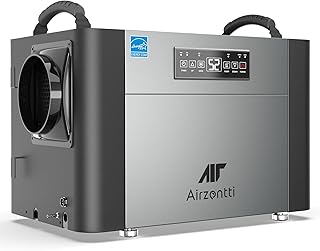
Most building scientists agree that 40–50% relative humidity is the sweet spot for residential comfort and material preservation. Below 30%, you get dry skin, static shock, and cracking in wood furniture. Above 60%, mold spores activate and dust mites flourish. A unit like the KNKA Energy Star 4500 Sq.Ft Dehumidifier or the Waykar 34 Pint model lets you set a precise target — typically via a digital humidistat — and the compressor cycles on and off to hold that range automatically. If your dehumidifier doesn’t have a numeric readout, treat the medium setting as a starting point and invest in a separate hygrometer (under ten dollars) to verify what’s actually happening at floor level, where moisture concentrates.
Match Capacity to Your Square Footage
Capacity isn’t marketing fluff — it determines whether the unit keeps up. A compact 95 oz tank model like the Dehumidifier 95OZ for Home or the ToLife Dehumidifier handles bedrooms, bathrooms, and apartments up to roughly 1,000 square feet where occasional dampness is the issue. Step up to a mid-range compressor unit such as the Waykar 34 Pint for spaces around 2,000 square feet like open-plan living areas or finished basements. For basements exceeding 4,000 square feet or coastal climates with persistent moisture intrusion, a heavy-duty 80-pint-per-day machine — the 5500 Sq.Ft Energy Star Most Efficient unit or the 4500 Sq.Ft Quilt Compressor model — is the honest choice. Oversizing isn’t wasteful; it means the compressor runs shorter cycles, uses less electricity per pint collected, and puts out less noise.
Continuous Drainage vs. Tank: Choose Based on Your Routine
Tank-based units are plug-and-play — fill, carry, dump. That works fine for a bedroom dehumidifier you check weekly. But in a basement or crawl space where you’d rather forget the machine exists, continuous gravity drainage through a hose is transformative. Both the KNKA 4500 and the Waykar 34 include drain hoses out of the box. Connect one to a floor drain or condensate pump, and you’ve essentially automated moisture removal. Just remember: if the hose runs uphill at any point, condensate can backflow and trigger a shutdown. Keep the drain line sloped downward and clear of kinks. The 5500 Sq.Ft Energy Star Most Efficient unit pairs well with a condensate pump if your drain sits higher than the unit’s outlet.
Understand Noise, Placement, and Room Flow
Where you put a dehumidifier changes how well it works as much as the unit’s specs. Place it centrally in the room with at least 12 inches of clearance on all sides so air can circulate through the intake and exhaust freely. Avoid corners or enclosed closets — the machine will recycle the same dry pocket and short-cycle without pulling moisture from the rest of the space. For bedroom use, models with a dedicated sleep mode like the ToLife or the KNKA drop to sub-40-decibel operation that won’t compete with a white-noise machine. The 4500 Sq.Ft Quilt Compressor model specifically targets quiet operation through its insulated housing, making it a realistic option for a home office where concentration matters.
Settings That Actually Save Energy
The biggest myth in dehumidifier ownership is that “lower is better.” Dropping a room to 30% RH doesn’t make it healthier — it just makes the compressor work harder and your energy bill climb. Set the humidistat to 45%, let the unit reach that level, and then let it maintain. Energy Star ratings matter here: the Waykar 34 Pint and the 5500 Sq.Ft Most Efficient unit both carry 2025 Energy Star certification, meaning they extract more moisture per watt than non-rated competitors. If your model offers an auto-restart feature after a power outage, enable it — you don’t want a summer storm to undo a week of careful moisture control while you’re away.
Tips
- Close doors to the room you’re dehumidifying so the unit isn’t fighting a larger volume of air than necessary.
- Clean the air filter every two weeks during peak summer months; a clogged filter reduces extraction efficiency by up to 25%.
- Pair a small hygrometer with your dehumidifier’s built-in sensor — they rarely agree perfectly, and the external reading gives you a trustworthy baseline.
- Empty and rinse the tank with white vinegar monthly even if you’re using continuous drainage, since residual moisture breeds biofilm.
Frequently Asked Questions
Should I run my dehumidifier all day or only at night?
In consistently humid climates, continuous operation at a 45% target is most efficient because the compressor cycles on and off automatically. In milder seasons, a timer function — available on the KNKA and Waykar models — lets you restrict运行 to off-peak electricity hours without sacrificing control.
Can one dehumidifier handle an entire house?
A single unit rarely covers a whole home unless the layout is open and compact. For multi-room houses, placing one unit per major zone (living area, basement, bedroom cluster) produces far more consistent results than one oversized machine struggling to push conditioned air through closed doors.
What happens if I set the humidity too low?
Below 30% RH, you’ll notice dry irritated skin, warped wooden furniture joints, and peeling paint. It also wastes energy. Stick to the 40–50% range unless a specific material — like a music instrument collection — demands tighter tolerance, and even then, monitor with a hygrometer rather than guessing.
Do dehumidifiers help with allergies?
Yes, meaningfully. Maintaining humidity below 50% suppresses dust mite reproduction and slows mold growth on surfaces you can’t easily see — behind baseboards, under sinks, inside closet walls. Combined with regular filter cleaning, a well-set dehumidifier reduces two of the most common indoor allergen sources.
Conclusion
The best dehumidifier setting isn’t a single number you guess and forget — it’s a 40–50% RH target matched to a unit properly sized for your square footage, connected to continuous drainage if the space demands it, and maintained with the small habits that keep efficiency high. Choose the right capacity from our recommended picks, place it with airflow in mind, and let the humidistat do the work. Your furniture, your walls, and your lungs will all thank you.