Key takeaways
- Frame construction: Reinforced steel outlasts hardwood-and-plywood builds under daily use, particularly in big-and-tall sizing. Check the stated weight capacity — anything at or above 400 lbs signals a frame engineered with margin rather than to a minimum.
- Motor count: Single-motor chairs move back and footrest together on a fixed arc. Dual and tri-motor systems separate them, which is what unlocks true infinite positioning and a genuine lay-flat angle. If you plan to nap in the chair, dual motor is the floor.
- Upholstery grade: Genuine leather develops patina and resists puncture; quality faux leather wipes clean and costs less but will craze at stress points eventually. Match the material to your household, not the showroom photo.
- Wall clearance: Standard recliners need 12 to 18 inches behind them. Wall-hugger mechanisms drop that to a few inches, which matters enormously in apartments and any room where the chair sits on a sightline rather than in a corner.
- Lift versus recline: A lift chair tilts forward to help you stand and is a mobility tool first. If that function is not needed, skip it — you will get better proportions and a cleaner profile from a dedicated recliner at the same price.
What's inside
Recliners have a reputation problem. For decades they were the piece you tucked into a corner and apologized for, all bulk and no line. That has changed faster than most furniture categories, but the shift has created a new dilemma: the market is now crowded with chairs that photograph beautifully and collapse within two seasons, alongside genuinely well-built pieces buried under identical marketing language. Frame quality, motor count, and upholstery grade are the three things that determine whether a chair lasts a decade, and they are almost never the things listed first.
This guide sorts the field by construction rather than styling. We looked at steel-frame reinforcement, single versus dual versus tri-motor lift mechanisms, genuine leather against faux, and how each chair actually behaves in a real room, including wall clearance, footprint, and whether the reclined silhouette reads intentional or accidental. Below are the models worth your attention this year, plus the specifications that separate a serious chair from a seasonal one.
As an Amazon Associate we earn from qualifying purchases.


How to Choose a Who Makes The Best Quality Recliner Chairs (2026)
- Frame construction: Reinforced steel outlasts hardwood-and-plywood builds under daily use, particularly in big-and-tall sizing. Check the stated weight capacity — anything at or above 400 lbs signals a frame engineered with margin rather than to a minimum.
- Motor count: Single-motor chairs move back and footrest together on a fixed arc. Dual and tri-motor systems separate them, which is what unlocks true infinite positioning and a genuine lay-flat angle. If you plan to nap in the chair, dual motor is the floor.
- Upholstery grade: Genuine leather develops patina and resists puncture; quality faux leather wipes clean and costs less but will craze at stress points eventually. Match the material to your household, not the showroom photo.
- Wall clearance: Standard recliners need 12 to 18 inches behind them. Wall-hugger mechanisms drop that to a few inches, which matters enormously in apartments and any room where the chair sits on a sightline rather than in a corner.
- Lift versus recline: A lift chair tilts forward to help you stand and is a mobility tool first. If that function is not needed, skip it — you will get better proportions and a cleaner profile from a dedicated recliner at the same price.
The Best Who Makes The Best Quality Recliner Chairs (2026)s Reviewed
MCombo Large Power Lift Recliner 7516
Built for taller frames with a genuinely generous seat depth, this one earns its place through the completeness of its feature set: three positions, heat, massage, cup holders, and USB ports without the price climbing into leather territory. The faux leather is the compromise, so treat it as a high-function chair rather than a heirloom piece.
Watson & Whitely Oversized Leather Power Recliner, Navy
The wall-hugger mechanism is the headline here — it recline fully with only inches of clearance, which makes it one of the few oversized chairs that works against a wall or in a tight living room. Genuine leather in a deep navy gives it a tailored look that most big-and-tall recliners never achieve.
DYNOX 500LBS Heavy Duty Big and Tall Power Lift Recliner 9398L
The most seriously engineered chair on this list: a reinforced steel frame rated to 500 lbs, tri-motor control, and an extended footrest that actually accommodates longer legs instead of ending at the ankle. If durability under heavy daily use is the priority, this is the one to beat.
Watson & Whitely Oversized Leather Power Recliner, Cream
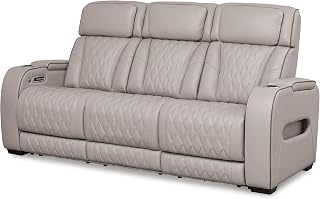
Same substantial build as its navy sibling but tuned for lay-flat positioning, with a power headrest and cup holders integrated cleanly rather than bolted on. The cream leather is the design choice — it reads far lighter in a room than any dark upholstery of the same volume.
Classic Leather Manual Recliner, Nut Brown
No motors, no ports, no cords — just a well-proportioned traditional recliner with rolled arms and a supportive back. For anyone who wants the aesthetic without the mechanism, manual is also the most reliable configuration you can buy.
Frequently Asked Questions
Is genuine leather worth the premium over faux?
For a chair you expect to keep five years or longer, yes. Leather breathes, softens, and tolerates abrasion; faux leather performs well early but tends to fail at the seat-front and arm crest where flexing concentrates.
What is the difference between a lift chair and a power recliner?
A lift chair tilts the entire base forward to bring you to standing. A power recliner only moves backward. Lift chairs cost more and sit slightly higher, so choose one only if standing assistance is genuinely useful.
How much space do I need behind the chair?
Plan for 12 to 18 inches on a standard mechanism. Wall-hugger models like the Watson & Whitely recliners cut that to roughly three to four inches, which is often the deciding factor in smaller rooms.
Do heat and massage features hold up over time?
The motors and heating elements are typically the first components to fail, and they are rarely serviceable. Treat them as a bonus rather than a reason to buy, and prioritize frame and mechanism quality instead.
Final Thoughts
If you want the most durable chair here, the DYNOX 9398L with its 500 lb steel frame and tri-motor lift is the clear structural winner. For a piece that works visually in an open room, the Watson & Whitely wall-hugger in navy delivers real leather and near-zero clearance. And the MCombo 7516 remains the smartest value for anyone who wants full power features without stretching the budget.