Key takeaways
- Measure plate stacks, usable shelf depth, door openings and combined weight before choosing a sideboard for everyday dish storage.
What's inside
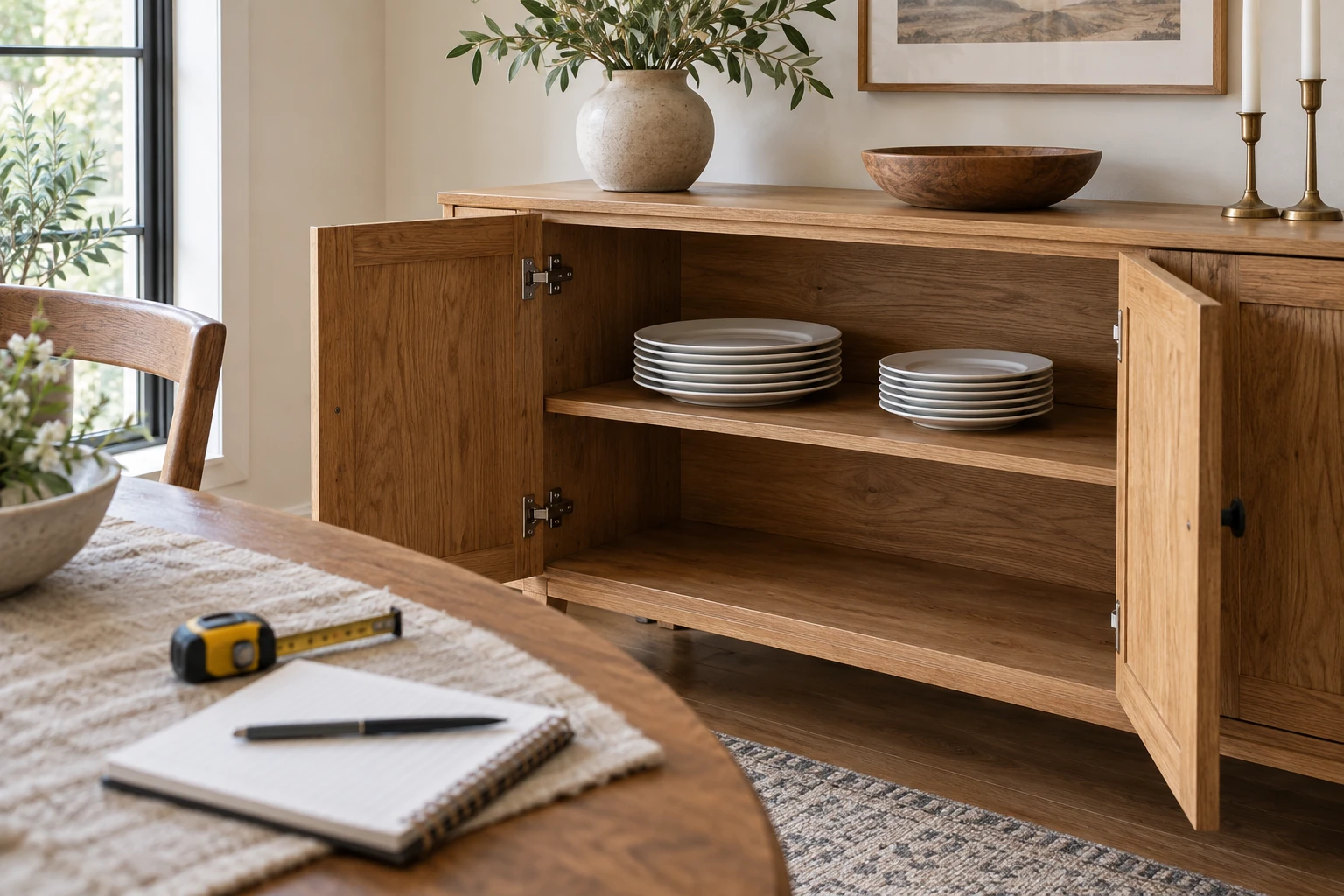
Choose a sideboard for dinner plates using its usable shelf depth and door opening, not the cabinet’s outside depth. Measure your largest plate or platter, the height and weight of the stack, and the space needed to lift it out. A stack that fits behind a closed door may still be awkward to retrieve.
The worksheet below turns dish storage into a measurable task. It avoids assuming every dinner plate is the same size or every adjustable shelf has the same load capacity.
Measure the dishes you actually own
For a round plate, measure its widest outside diameter, including the rim. For a square plate or oval platter, record width and depth in the orientation you intend to store it. Include handles or projecting edges on serving pieces.
Make realistic stacks on a stable surface and measure their total height. Weigh a manageable stack with suitable scales rather than lifting an unnecessarily heavy pile. Record separate groups for daily plates, occasional platters and bowls. A single “dishes” entry hides different storage needs.
For context, Corelle identifies its Winter Frost White dinner plates in this six-pack as 10.25 inches in diameter. That is a useful exact-product example, not a universal dinner-plate size. Your everyday plates or a serving platter may require a different footprint.
Ask for the shelf and opening dimensions
Overall cabinet depth includes its construction and door arrangement. Obtain the actual shelf depth from front to back, then identify hinges, stops or other parts that intrude into the intended dish position. Check the clear door opening, because a wide interior behind a narrower entrance does not guarantee easy access.
For a modular system, match the shelf to the specific frame. IKEA’s BESTÅ shelf, article 002.955.54, lists dimensions of 22 by 14⅛ inches and a maximum load of 44 pounds. Those figures describe that shelf in its intended system. They do not establish the interior dimensions, mounting capacity or shelf rating of another sideboard.
If a retailer provides only external dimensions, ask for an interior drawing or a measurement showing the endpoints. Label missing depth or load information as unknown instead of subtracting guessed panel thicknesses.
Use this plate-storage worksheet
| Item | Dish measurement | Cabinet check |
|---|---|---|
| Largest footprint | Diameter or width × depth | Usable shelf area clear of hardware |
| Stack height | Actual intended group | Vertical opening plus retrieval space |
| Stack weight | Measured manageable groups | Applicable shelf limit and loading instructions |
| Entry opening | Dish width in intended orientation | Door opening with hinges in place |
| Hand access | How you grip and lift the stack | Clear route out without scraping or tilting precariously |
| Other contents | Bowls, trays or accessories sharing the shelf | Combined load and usable area |
Keep plate size and hand-access space as separate entries. A geometric fit with almost no spare room may require you to pinch a rim or pull out several objects first. Your intended daily routine should determine whether that arrangement is acceptable.
A worked example: depth passes, retrieval needs revision
Illustrative dimensions and weights: a plate is 10½ inches across. The proposed shelf has 12 inches of usable depth. The difference is 1½ inches, which shows that the plate footprint fits front to back. It does not specify how that spare space should be divided or prove comfortable access.
Eight plates form a 6-inch-high stack, but the clear opening above the shelf is only 6¼ inches. Although the stack is shorter than the opening, the small remaining gap makes the planned lift-out motion questionable. Test the arrangement with the real dishes in a suitable showroom or ask for a larger shelf spacing.
Suppose two stacks weigh 9 pounds each and a tray adds 3 pounds. The combined planned load is 21 pounds. Compare that total with the exact shelf’s limit and loading conditions. Do not compare each stack separately and forget the shared tray, or use the cabinet-top rating as the shelf rating.
Plan shelf height around retrieval
An adjustable shelf provides positions, not unlimited adjustment. Ask where its available support holes place the shelf and how much clear height remains after the shelf thickness is included. A tall pitcher on the lower shelf may reduce the space available for plates above it.
Consider two smaller stacks if one tall stack is awkward to handle, provided the resulting layout meets the shelf’s loading instructions. Keep frequently used dishes where you can reach them without stretching around a door. Avoid creating a tightly packed arrangement that must be unpacked for every meal.
Confirm assembly and access before loading
Follow the cabinet’s assembly, shelf-support and anchoring instructions. Check that every shelf support is installed as intended before placing dishes inside. Do not increase the claimed capacity by adding an improvised support or changing the frame.
Open the doors in the cabinet’s final room position. A neighboring wall or chair can limit the opening angle and change the access you observed in a product photo. Keep the installation record, shelf rating and dish worksheet together. The successful sideboard is one that supports the planned load and lets you put away and retrieve your dishes without a daily puzzle.