Key takeaways
- Check folded trolley width, depth, height and opening space before buying. Includes a recess worksheet and an example showing hinge interference.
What's inside
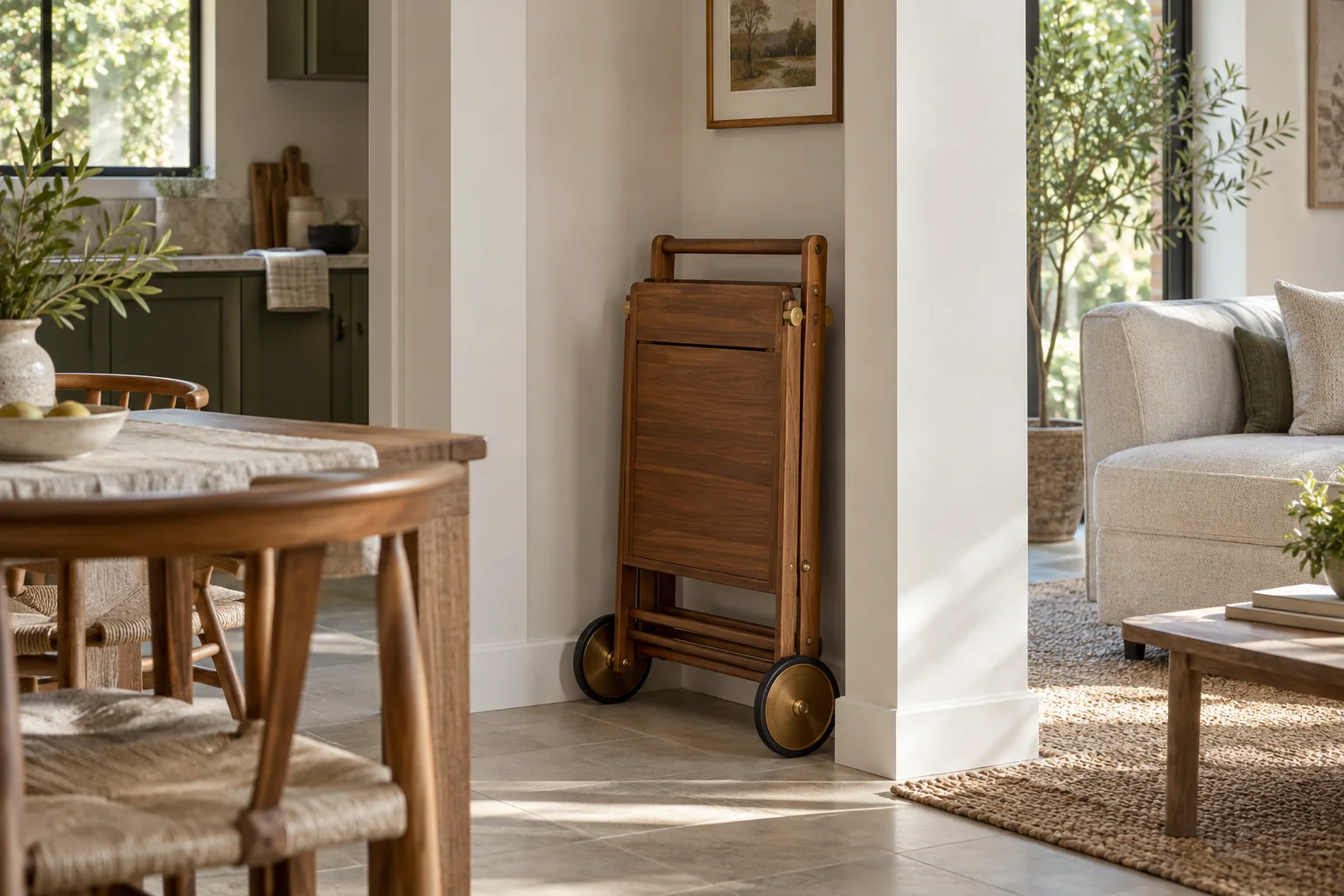
A folding serving trolley fits a storage gap only when its complete folded width, depth and height fit the available space in the intended orientation. You also need a workable route in and out and room to unfold it. “Folds flat” is a description, not a dimension.
Measure the trolley in three states: open for serving, closed for storage and moving between them. This separates a cart that can technically be squeezed into a recess from one that is convenient to use before every meal.
Identify what actually folds
Some trolleys fold their shelves inward; others reduce one dimension while retaining a substantial wheelbase. A drop-leaf cart may have a smaller top when closed but retain its cabinet footprint. Look at the operating instructions and the closed-state drawing rather than assuming all folding products work alike.
Foppapedretti’s Service trolley specification gives open dimensions of H76, D49 and W75 cm, and closed dimensions of H76, D49 and W27 cm. In that example the width changes while the stated depth and height remain the same. Use the measurements for your exact version; this example is not a universal trolley size.
Do not substitute shipping-carton dimensions for closed dimensions. Packaging may include loose parts, protective spacing or a different orientation. Save the product drawing with labels visible so nobody swaps width and depth while checking the recess.
Measure the smallest usable storage opening
Measure the opening at the floor, at the height of the trolley’s widest folded part and near the top. Skirting boards, door hinges and a projecting shelf can each reduce the usable space. Check the depth with any cupboard door closed, including the space occupied by its inside hardware.
Record nearby functions as well. A trolley must not block a door, access panel, heating outlet or necessary passage. A storage gap beside an appliance is not automatically suitable: preserve the appliance’s required access and clearances.
| State | Dimensions to record | Extra question |
|---|---|---|
| Closed | Maximum width, depth and height | Do wheels, handles or latches project? |
| Stored | Smallest opening and usable depth | Can the door close without contact? |
| Moving | Route, thresholds and turning points | Can it roll out without lifting? |
| Opening | Space swept by shelves and frame | Can you reach the required locks? |
| Serving | Full open footprint | Are doors and walking routes usable? |
Calculate the difference, then check handling space
Consider a hypothetical clear recess measuring 32 cm wide, 53 cm deep and 81 cm high. A trolley with the example closed dimensions of 27 by 49 by 76 cm leaves total differences of 5 cm, 4 cm and 5 cm respectively. That establishes a possible geometric fit in the chosen orientation.
It does not establish enough space for your hand, a wheel that swivels outward or the movement needed to release a latch. Do not label the remaining 5 cm a manufacturer-approved clearance. Mark the planned footprint on a loose sheet on the floor and check where you will stand and grip the trolley.
If a cupboard hinge projects 6 cm into that 32 cm opening at trolley height, the effective width becomes 26 cm there. The 27 cm trolley no longer passes in the same orientation. Recording the narrowest point prevents an apparently generous outside cupboard measurement from hiding this problem.
Plan the unfolding location
You may need to remove the trolley completely before opening it. Reserve a level place where the entire mechanism can move as its instructions require. Avoid planning to open it while wedged halfway inside the recess or while balancing objects on an unsupported shelf.
Read how the open position locks and how the closed position is secured. Keep hands clear of folding joints and follow the maker’s sequence. The amount of empty floor required depends on the mechanism, so ask for a demonstration or an operating video when a drawing leaves the movement unclear.
Check whether the product is intended to stand upright when folded. Do not lean a trolley against a wall simply because that would make it fit. Likewise, do not assume that a maker’s statement about one trolley retaining bottles while folded permits dishes or appliances to remain on another design during folding.
Rehearse the storage routine before filling it
On receipt, inspect the assembled trolley according to its instructions and try the empty route first. Check caster orientation, threshold handling and the ability to reach any locks. Do not force the folded frame through a tight opening or drag it sideways to compensate for poor access.
Then establish a place for items that must be removed before folding. A cart that needs to be emptied into an already crowded cupboard may save floor space but create a frustrating daily task. This is a workflow decision you can evaluate without making assumptions about its load capacity.
Keep a one-line storage plan with the dimensions: “Fold empty in the dining area, secure as instructed, roll into recess with handle facing out.” Change that wording to match the actual product. A confirmed three-dimensional fit plus a repeatable operating route is more useful than the smallest folded-thickness number in a listing.