Key takeaways
- Table height: Floor to table top. Standard dining tables are 28 to 30 inches. Counter-height tables are 34 to 36 inches.
- Apron height: Floor to the bottom of the table apron or skirt underneath. This is your real limit, often 25 to 27 inches on a standard table.
- Chair arm height: Floor to the top of the armrest. Most dining chairs with arms are 25 to 27 inches.
Dining chairs with arms will fit your table only if the arm height is at least 2 inches lower than the lowest point of your table apron and you have 24 to 28 inches of width per chair for comfortable elbows and pull-out space.
If you skip these two measurements, you risk chairs that won’t slide in, arms that scrape the table edge, and a dining set that feels cramped even in a large room. This guide gives you the exact numbers to check before you buy, plus how to choose between upholstered and hard arms for your space, cleaning needs, and comfort.
Our top picks

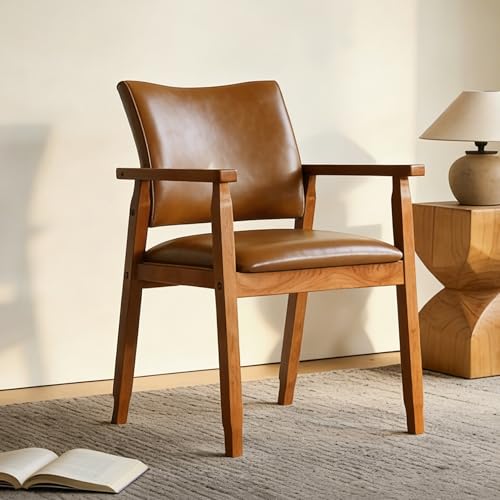


As an Amazon Associate we earn from qualifying purchases at no extra cost to you. Ratings are shown as listed on Amazon.
Will It Fit Under Your Table? Measure These 3 Numbers First
Most product listings show overall height, but what matters for dining chairs with arms is where the arms sit relative to your table.
1. Arm Height vs. Table Apron Clearance
Take these measurements with a tape measure:
- Table height: Floor to table top. Standard dining tables are 28 to 30 inches. Counter-height tables are 34 to 36 inches.
- Apron height: Floor to the bottom of the table apron or skirt underneath. This is your real limit, often 25 to 27 inches on a standard table.
- Chair arm height: Floor to the top of the armrest. Most dining chairs with arms are 25 to 27 inches.
You need a minimum of 2 inches of clearance between the top of the arm and the bottom of the apron to slide the chair in without lifting it, and 7 inches between the seat and the table top for thigh clearance. For chairs with fully upholstered arms that you want to tuck completely under the table, aim for 3 to 4 inches of clearance to avoid fabric wear.
| Table Type | Typical Table Top Height | Typical Apron Bottom Height | Ideal Max Arm Height | Result |
|---|---|---|---|---|
| Standard dining table without apron | 29 – 30 inches | 29 – 30 inches (no apron) | 26 – 27 inches | Arms slide under easily |
| Standard dining table with 3-4″ apron | 29 – 30 inches | 25.5 – 26.5 inches | 23.5 – 24.5 inches | Requires low arms or armless chairs |
| Mid-century / pedestal table | 28.5 – 29 inches | 28.5 – 29 inches | 26 – 26.5 inches | Most armchairs fit |
| Counter-height table | 34 – 36 inches | 32 – 34 inches | 30 – 32 inches | Needs counter stools with arms, not standard dining chairs |
2. Chair Width and Depth
Armchairs are 4 to 8 inches wider than armless chairs. Measure the full width at the widest point of the arms, not just the seat.
- Narrow armchair: 22 to 23.5 inches wide
- Standard armchair: 24 to 26 inches wide
- Oversized / upholstered armchair: 26.5 to 30 inches wide
- Standard depth: 21 to 24 inches, plus 14 to 18 inches to pull the chair out
If you already own a table, measure between the table legs at floor level. For a table with four legs, subtract 4 inches from the leg-to-leg distance to avoid banging elbows on legs when seated.
3. Seat Height
For a 29 to 30 inch table, look for a seat height of 17 to 19 inches. For a 28 inch table, stay at 17 to 18 inches. A seat higher than 19 inches will leave most people with knees hitting the apron and feet not resting flat if they are under 5’6″.
Upholstered vs. Wood vs. Metal Arms: Which Is Right For You?
Comfort, durability, and cleaning are the real trade-offs — not just looks.
| Arm Type | Comfort for Long Meals | Durability / What Wears First | Cleaning | Best For |
|---|---|---|---|---|
| Fully upholstered (fabric over foam) | Highest – soft on elbows and forearms, warm in winter | Fabric on arm top pilling and foam compression after 3-5 years of daily use; foam density 1.8 lbs/cu ft+ lasts longer than 1.5 | Requires vacuuming and spot cleaning; performance fabrics like tightly woven polyester or solution-dyed acrylic resist stains better than linen or cotton velvet | Hosts who linger at the table, formal dining rooms |
| Wood arms (solid wood) | Firm – comfortable with a cushion but hard for leaning | Very durable; finish can scratch from rings or plates. Solid wood can be refinished, engineered wood cannot | Wipe clean; no fabric to stain | Families with kids and pets, daily-use kitchens |
| Metal arms (with or without pad) | Low unless padded; can feel cold and hard | Powder-coated metal resists chipping better than painted metal; loose welds or wobble is the first failure point | Wipe clean; padded versions need fabric care | Modern small spaces, renters who need lightweight chairs |
| Partially upholstered (wood frame + padded armrest cap) | Balanced – soft where you rest arms, hard frame elsewhere | Arm cap fabric wears before frame; replaceable caps extend life | Spot clean caps only | Best compromise for comfort and easy maintenance |
Market price ranges in 2026: wood armchairs usually $150–$400 each, fully upholstered armchairs $250–$600 each, and solid wood frames with high-density foam and performance fabric often $400–$800 each. Sets of four are often priced lower per chair than single armchairs sold as captain’s chairs.
How Much Space Do You Need? Room-Size Fit Guide
Arms add width and change how many chairs actually fit. Use these spacing rules:
- 24 inches minimum side-to-side between chair centers for armless chairs, 26 to 28 inches for chairs with arms
- 36 inches minimum from table edge to wall or sideboard to pull out and sit down; 42 to 48 inches if someone needs to walk behind a seated person
- 12 inches minimum between arm and table leg or apron side
Here is what that means in real rooms:
| Room or Table Size | What Fits With Arms | What Does Not Fit |
|---|---|---|
| 10×10 ft room with 48″ round table | 4 armchairs (one per side) – leaves ~34″ to wall on each side, tight but workable | 6 armchairs – requires 60″ round table and 11×13 ft minimum |
| 10×12 ft room with 60″ x 36″ rectangular table | 4 armchairs (2 per side) or 2 armchairs at heads + 2 armless on sides | 6 wide armchairs (26″+) – you will have less than 30″ pull-out space on long sides |
| Small apartment / 36″ x 36″ bistro table | 2 narrow armchairs (22-23.5″ wide) placed opposite each other | 4 armchairs – blocks traffic flow; use armless or folding instead |
| 72″ x 36″ table in open plan | 6 armchairs if they are 23-24″ wide; 4 armchairs + 2 armless is more comfortable | 6 oversized 28″ armchairs – needs a 84″ table |
Weight and moving notes: A solid wood armchair typically weighs 20 to 30 lbs per chair, upholstered armchairs 25 to 35 lbs, and boxed pairs often ship at 60 to 85 lbs per carton. Check your doorway width — most interior doors are 29 to 30 inches, so assembled armchairs up to 26 inches wide pass through, but 28 to 30 inch oversized models may need to be angled. If you rent or move often, look for chairs that arrive fully assembled or with simple leg-bolt assembly rather than full-frame construction.
Which Dining Chair With Arms Should You Choose? A Decision Matrix
Match your situation to the best configuration. Many people save space and money by mixing.
| Your Situation | Best Pick | Why |
|---|---|---|
| Small dining room or apartment under 120 sq ft | 2 armchairs only at the heads of the table + armless chairs on the sides | Cuts total width by 8-12 inches, keeps arm comfort where it matters most, easier to tuck sides under table |
| Kids and pets, daily meals | Solid wood or metal frame with wood arms and a removable seat cushion | Wipes clean, no fabric arms to stain, cushions can be reupholstered. Avoid light linen and velvet. |
| Renter / need to move chairs often | Metal or engineered wood frame under 22 lbs per chair, 1.8+ foam density if upholstered | Lighter to carry, lower box weight, less risk of damage in moves |
| Back pain or long dinners (1+ hours) | Upholstered armchair with 18-19″ seat height, lumbar curve, and padded arms at 25-26″ | Arms reduce shoulder strain when leaning, proper seat height keeps knees at 90 degrees |
| Formal dining room, host often | Fully upholstered armchairs with performance fabric, weight limit 275-300 lbs | Most comfortable for guests, higher weight capacity and foam density for longevity |
Assembly, Durability and Weight Limits
Before you buy, check the spec sheet for two often-missed details:
- Weight capacity: Most dining chairs with arms are rated 250 to 300 lbs. Solid wood and metal frames often handle 300 lbs, while engineered wood or lightweight designs may be limited to 225 to 250 lbs. If you need more, look for commercial-grade or contract-rated chairs.
- Assembly type: Knock-down chairs (legs and back bolt on) take 15 to 30 minutes per chair and may loosen over time — tighten joints every 6 months. Fully assembled or welded frames have fewer failure points but are harder to move through narrow hallways.
- What wears first: On upholstered arms, the top edge fabric; on wood arms, the finish where hands rest; on any chair with stretchers, the leg joints. Chairs with corner blocks and dowels last longer than those with only screws and staples.
To protect floors and reduce wobble, add felt glides if you have hardwood and check that the chair has adjustable levelers. For chairs that will slide in and out daily, a floor-to-arm height that lets you push the chair fully under the table reduces floor wear and frees up floor space.
Quick Checklist Before You Order
- Measure table top height, apron bottom height, and leg-to-leg width
- Choose arm height at least 2 inches below apron bottom, 3 to 4 inches if upholstered
- Allow 26 to 28 inches of table length per armchair and 36 inches of pull-out space behind
- Decide arm material based on cleaning and comfort: wood/metal for easy care, upholstered for long seating comfort
- For small rooms, buy 2 armchairs as captain’s chairs and pair with armless sides — it fits almost any 60-inch table