Key takeaways
- Seat-to-table gap: comfortable dining needs roughly 10–12 in between seat top and tabletop. Low camp sets pair an 11–12 in seat with a 15–16 in table. Mixing a low beach chair with a 27-in dining table means eating off your lap.
- Per-person table space: allow ~24 in of table edge per diner. A 28 x 28 in table seats two for a real meal and four for drinks, regardless of what “4-person” marketing claims.
- Footprint: a table plus four chairs needs about a 7 x 7 ft patch once you include 20–24 in of scoot-back room behind each seat — check that this fits under your 10 x 10 ft canopy alongside the cooler and stove.
- Ground contact: narrow pole feet sink into sand and soft turf. Wide disc feet or sled-style bases are worth having if you camp on beaches, or carry a set of foot pads.
Choose a folding camping table and chairs set by carry distance first and everything else second. If the farthest you’ll haul it is the 50 feet between your tailgate and a campsite, a 30–45 lb steel set is often the best value on the market. If you’ll shoulder it a quarter mile to a park lawn, cap the total packed weight near 12–15 lb, or the set will quietly migrate to the garage and stay there. The three specs that actually decide this — packed weight, folded dimensions, and load rating — are the ones most listings bury or exaggerate, so here’s how to read them.
Our top picks

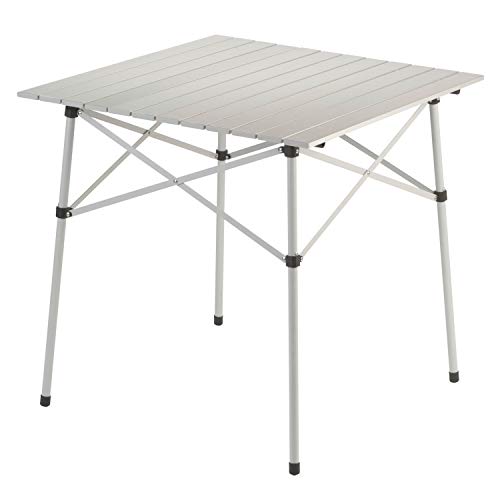

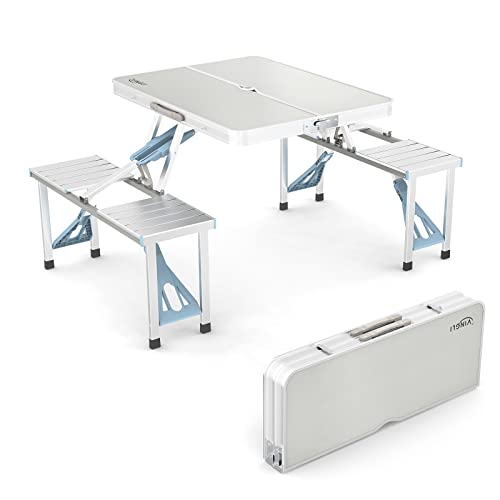
As an Amazon Associate we earn from qualifying purchases at no extra cost to you. Ratings are shown as listed on Amazon.
The three numbers that decide whether a set gets used
Packed weight means the whole bundle, not just the table. A “lightweight” table at 9 lb becomes a 19 lb carry once you add two 5 lb chairs. How the weight splits matters too: a one-piece suitcase set concentrates 30+ lb in a single briefcase-style carry, which is fine for a parking lot but miserable over distance. Two shoulder bags at 7 lb each are genuinely walkable. As a rough ceiling, most adults can comfortably one-hand carry about 20 lb for a few hundred yards.
Folded dimensions come in two shapes. Quad-fold chairs and roll-top tables collapse into long, skinny bundles — typically 34–38 in long and 6–8 in thick — which fit a sedan trunk (most open ~40 in wide) only diagonally or lengthwise. Suitcase and fold-in-half designs pack flat, roughly 34 x 17 x 4 in, and slide into a hatchback or SUV easily. Measure your trunk before buying, and check whether the tabletop itself rolls or is a rigid panel — a rigid 36-in panel won’t fit where a roll-top will.
Load ratings are static numbers: a chair rated 250 lb assumes a person lowering themselves in gently, not dropping in after a long hike. Buy with 25–30% headroom over the heaviest user. Table ratings matter more than people expect — a stocked 45-quart cooler weighs 50–60 lb, which exceeds the rating of many budget roll-tops before the stove and food even land on it.
| Set type | Total packed weight (table + 2 chairs) | Largest folded piece | Typical load ratings | Usual price |
|---|---|---|---|---|
| Ultralight packable (aluminum pole frames, fabric tops) | 5–9 lb | Chair bundles ~14 x 5 in; table ~16 x 5 in | Chairs 250–320 lb; table 30–50 lb | $250–$450 |
| Midweight aluminum (roll-top table, quad-fold chairs) | 15–25 lb | Table ~28 x 8 in; chair bags ~36 x 8 in | Chairs 225–300 lb; table 50–80 lb | $120–$280 |
| Steel / suitcase picnic set | 25–45 lb | Suitcase ~34 x 17 x 4 in | Bench seats 220–280 lb each; table 60–120 lb | $80–$220 |
| Folding bistro set (3-piece, steel or aluminum) | 20–40 lb | Chairs fold flat ~37 x 16 x 3 in; table ~30 in round | Chairs 250–300 lb | $80–$250 |
Aluminum vs. steel: what the material actually changes
The frame material is the single biggest driver of both carry weight and lifespan. Neither is universally better — they fail differently and suit different trips.
| Property | Aluminum frame | Steel frame |
|---|---|---|
| Weight per chair | 2–5 lb | 6–12 lb |
| Corrosion | Won’t rust; safe for beaches and boats | Powder coat chips at joints; rust follows within 1–3 seasons if stored damp |
| Failure mode | Poles bend or crack, usually suddenly | Bends gradually; often repairable |
| Rated capacity | 225–320 lb typical | 250–800 lb on heavy-duty models (the ALPS Mountaineering King Kong chair is rated 800 lb) |
| Cost | Higher per pound saved | Cheaper at the same size |
| Feel under load | Slight flex | Rigid and planted |
Mixed sets exist and are worth knowing about: an aluminum roll-top table paired with steel-frame chairs splits the difference — you keep the table light (it folds smallest) while gaining cheaper, higher-capacity seating. Tabletops are a separate decision. Blow-molded HDPE tops wipe clean and shrug off spills, aluminum slat tops are lighter and heat-tolerant (you can set a hot pan on them), and bamboo tops look great but can warp if put away wet.
Match the set to the trip
| Your situation | Best pick | Minimum spec to look for |
|---|---|---|
| Car camping, site beside the vehicle | Midweight aluminum or steel, dining height | 27–28 in table, 16–18 in seat height |
| Tailgating and serving food | HDPE-top fold-in-half table plus tall chairs | Wipe-clean top, ~100 lb table rating |
| Picnic a long walk from parking | Lightweight folding camping table and chairs in shoulder bags | Under ~15 lb total, longest piece under 36 in |
| Beach or soft ground | Low aluminum set with wide feet | Disc or sled-style feet, rust-proof frame |
| Apartment balcony that doubles as camp gear | Folding bistro table and chairs | Flat-folding chairs, 24–30 in table |
| Kayak camping, festivals, strict weight limits | Ultralight pole-and-fabric set | Under ~9 lb total, packs under 18 in |
For car camping, prioritize comfort over ounces: a 27–28 in dining-height table with 16–18 in seats lets adults eat normally instead of hunching. For tailgating, a suitcase-style folding picnic table and chairs or a fold-in-half HDPE table earns its weight — the top doubles as a buffet surface, tolerates rain and spilled drinks, and hose-washes clean afterward. For walk-in picnics, a foldable camping table and chairs set that splits into two shoulder bags is the difference between gear you bring and gear you don’t; low-profile chairs are acceptable here because you’ll sit on grass anyway. A folding bistro table and chairs set is the underrated pick for small-space dwellers: steel versions survive a balcony in all weather, and the same set goes in the trunk for campground duty — flat-folding chairs store against a wall in under 4 in of depth.
Sizing details listings gloss over
- Seat-to-table gap: comfortable dining needs roughly 10–12 in between seat top and tabletop. Low camp sets pair an 11–12 in seat with a 15–16 in table. Mixing a low beach chair with a 27-in dining table means eating off your lap.
- Per-person table space: allow ~24 in of table edge per diner. A 28 x 28 in table seats two for a real meal and four for drinks, regardless of what “4-person” marketing claims.
- Footprint: a table plus four chairs needs about a 7 x 7 ft patch once you include 20–24 in of scoot-back room behind each seat — check that this fits under your 10 x 10 ft canopy alongside the cooler and stove.
- Ground contact: narrow pole feet sink into sand and soft turf. Wide disc feet or sled-style bases are worth having if you camp on beaches, or carry a set of foot pads.
What wears out first
- Seat fabric at the corner stress points is the first failure on almost every chair, typically in seasons two through four. Double-stitched, double-layer 600D polyester lasts noticeably longer than thin single-layer cloth.
- Shock cord inside aluminum pole sets loses stretch over time; it’s replaceable on better designs.
- Steel frames rust at hinge points where the powder coat chips — inspect joints, not just flat panels, and touch up chips early.
- Suitcase and fold-in-half tables fail at hinge rivets and the plastic carry handle before anything else.
- Carry bags die before the furniture, zippers first. A dead bag doesn’t kill the set, but it changes how far you’re willing to carry it — some brands sell replacements.
Whatever you buy, the single biggest lifespan factor is storage: dry the fabric before bagging it, and don’t leave a steel set standing in a damp garage corner.
FAQ
How much weight capacity do I really need?
Add 25–30% to the heaviest regular user. If that’s 220 lb, buy chairs rated 300 lb or more. Ratings assume a static sit; plopping down or kids climbing on laps creates much higher momentary loads.
Can a folding camping set live outside permanently?
Aluminum frames tolerate it; polyester fabric and steel don’t. Any fabric seat will mildew and UV-degrade within a season or two of constant exposure. If the set stays on a patio, a powder-coated steel or aluminum bistro set with slatted seats — no fabric — is the right tool.
Is a one-piece folding picnic table and chairs better than separate pieces?
It’s faster to set up and impossible to leave a piece behind, and bench seats pack more people per inch. The trade-offs are a single 30–40 lb carry instead of split loads, backless bench seating, and a fixed table-to-seat distance that doesn’t suit every body. For comfort and flexibility, separate chairs win; for grab-and-go simplicity, the suitcase format is hard to beat.